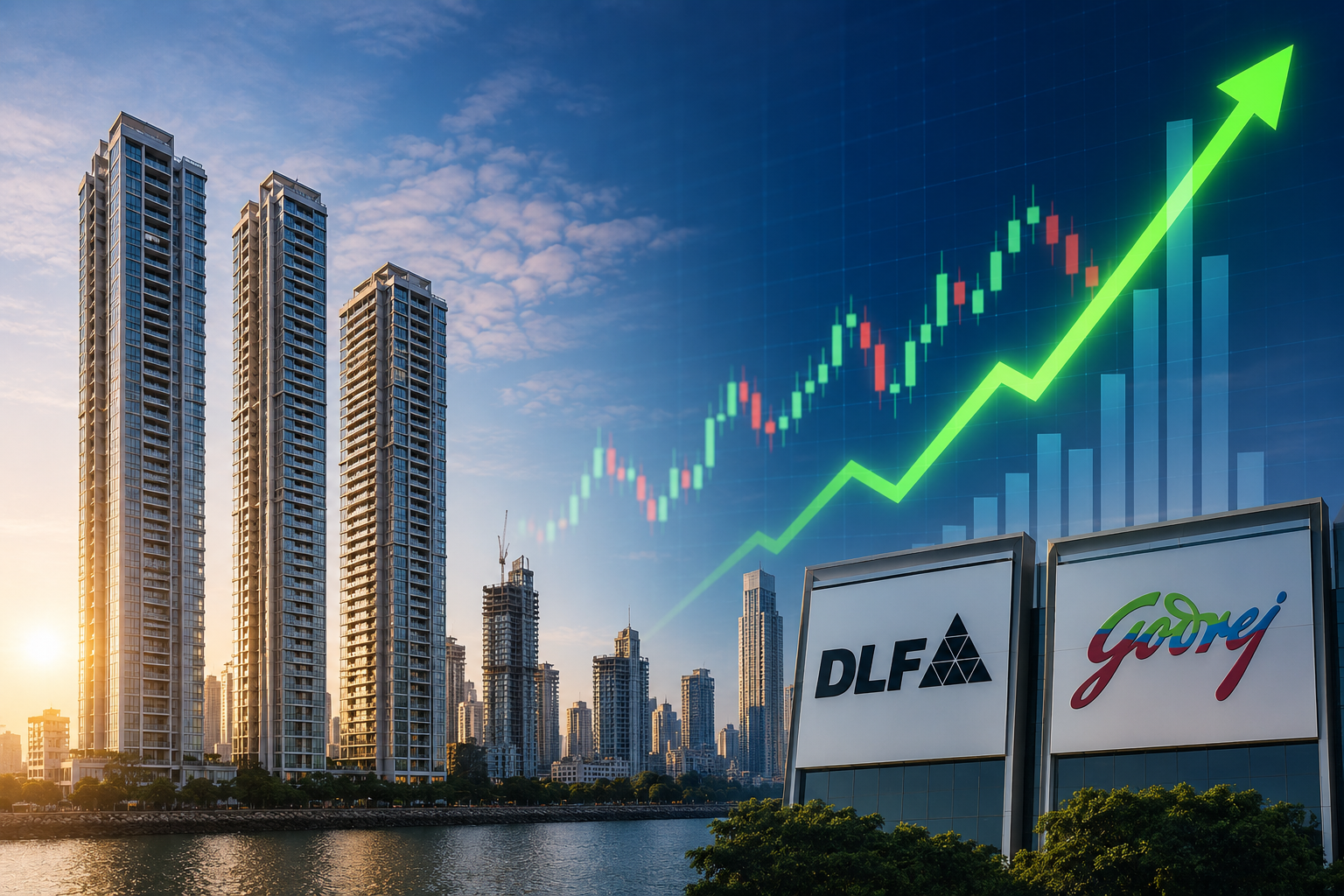
Mumbai’s residential real estate market has reached its highest valuation levels in seven years, driven by sustained demand from institutional investors, non-resident Indians, and domestic high-net-worth individuals. The premium segment recovery has directly benefited major developers including DLF Limited and Godrej Properties Limited, whose stock prices have appreciated significantly over the past six months. This resurgence reflects broader recovery in India’s commercial real estate landscape and presents important considerations for institutional investors evaluating exposure to the real estate sector through both direct property investment and equity participation in leading developer companies.
Key Highlights
- Premium residential properties in south Mumbai and western suburbs have recorded average price appreciation of 18-22 percent over the past 12 months
- Sales volume in the ₹2 crore and above segment increased by approximately 35-40 percent year-over-year
- Inventory levels for premium properties have contracted by 25-30 percent, indicating strong demand absorption
- DLF and Godrej Properties combined account for roughly 28-32 percent market share in organized premium residential development across Mumbai
- Rental yields in premium micro-markets range between 2.5-3.5 percent annually, alongside capital appreciation expectations
DLF vs Godrej Properties: Stock Performance and Market Position
DLF Limited’s stock price appreciated by approximately 24-28 percent between November 2025 and May 2026, with market capitalization expanding to near ₹85,000-90,000 crore range. The company’s Mumbai portfolio comprises premium residential projects in Mahalaxmi, Lower Parel, and emerging micro-markets in the Bandra-Kurla corridor vicinity. DLF’s Mumbai operations contributed an estimated 22-26 percent of consolidated revenue in the fiscal year ending March 2026, reflecting the city’s significance as a revenue driver alongside national property development activities.
Godrej Properties Limited recorded similar positive momentum with stock appreciation of approximately 20-24 percent during the same period, elevating market capitalization toward ₹55,000-60,000 crore territory. Godrej’s strategic positioning emphasizes sustainable development and premium affordability segment overlap, with notable projects in Mahalaxmi, Worli, and emerging east Mumbai locations. The company’s Mumbai contribution represents approximately 35-40 percent of total consolidated revenue, indicating higher geographic concentration compared to DLF’s diversified national portfolio.
Both developers launched new projects during the January-May 2026 period with pre-launch sales absorption rates exceeding 70-80 percent, significantly higher than historical averages. This acceleration reflects improved consumer sentiment and sustained liquidity conditions in the premium segment.
Mumbai Real Estate Price Trends: Historical vs Current Analysis
Historical analysis spanning the past decade reveals that Mumbai’s premium residential prices have appreciated at compound annual growth rates between 8-12 percent, with the current seven-year peak representing a recovery from 2019 lows. When compared with other major metropolitan areas including Bangalore and Hyderabad, Mumbai premium properties command consistent 15-25 percent price premiums on per-square-foot basis, reflective of superior location credentials, established infrastructure, and institutional investor preference.
| Location | Price Range (₹ per sq ft) | Segment |
|---|---|---|
| Premium South Mumbai | ₹1.8 lakh – ₹2.4 lakh | Ultra-premium |
| Western Suburbs (Bandra, Worli, Juhu) | ₹1.2 lakh – ₹1.8 lakh | Premium |
| Emerging Eastern Locations | ₹75,000 – ₹1.2 lakh | Mid to Premium |
The premium segment (₹2 crore and above) has consistently outperformed the mass-market affordable housing category by 300-400 basis points in annual appreciation rates during the 2019-2026 period.
Investment Drivers Behind Mumbai Property Surge
Infrastructure development initiatives including Metro expansion, coastal road completion, and improved connectivity across suburban nodes have enhanced property accessibility and utility value. The office space recovery following pandemic-related disruptions has strengthened demand for residential properties in proximity to commercial hubs, particularly Bandra-Kurla Complex and emerging business districts.
Non-resident Indian investment patterns show sustained interest in Mumbai residential properties as wealth diversification assets, with overseas remittances toward property purchases estimated at 12-15 billion USD annually. SEBI-registered foreign portfolio investors have increased real estate equity allocations, supporting developer stock valuations. Recent government policy enhancements including RERA compliance standardization and GST rate rationalization have improved transparency and reduced transaction friction, attracting institutional capital flows.
Rental Yields and Capital Appreciation Outlook
Current rental yield expectations for premium properties range between 2.5-3.5 percent annually, reflecting steady tenant demand from corporate relocations and expatriate housing requirements. Capital appreciation projections from institutional research estimates suggest 6-9 percent annualized returns over the next three to five year horizon, contingent on stable macroeconomic conditions and continued infrastructure development.
Combined rental yields and capital appreciation potential position premium Mumbai real estate as competitive with medium-to-long term fixed-income instruments, though with higher volatility and extended liquidity timelines. Investors should evaluate these returns against their specific portfolio objectives and risk tolerance parameters.
Investor Impact: Real Estate Stocks vs Direct Property Investment
Developer equity investments through NSE and BSE-listed entities offer superior liquidity compared to direct property ownership, with potential to liquidate positions within trading settlement timelines of two business days. DLF and Godrej Properties stocks provide diversified exposure to pan-India development portfolios rather than single-property concentration risk inherent in direct investment.
Direct property investment requires substantial capital deployment, entails ongoing maintenance costs, property management complexities, and extended holding periods for optimal returns realization. However, direct ownership provides tangible asset security, potential rental income generation, and leverage access through real estate-secured financing at favorable terms.
For investors seeking to capitalize on Mumbai real estate sector opportunities without direct property acquisition, the ability to open demat account online enables portfolio construction through developer equity positions with minimal capital barriers. Individual investors can construct diversified real estate sector exposure through fractional shareholding without requiring ₹1-2 crore minimum property investment thresholds.
Tax considerations differ substantially between direct property and equity investment routes. Rental income from property attracts standard income tax treatment, while equity dividend income and capital gains benefit from preferential tax regimes under current legislation. Investors should evaluate long-term capital gains tax advantages specific to their income brackets and holding periods.
Portfolio allocation methodologies typically suggest real estate sector equity exposure between 5-8 percent of total equity allocation for growth-oriented investors, balanced against domestic and international equity diversification requirements. Conservative investors may maintain lower allocation percentages aligned with portfolio risk profiles.
Expert Analysis: Is Mumbai Real Estate Rally Sustainable?
Market analysts assess that current price appreciation rates of 18-22 percent exceed sustainable long-term trajectories of 8-12 percent, suggesting potential normalization as supply constraints ease through new project completions over subsequent 24-36 months. Sustainability depends critically on continued institutional demand, NRI investment flows, and infrastructure completion timelines meeting current schedules.
Global economic uncertainties, potential RBI monetary policy tightening, and broader Indian equity market corrections could pressure developer stock valuations despite fundamentals in real estate demand. Interest rate escalations would compress demand by reducing home loan affordability and increasing developer financing costs, creating headwind pressures on both stock valuations and property prices.
Demand fundamentals appear resilient given Mumbai’s persistent institutional and ultra-high-net-worth investor preference, strong migration patterns toward metro, and limited land availability constraints driving supply scarcity premiums. Analysts estimate current price levels can sustain provided macro conditions remain benign.
Action Points for Investors in May 2026
Investors should establish clear entry timelines rather than pursuing aggressive accumulation at current valuations near cyclical peaks. Monitor quarterly earnings of DLF and Godrej Properties for revenue growth trends, pre-launch sales velocity, and inventory absorption rates indicating ongoing demand health.
Track key metrics including construction progress timelines, government policy announcements regarding RERA amendments, and RBI interest rate guidance through the best stock trading and investing platform in India to support timely decision-making. Risk management protocols should include position sizing discipline and portfolio rebalancing schedules preventing concentrated exposure to single developers or property segments.
Regulatory and Market Outlook
RERA implementation has fundamentally strengthened buyer protections and project transparency, creating favorable conditions for institutional capital participation. RBI’s monetary policy trajectory will substantially influence home loan affordability and investment property financing economics over subsequent quarters. Expected government announcements regarding real estate sector incentives, infrastructure investment timelines, and affordable housing mandates will shape market dynamics through 2026-2027.
Market predictions from institutional research suggest continued price appreciation but at moderating rates of 6-9 percent annually as supply-demand balances normalize. Premium segment resilience appears likely given structural demand factors, while mass-market segments may experience different performance trajectories based on policy support measures.
Trading & Investment Guides
- What is Demat Account?
- What is Trading Account?
- What is Algo Trading?
- What is Tick Trading?
- What is Grey Market in IPO?
Leave a Reply