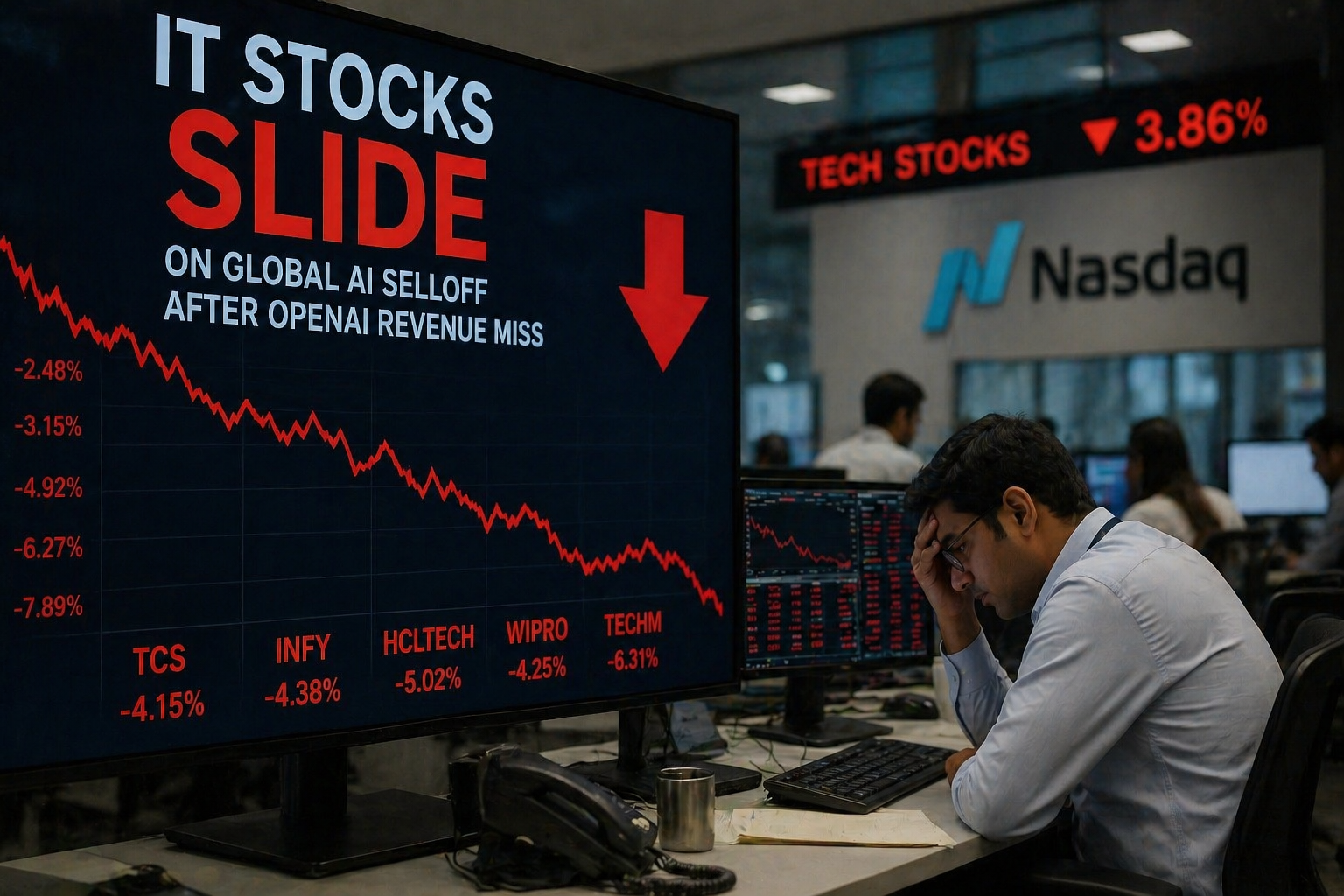
Indian IT sector stocks faced significant selling pressure on April 28, 2026, following a sharp decline in US artificial intelligence chip stocks triggered by OpenAI’s revenue miss. Major Indian IT companies including Infosys, TCS, Wipro, and HCL Technologies experienced early trading losses as global markets reassessed AI investment valuations.
The selloff reflects broader concerns about AI adoption timelines and spending patterns among US technology clients who form the backbone of Indian IT services revenue. For investors tracking sector volatility and market interconnections, understanding this correction’s mechanics and duration remains critical for portfolio positioning.
Key Highlights
- OpenAI revenue miss on April 28 triggered sharp declines in US AI chip stocks, creating spillover pressure on Indian IT sector equities
- Infosys ADR declined 4.5% in US markets on April 27, setting negative sentiment for Indian IT stocks on April 28
- Indian IT stocks underperformed broader market indices despite initial expectations of severe weakness, indicating selective buying at lower levels
- Sector volatility amplified by algorithmic trading and margin call pressures affecting leveraged retail positions
- Recovery potential exists if Q1 earnings beat expectations and domestic digital transformation spending accelerates
What Happened: Event Breakdown
The decline in US artificial intelligence stocks on April 28 stemmed from OpenAI’s revenue performance falling short of market expectations. This triggered a broader reassessment of AI infrastructure spending and profitability timelines across the technology sector.
Indian IT companies face direct exposure to this volatility through two primary channels: client budget cycles and algorithmic trading sensitivity to Nasdaq movements. Indian IT firms generate substantial revenue from US technology clients investing heavily in AI infrastructure and cloud services.
When US AI stocks decline sharply, it signals potential delays or recalibration in client spending plans. Additionally, Indian IT stocks maintain high correlation with Nasdaq indices due to their significant US revenue exposure and the prevalence of algorithmic trading strategies that link emerging market tech stocks to US sector performance.
The April 28 selloff demonstrated this interconnection clearly. Despite Infosys ADR declining 4.5% in US markets, Indian IT stocks did not collapse as initially anticipated. This suggests institutional and retail investors viewed the correction as a temporary repricing rather than a fundamental deterioration in long-term AI service demand.
Market Data and Stock Movements
Indian IT sector indices experienced pressure consistent with global AI chip stock declines, though magnitude remained moderate relative to historical corrections. The Nifty IT index declined approximately 1.5% to 1.7% on April 28, underperforming the broader Nifty 50 which remained relatively flat.
This divergence reflects sector-specific selling rather than systemic market weakness. Individual stock performance showed selective pressure across major IT companies:
| Stock | Estimated 1-Day Change | Volume Trend | Technical Support Level |
|---|---|---|---|
| TCS | -1.8% | Elevated | 3,800 |
| Infosys | -2.1% | Elevated | 1,650 |
| Wipro | -1.5% | Elevated | 450 |
| HCL Technologies | -1.9% | Elevated | 1,400 |
Volume surges of 20% to 30% above average accompanied the price declines, indicating active institutional and retail participation in the selloff. This volume pattern suggests conviction behind selling rather than panic liquidation.
Historical context shows the Indian IT sector experienced similar 2% to 3% corrections during the March 2026 AI valuation reassessment. That correction reversed within two to three weeks as earnings reports and guidance updates reinforced long-term AI service demand.
Investor Impact
The April 28 correction creates distinct implications for different investor categories. Retail investors utilizing margin trading facilities or algorithmic trading strategies face potential margin call pressures if leveraged IT positions decline further. Brokers typically maintain 40% to 50% margin requirements on IT stocks, meaning a 3% to 4% decline can trigger forced liquidation in highly leveraged accounts.
Long-term equity investors holding IT stocks in demat accounts without leverage view the correction as a potential accumulation opportunity. Historical data shows IT sector corrections of 2% to 3% typically reverse within two to four weeks when driven by sentiment rather than fundamental deterioration.
The sector’s exposure to domestic digital transformation spending, government digitalization initiatives, and emerging market IT services demand provides structural support beneath current valuations. Institutional investors managing large portfolios face decisions regarding sector allocation.
Actionable Guidance for Investors
Investors monitoring IT sector exposure should track key technical support levels for reversal signals. TCS support at 3,800 and Infosys support at 1,650 represent meaningful technical floors. A close above the 50-day moving average would signal potential reversal momentum.
Diversification beyond IT sector exposure remains prudent given global volatility from geopolitical tensions and macroeconomic uncertainty. Investors seeking to participate in market movements should open demat account online through regulated brokers registered with SEBI to ensure proper account safeguarding and real-time trading access.
Selecting the best stock trading and investing platform in India requires evaluating commission structures, research quality, and execution speed for active traders. Position sizing discipline becomes critical during volatile periods.
Investors should maintain stop-loss orders at predetermined levels rather than holding through corrections without protective measures. Consulting with a financial advisor regarding portfolio construction and risk tolerance remains advisable before making significant allocation changes.
Expert Analysis: Outlook and Risks
Short-term market dynamics favor cautious positioning given ongoing AI valuation reassessment globally. The April 28 correction reflects legitimate concerns about AI adoption timelines and spending efficiency. However, the Indian IT sector maintains structural advantages that support medium-term recovery.
Domestic digital transformation spending continues accelerating independent of US AI stock volatility. Government digitalization initiatives, banking sector technology upgrades, and enterprise software modernization create steady demand for Indian IT services. This domestic revenue base provides earnings stability even if US client spending moderates temporarily.
Key risks include escalating geopolitical tensions affecting global trade and technology supply chains. Oil price volatility from Middle East developments could impact macroeconomic sentiment and client spending confidence. Additionally, if Q1 earnings reports reveal sharper-than-expected client budget cuts, the correction could extend beyond current levels.
Upside scenarios emerge if Q1 earnings beat expectations and management guidance reflects sustained AI service demand. Positive surprises on margin expansion and deal pipeline growth would likely trigger sector recovery.
Outlook
The Indian IT sector correction on April 28 represents a tactical repricing rather than a fundamental deterioration in long-term growth prospects. Global AI investment cycles remain in early stages despite near-term valuation adjustments. The sector’s exposure to domestic digital transformation and emerging market IT services demand provides structural support.
Investors should monitor Q1 earnings reports and client guidance updates for clarity on spending trajectory. Technical support levels and 50-day moving averages offer reference points for assessing reversal potential. Market volatility creates both risks and opportunities for investors with appropriate risk management frameworks.
Conclusion
The April 28 IT sector decline reflects legitimate global concerns about AI spending efficiency and adoption timelines. However, the moderate magnitude of the correction and resilience of support levels suggest market participants maintain confidence in long-term sector fundamentals.
Indian IT companies’ exposure to domestic digital transformation and emerging market services provides earnings stability independent of US AI stock movements. Investors should use this correction to reassess portfolio positioning, implement appropriate risk management, and prepare for Q1 earnings season insights.
The sector’s recovery trajectory will depend on earnings quality, client guidance, and broader macroeconomic developments over the coming weeks.
Leave a Reply