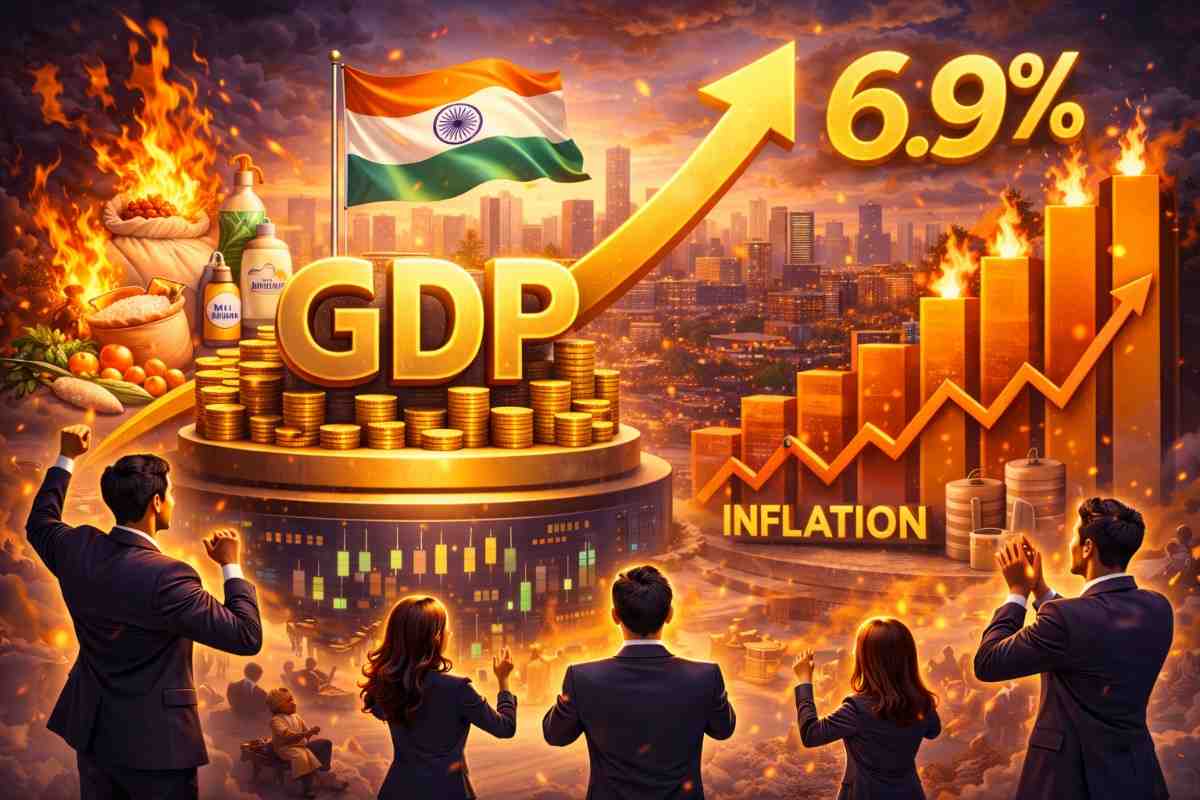
The Asian Development Bank has upgraded its projection for India’s FY26 GDP growth to 6.9 percent, underscoring the resilience of domestic demand despite escalating global headwinds. This optimistic outlook, released amid a volatile geopolitical landscape, contrasts with the Reserve Bank of India’s more bullish 7.6 percent estimate for the same period. Lower U.S. tariffs on Indian goods and easing financing conditions are key drivers, even as inflation risks loom large with forecasts pointing to a sharp rise to 4.5 percent this year. For institutional investors tracking the NIFTY 50 and SENSEX, these developments signal a mixed but fundamentally sturdy economic trajectory, warranting close monitoring of RBI’s monetary policy responses and INR stability.
Key Highlights
- ADB raises FY26 GDP growth forecast to 6.9%, up from prior estimates, driven by robust domestic demand and lower U.S. tariffs.
- FY27 growth projected at 7.3%, bolstered by domestic reforms and prospective trade pacts with the European Union.
- Inflation expected to surge to 4.5% this fiscal year from 2.1% in FY26, fueled by rising food prices and global oil volatility.
- RBI’s FY26 GDP estimate stands at 7.6%, highlighting stronger domestic momentum amid trade uncertainties.
- Middle East conflict poses downside risks to energy prices, trade flows, and remittances, potentially impacting macroeconomic stability.
India GDP Growth Projections
The Asian Development Bank’s revised forecast of 6.9 percent GDP growth for FY26 reflects India’s ability to decouple from global slowdowns, primarily anchored in vigorous domestic consumption and investment. This upgrade comes against a backdrop of persistent geopolitical tensions, including the protracted Middle East conflict, which could otherwise dampen momentum through higher energy costs. Strong domestic demand, supported by moderating interest rates and improved liquidity, positions India as a standout performer in emerging markets. The RBI’s parallel projection of 7.6 percent for FY26 further reinforces this narrative, suggesting that fiscal impulses like government salary hikes could amplify growth trajectories.
Looking ahead to FY27, ADB anticipates acceleration to 7.3 percent, predicated on structural reforms and emerging trade agreements, notably with the European Union. These pacts could unlock new export avenues for sectors like pharmaceuticals and IT services, critical to NIFTY 50 heavyweights such as Infosys and TCS. However, investors must weigh the divergence between ADB’s conservative stance and RBI’s optimism, with the latter emphasizing resilient private consumption despite external shocks. For BSE and NSE traders, this implies selective positioning in consumption-led indices, where domestic demand buffers global volatility. Investors looking to participate in this market movement can open demat account through SEBI-registered brokers.
Inflation Pressures and RBI Policy Stance
Inflation emerges as the primary near-term concern, with ADB forecasting a more than doubling to 4.5 percent this fiscal year from 2.1 percent in FY26. This spike is attributed to escalating food prices, exacerbated by supply chain disruptions, and upward pressure from global oil benchmarks amid Middle East instability. While CPI and WPI data from the past 24 hours remain subdued, underlying trends signal vigilance, particularly as pass-through effects from imported energy hit household budgets. The RBI, in its recent commentary, has signaled a cautious approach to monetary policy, prioritizing growth over aggressive rate hikes despite inflation creeping toward the upper tolerance band.
RBI Governor Shaktikanta Das recently noted that easing financing conditions would sustain capex cycles in infrastructure and manufacturing, key to NIFTY 50 outperformers like Larsen & Toubro and Reliance Industries. Market data shows the 10-year G-Sec yield holding steady at around 6.85 percent, reflecting anchored inflation expectations. However, a prolonged oil price rally above $85 per barrel could force a 25 basis point repo rate adjustment at the next policy review, impacting rupee stability. The INR has traded in a narrow 83.40-83.70 band against the USD in early sessions, buoyed by forex reserves exceeding $650 billion, providing RBI ample intervention room. This development presents new considerations for stock investment strategies focused on Indian equities.
Macro Risks and Market Metrics
| Indicator | Current/Projection | Details |
|---|---|---|
| GDP Growth FY26 | ADB: 6.9% vs RBI: 7.6% | FY27 at 7.3% |
| Inflation Trajectory | 4.5% this year | Up from 2.1% FY26 baseline |
| INR Performance | 83.55/USD | NSE forex turnover up 12% |
| NIFTY 50 | 22,450 points | Down 0.8% on profit-booking |
| SENSEX | 74,200 points | Caution in rate-sensitive sectors |
| Banking NIFTY | 48,500 points | Resilient performance |
These metrics underscore downside risks from external shocks, with remittances—a $120 billion annual inflow—potentially contracting 5-7% if Middle East tensions escalate. Conversely, lower U.S. tariffs enhance competitiveness for exporters like Dr. Reddy’s Laboratories and Sun Pharma, potentially lifting midcap indices by 3-5% in the coming quarter. Retail participation has grown significantly as access to a reliable trading platform has become more widespread.
Market Outlook
For Indian investors, the outlook balances robust growth prospects with inflation and geopolitical tailwinds. Institutional portfolios should tilt toward domestic cyclicals like FMCG giants Hindustan Unilever and ITC, which benefit from strong consumption, while hedging currency exposure via USD-INR forwards given rupee depreciation risks. RBI’s policy pivot toward neutrality by mid-FY26 could catalyze a 5-7% NIFTY 50 rally, but watch for oil at $90/barrel triggering rate hikes. Key players like Adani Ports and JSW Steel offer value in infra plays, with analysts projecting 15-20% earnings upside on capex revival. Investors must monitor April CPI print and U.S. tariff finalizations for directional cues.
Conclusion
India’s economy demonstrates remarkable fortitude, with ADB’s 6.9 percent FY26 GDP upgrade affirming domestic demand as the bedrock amid global turbulence. Yet, inflation’s ascent to 4.5 percent and Middle East risks demand proactive RBI stewardship to safeguard growth. For financial professionals navigating BSE and NSE, this confluence points to opportunities in resilient sectors, tempered by vigilant risk management. As reforms and trade winds align, India’s trajectory remains upward, positioning it as the preeminent emerging market story for discerning investors.
| Trending Market Data | |
|---|---|
| Penny Stocks | Penny Stocks Under ₹1 |
| Penny Stocks Under ₹5 | Penny Stocks Under ₹10 |
| Advances & Declines | Top Gainers Today |
| Highs & Lows Today | Top Losers Today |
| ADR Prices | Heat Map |
Leave a Reply