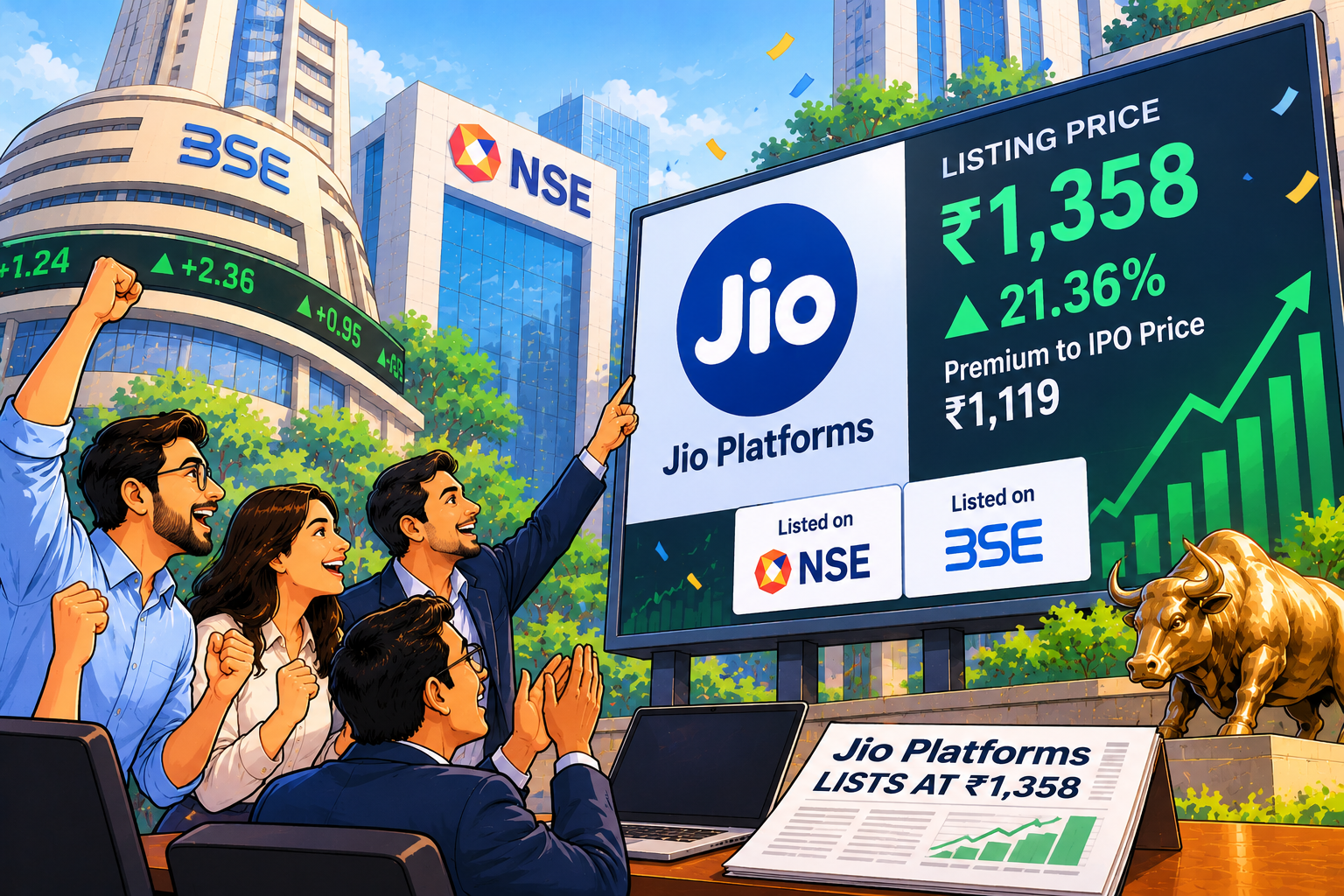
Shares of Jio Platforms made their stock market debut on Wednesday, October 28, 2026, listing at ₹1,358 apiece on both the NSE and the BSE. That is a premium of 21.36% over the IPO issue price of ₹1,119 for investors who received allotment in the ₹30,213 crore offer.
The listing comes five days after the issue closed with 22.19 times overall subscription, led by institutional investors.
Jio Platforms Listing Price and Premium
The table below shows what the listing meant for the upper end of the price band.
| Detail | Figure |
|---|---|
| IPO price band | ₹1,065 to ₹1,119 per share |
| Issue price (upper band) | ₹1,119 |
| Listing price on NSE and BSE | ₹1,358 |
| Listing premium | 21.36% |
| Gain per share at listing price | ₹239 |
| Cost of one lot of 12 shares | ₹13,428 |
| Value of one lot at listing price | ₹16,296 |
| Gain per lot | ₹2,868 |
Investors who received one lot of 12 shares made ₹2,868 per lot, taking the value of the investment to ₹16,296 at the listing price. These are gains on paper at the opening price and change as the stock trades through the day.
How the Listing Compared With Grey Market Expectations
Unofficial indicators ahead of listing had pointed to a similar premium. A TradingView News report published before the debut cited a grey market premium implying a listing price of about ₹1,369, or 22.34% above the issue price. The actual listing at ₹1,358 was slightly lower than that estimate.
The grey market is an unofficial, unregulated market, and its premium is not an official forecast. Listing prices can differ from it, as they did here.
Demand That Led to the Listing
The issue closed on October 23 with strong institutional demand. Exchange data showed subscription of 22.19 times overall.
- Qualified institutional buyers (QIBs): 70.55 times.
- Non-institutional investors (NIIs): 14.00 times.
- Retail investors: 2.72 times.
- Employees: 2.93 times.
- Shareholders: 7.60 times.
Ahead of the public issue, Jio Platforms raised ₹8,109.85 crore from anchor investors. Upstox lists Life Insurance Corporation of India (LIC), New World Fund Inc, the Government of Singapore, BNP Paribas Financial Markets, Capital Group, Fidelity, BlackRock, the Monetary Authority of Singapore and the Abu Dhabi Investment Authority among them.
Key Terms of the Jio Platforms IPO
The offer was entirely a fresh issue of up to 27 crore shares, so the proceeds go to the company. The company has said it plans to use the money to prepay certain borrowings of Reliance Jio Infocomm and for general corporate purposes.
At ₹30,213 crore, the IPO was larger than Hyundai Motor India’s ₹27,858.75 crore offering in 2024, which had been the biggest in the country until now. At the upper end of the price band, the post-issue valuation was about ₹10.3 lakh crore.
What Listing Means for Investors Who Received Shares
Shares allotted in the IPO were scheduled to be credited to investors’ demat accounts on October 27, so allottees could trade from the first minute of listing. Investors who hold the shares can sell them through their broker, hold them, or place a limit order at a price of their choice.
Allottees should keep a few points in mind:
- The listing price is only the first traded price. The stock can move above or below it during the session.
- Gains or losses are realised only when shares are sold, and tax rules apply to profits on listed shares.
- Newly listed stocks often show higher volatility in the first few sessions because price discovery is still under way.
Investors who held shares in a demat and trading account could place sell orders from the opening of trade. Those who did not apply or did not receive an allotment can still buy the stock on the exchanges through a stock trading app or a broker’s terminal, at the market price, with no application window or lottery involved.
Market Backdrop on Listing Day
The debut comes during a week in which benchmark indices have been volatile. On Tuesday, October 27, the Sensex ended 8.08 points lower at 73,598.67 and the Nifty 50 closed at 22,749.75, down 3.45 points. Crude oil prices and the US Federal Reserve’s policy decision, due on October 28, have kept investors cautious.
Reports from exchange data and brokerages will show how the stock trades over the day, and the closing price will matter more for investors than the opening price.
Points to Watch After the Listing
Several items will matter for the stock in the coming sessions:
- How the price holds relative to the ₹1,358 listing level through the day.
- Trading volumes and the reaction of institutional investors who received allotments at ₹1,119.
- Disclosures from the company and the exchanges after listing.
- Broader market direction, including the Fed decision and crude oil prices.
This report covers the listing as reported on October 28. Investors should check exchange websites for live prices and official announcements.
Related Stock Market Insights
- How to Apply for IPO in India?
- Types of IPO with Example
- How Does IPOs Work?
- What is Grey Market in IPO and How It Works?
- How to Meet the IPO Eligibility Criteria?
Leave a Reply