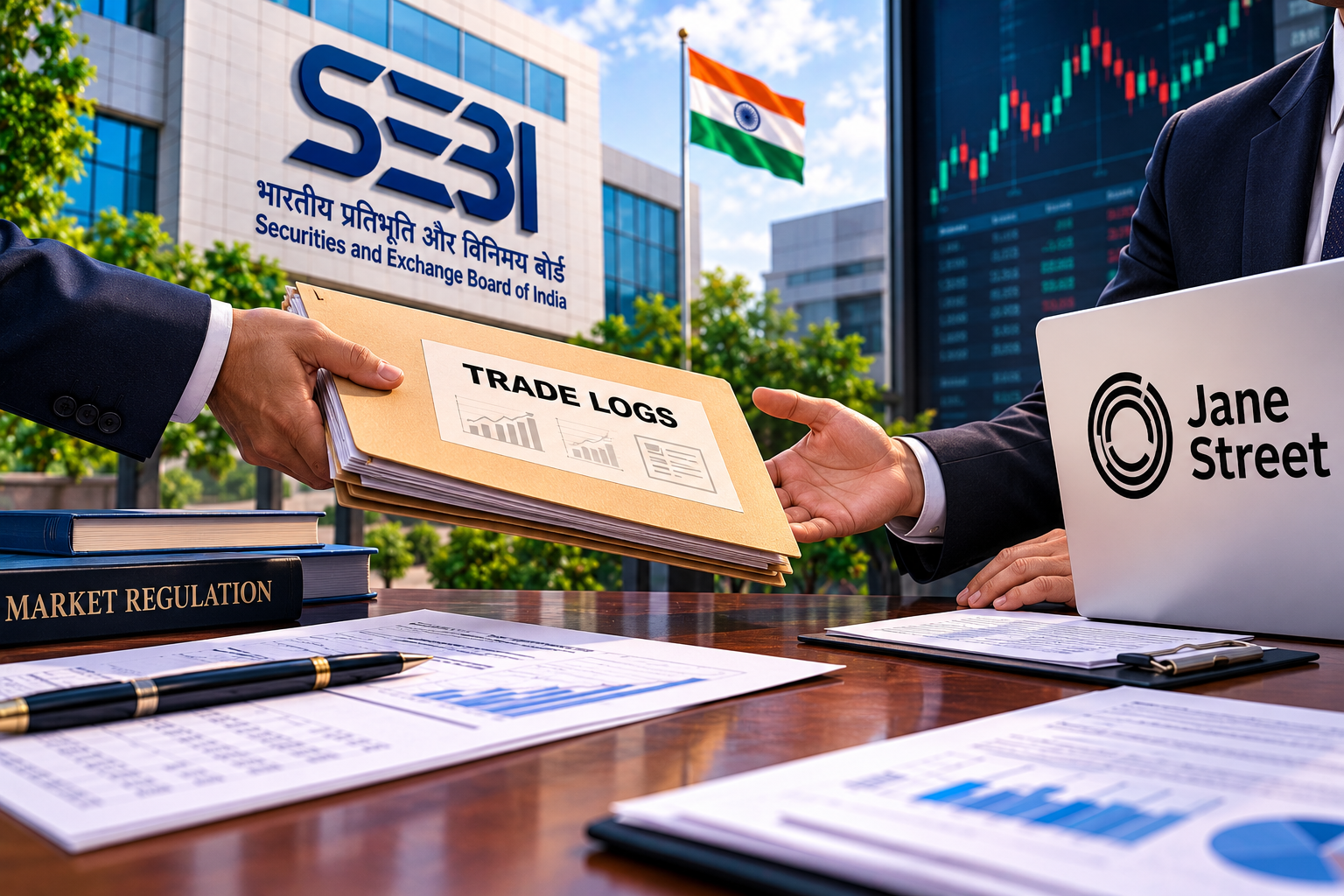
The Securities and Exchange Board of India (SEBI) has told a court that it has shared with Jane Street Group LLC the trade logs it relied on for its preliminary order, and has asked the Wall Street trading firm to respond to allegations of market manipulation. Bloomberg reported the development on Wednesday, 7 October 2026.
The case centres on the NSE Nifty Bank index. SEBI alleges that Jane Street influenced the pricing of stocks in the index, while the firm says its trading was conventional index arbitrage.
What SEBI told the court on 7 October
SEBI’s lawyer Gaurav Joshi said the regulator has provided details of the actual trades, including their timing, quantity and prices. SEBI has withheld the names and tax identification details of counterparties.
The regulator will not share additional details, its counsel said, because it did not base its probe on those records. SEBI has asked Jane Street to respond to the allegations now that the trade logs are with the firm.
Why Jane Street wanted more documents
The disclosure followed a dispute over redactions. Jane Street’s lawyer had argued until Monday, 5 October, that most of the information in the trade logs shared by SEBI was redacted.
Jane Street has also been seeking additional documents, including SEBI’s communication with the National Stock Exchange (NSE) that led to the investigation. SEBI’s position is that it will give the records it relied on and no more.
The allegation around the Nifty Bank index
SEBI’s interim order of 3 July accused Jane Street and its group entities of manipulating the Nifty Bank index through a two-part trading strategy. The regulator alleged unlawful gains of around ₹4,843 crore.
The trades are central to the allegation that Jane Street influenced the pricing of stocks in the index. The Nifty Bank index is a closely watched benchmark that serves as the foundation for heavily traded options contracts.
Jane Street has denied the allegations. It maintains that its trading activity represented conventional index arbitrage and not market manipulation.
| Date | Development |
|---|---|
| 3 July | SEBI issues an interim order alleging manipulation of the Nifty Bank index and unlawful gains of about ₹4,843 crore |
| 18 July | Trading restriction on the entities is lifted after Jane Street deposits the alleged gains in an escrow account |
| 5 October | Jane Street’s lawyer argues that most of the information in the trade logs is redacted |
| 7 October | SEBI tells the court it has shared the trade logs and asked Jane Street to respond |
The allegations are at a preliminary stage, and Jane Street denies them. Because the Nifty Bank index is an NSE benchmark, the firm’s request for SEBI’s communication with the exchange goes to how the investigation began, and SEBI has so far declined to go beyond the trade logs it relied on.
What each side says
The two positions are far apart, which is why the dispute over documents matters to the final outcome.
| Issue | SEBI | Jane Street |
|---|---|---|
| Trade data | Shared logs it relied on, with timing, quantity and prices | Argued that most of the information was redacted |
| Counterparty details | Names and tax identification withheld | Wants more documents, including SEBI’s communication with NSE |
| Core allegation | Manipulation of Nifty Bank through a two-part strategy | Denies it, calling its trading conventional index arbitrage |
| Next step | Asked the firm to respond to the allegations | Response to the allegations now awaited |
Terms in the case explained
A few terms help in following the dispute:
- Interim order: A preliminary order passed by the regulator before a final decision, which can include temporary restrictions on trading.
- Trade logs: Records of individual trades, including their timing, quantity and prices.
- Escrow account: An account where money is held by a third party until a dispute is resolved.
- Index arbitrage: A strategy that profits from price differences between an index and its constituent stocks or related contracts, which is how Jane Street describes its trading.
What the dispute means for derivatives markets
According to the Bloomberg report, the outcome of the dispute could shape how global trading firms perceive the regulation of high-frequency traders in one of the world’s largest derivatives markets. The Nifty Bank index is the foundation for heavily traded options contracts.
SEBI published a study on retail participation, trading behaviour and profitability in equity derivatives on 20 August 2026.
For individual investors, the practical points are straightforward:
- Anyone who wants to trade in F&O needs a demat and trading account, and access to an online trading platform to place orders in index options and futures.
- Index derivatives are priced off benchmarks such as Nifty Bank, which is why questions about how those benchmarks are influenced draw regulatory attention.
- The next step in the case is Jane Street’s response to SEBI’s allegations, following the data share on 7 October.
Related Stock Market Insights
- What is a Demat Account?
- Top Semiconductor Stocks in India
- Top AI Stocks in India
- What is Algo Trading?
- Algo Trading Platform in India
| Explore Trending Indices | |
|---|---|
| Bank Nifty | Nifty Commodities |
| BSE 100 | BSE BANKEX |
| BSE SENSEX | BSE MIDCAP |
| Nifty IT | Nifty 100 |
| FINNIFTY | Nifty Pharma |
Leave a Reply