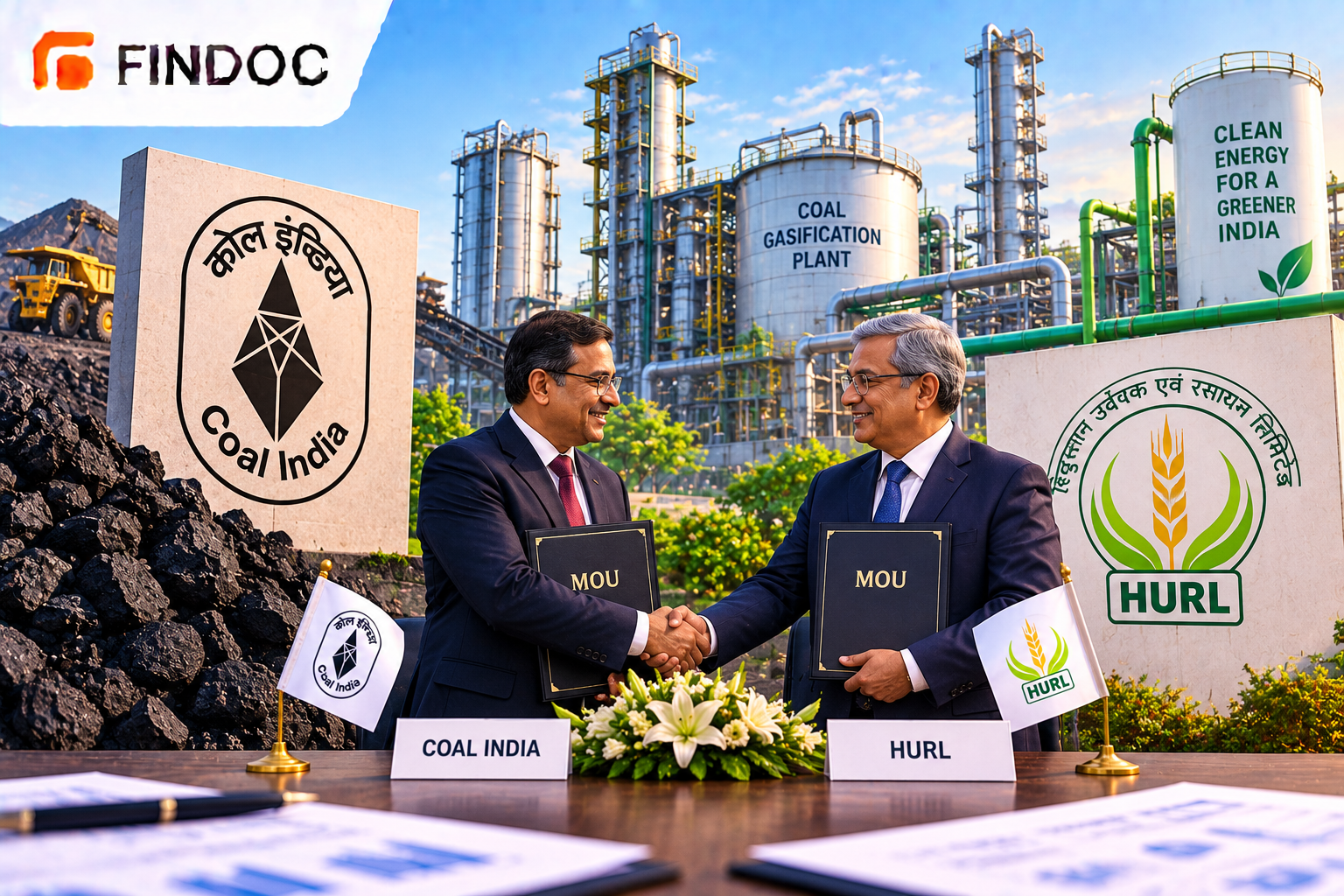
Coal India Ltd and Hindustan Urvarak & Rasayan Limited (HURL) have executed a non-binding memorandum of understanding to explore the development of a coal gasification-based urea production facility at Sindri, Jharkhand, the public sector coal miner disclosed in a regulatory filing on Monday, 28 September 2026. Coal India shares are among those in focus following the announcement.
The MoU marks an early-stage exploratory step toward converting coal into a feedstock for fertiliser production, a technology pathway India has been pursuing as part of its broader coal-to-chemicals and energy security strategy.
What the MoU Covers
As a non-binding memorandum of understanding, the agreement commits Coal India and HURL to jointly explore the feasibility of a coal gasification-based urea production project at Sindri, rather than establishing firm commitments on investment, capacity or timelines at this stage. Non-binding MoUs of this kind are typically followed by detailed feasibility studies before either party commits to a definitive, binding agreement.
| Parameter | Details |
|---|---|
| Parties | Coal India Limited and Hindustan Urvarak & Rasayan Limited (HURL) |
| Agreement Type | Non-binding Memorandum of Understanding |
| Proposed Technology | Coal gasification-based urea production |
| Location | Sindri, Jharkhand |
| Disclosure Date | 28 September 2026 |
| Stage | Exploratory, feasibility to follow |
What Coal Gasification Involves
Coal gasification is a process that converts coal into synthesis gas, a mixture primarily of carbon monoxide and hydrogen, which can then be used as a feedstock for producing various chemicals, including ammonia and, subsequently, urea, a widely used nitrogen fertiliser. This differs from directly burning coal for power generation, since gasification is aimed at producing a chemical feedstock rather than heat energy.
For India, which imports a significant share of its natural gas, the primary current feedstock for urea production, developing coal-based alternatives is seen as a way to reduce dependence on imported gas for fertiliser manufacturing, using the country’s relatively larger domestic coal reserves instead. Domestic coal reserves are substantially larger than India’s proven natural gas reserves, which is part of the strategic rationale behind exploring coal gasification as a fertiliser feedstock pathway over the long term.
- The MoU is non-binding and represents an early, exploratory stage of the potential project.
- Coal gasification converts coal into a chemical feedstock for urea production, distinct from coal-fired power generation.
- Sindri, Jharkhand, has a legacy as a fertiliser production hub in eastern India.
- The project fits India’s broader push to reduce natural gas import dependence for fertiliser manufacturing.
Why Sindri and HURL Are Relevant to This Plan
Sindri has a long-standing association with India’s fertiliser industry, having hosted fertiliser production facilities for decades. HURL itself is a joint venture entity formed to revive and modernise dormant fertiliser plants at several locations, including Sindri, as part of India’s push to restore domestic urea production capacity and reduce reliance on imports.
Coal India, as the world’s largest coal mining company, brings direct access to coal feedstock and mining expertise to a potential coal gasification project, while HURL brings established fertiliser manufacturing operations and site infrastructure at Sindri, making the pairing a logical fit for exploring this specific technology pathway at this specific location. HURL was formed through a joint venture involving Coal India, NTPC, IRCON International and Fertilizer Corporation of India, with a mandate to revive dormant urea production units, giving Coal India an existing institutional relationship with HURL predating this specific MoU.
What This Means for Coal India’s Diversification Strategy
Coal India has been exploring diversification beyond its core coal mining business into downstream applications, including coal gasification and coal-to-chemicals projects, as part of a broader strategy to add value to its coal output rather than solely selling raw coal. This MoU is consistent with that stated diversification direction, though it remains at a very early, non-binding stage, with the feasibility study phase likely to determine whether the project ultimately proceeds to a binding agreement.
- The MoU does not commit either party to specific investment amounts or capacity targets.
- Coal gasification projects typically require years of feasibility study, approvals and construction before commissioning.
- The partnership fits Coal India’s stated diversification strategy into downstream coal applications.
- HURL’s existing Sindri infrastructure could provide a head start relative to a greenfield site.
What Investors Should Watch Next
- Progress from this non-binding MoU toward a definitive, binding agreement
- Feasibility study outcomes and any disclosed capital expenditure estimates
- Regulatory and environmental approval processes for a coal gasification facility
- Broader updates on Coal India’s coal-to-chemicals diversification pipeline
Shareholders tracking Coal India through their holdings can watch for updates as this exploratory MoU progresses toward a feasibility study and, potentially, a binding agreement. Investors who open demat account online to track PSU and coal-sector stocks may also want to follow this project alongside Coal India’s other diversification initiatives when assessing the company’s longer-term growth strategy on a trading platform.
Related Stock Market Insights
- What is a Demat Account?
- How to Open a Demat Account?
- What is Trading Account?
- What is Algo Trading?
- Algo Trading Platform in India
Leave a Reply