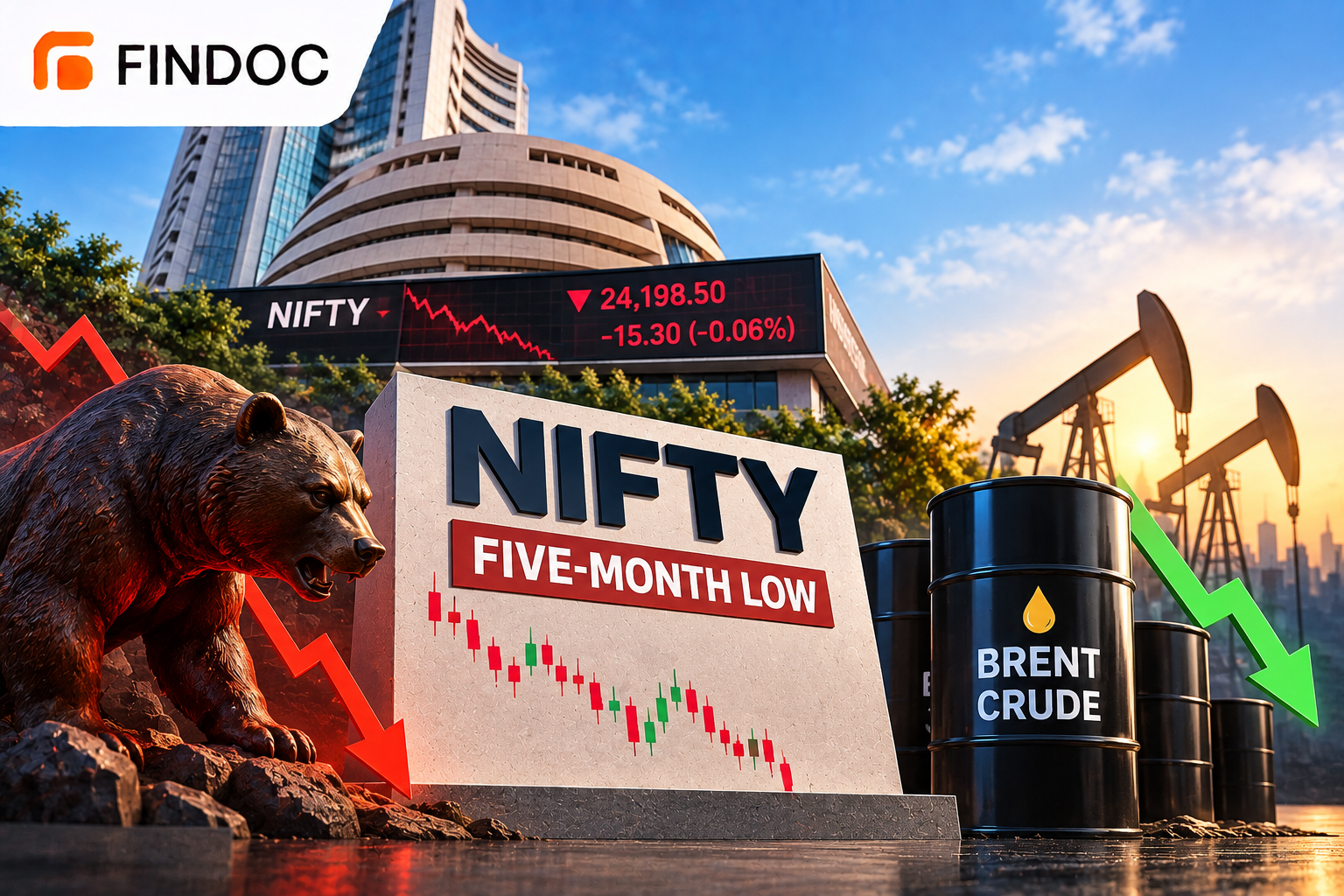
The Nifty 50 opened slightly lower at 23,035 on Friday, 25 September 2026, a day after the index closed at its lowest level in over five months. Thursday’s 1.64% fall, the Nifty’s biggest single-day drop since 8 July, came as Brent crude hovered near $105 a barrel and US bond yields climbed.
The BSE Sensex also started Friday’s session marginally in the red. A dip of more than 1% in crude oil prices, on hopes of a truce between the US and Iran, kept losses limited in early trade.
How Sensex and Nifty Closed on Thursday
Thursday’s session saw a broad sell-off led by banks and non-banking finance companies (NBFCs). Only three of the 50 Nifty stocks ended higher.
| Parameter | Details |
|---|---|
| Nifty 50 | Closed at 23,063.10, down 383.7 points (1.64%) |
| BSE Sensex | Closed at 73,580.54, down 1,247.7 points (1.67%) |
| India VIX | Closed at 12.7, up 22.8% |
| Market Cap of BSE-Listed Firms | Down ₹2.7 trillion (0.5%) |
The Nifty’s close was its lowest since early April. India VIX, the NSE volatility index that tracks expected market swings, jumped sharply, signalling greater caution among traders.
HDFC Life Insurance, Bajaj Finance, Axis Bank and Bajaj Finserv were the top Nifty losers, falling between 4.5% and 6.2%. The total market value of BSE-listed companies fell by ₹2.7 trillion despite the listing of NSE shares on the same day.
Three Triggers Behind the Nifty’s Fall
Several pressures came together on Thursday, each hitting a different part of the market.
- Crude oil near $105: Brent November futures were up 1.8% at $104.9 a barrel on Thursday evening. India imports most of its crude, so higher oil prices raise the import bill and can feed into inflation and corporate costs.
- Rising US bond yields: The US 10-year Treasury yield rose to 5.12% on Thursday. Higher yields in the US tend to make riskier assets, including emerging market equities, less attractive to global investors.
- IRDAI’s draft commission caps: The insurance regulator’s proposal to cap commissions and lower insurers’ expense limits hit insurers, banks and NBFCs that earn fees from selling insurance.
The combination explains why financial stocks, which carry a large weight in both the Nifty and the Sensex, dragged the indices lower. PB Fintech fell 36% on the IRDAI proposal, while several lenders lost between 3% and 8% during the day.
How Friday’s Session Started
On Friday, the Sensex opened 54.62 points, or 0.07%, lower at 73,525.92. The Nifty opened 28.10 points lower at 23,035. In the pre-open session, the Sensex had briefly traded 66 points higher at 73,646.
Broader markets were mixed in early trade. The BSE Smallcap Select index rose 0.29% to 9,190.36, while the BSE Midcap Select index slipped marginally.
Market breadth on the NSE was close to even in early deals, with 1,370 stocks advancing against 1,327 declining. The Indian rupee opened 6 paise stronger at 95.90 against the US dollar, compared with Thursday’s close of 95.96.
Global Cues for Indian Markets on Friday
Brent crude fell more than 1% in Asian trading hours to around $105.7 a barrel. The decline followed reports that the US and Iran are exploring a phased path out of the war, which raised hopes of a truce.
US markets offered little support. The Dow Jones Industrial Average fell 0.31% and the S&P 500 slipped 0.02% overnight, while the Nasdaq Composite ended 0.01% higher. The US 10-year Treasury yield extended gains to 5.22%.
Asian markets were mixed as investors assessed the meeting between US President Donald Trump and Chinese President Xi Jinping. Japan’s Nikkei 225 rose 1.30%, while Hong Kong’s Hang Seng fell 1.64%. Markets in mainland China and South Korea were closed on Friday.
| Parameter | Details |
|---|---|
| Brent Crude | About $105.7 a barrel, down about 1.2% |
| US 10-Year Treasury Yield | 5.22% |
| Nikkei 225 | Up 1.30% |
| Hang Seng | Down 1.64% |
| Rupee vs US Dollar | Opened at 95.90 |
What the Selloff Means for Investors
A five-month low in the Nifty reflects pressure from outside India, mainly oil and global bond yields, as well as a sector-specific shock from the insurance regulator. These are different kinds of risks, and each can change direction quickly.
For long-term investors, a volatile phase is a reason to review the asset allocation and quality of holdings rather than react to one session. Those planning to open a demat account and begin investing can use this period to understand how index moves, volatility and sector news affect a portfolio.
Intraday traders using a share market app should factor in the higher India VIX, since elevated volatility usually means wider price swings and higher margin needs on derivatives positions.
Key Things to Track Next
Indian markets will take their direction from a few clear variables over the coming sessions:
- Brent crude movement and any concrete progress on a US and Iran truce
- US Treasury yields, now above 5%
- Foreign investor flows into Indian equities
- Further clarity on IRDAI’s draft rules, open for comments until 25 October 2026
Friday’s flat opening, after Thursday’s sharp fall, leaves these factors as the main triggers to watch through the rest of the session.
Leave a Reply