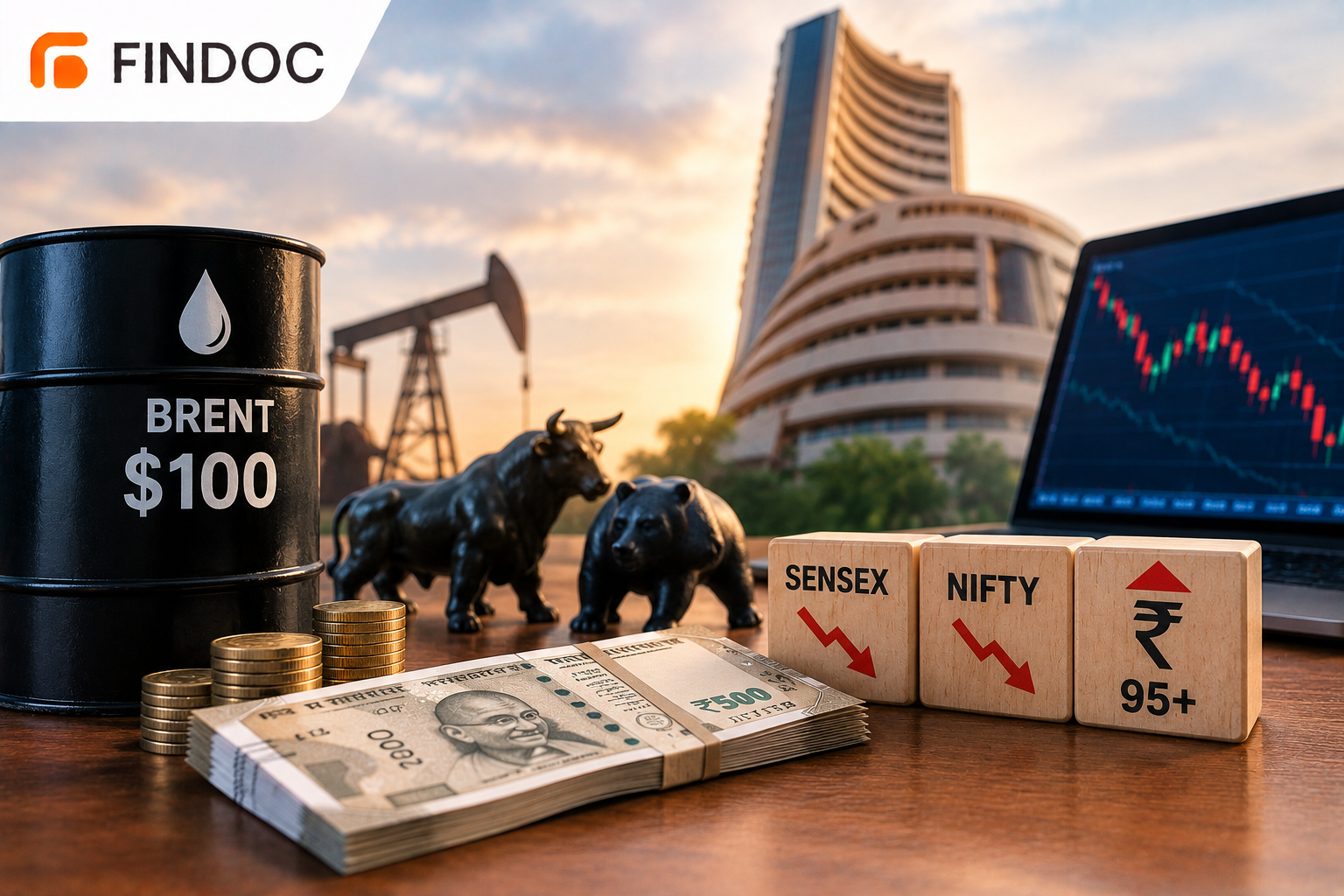
Brent crude pushed close to $100 a barrel on Wednesday, 9 September 2026, as the US-Iran conflict widened. Indian equities fell, the rupee slipped past ₹95, and India’s own crude basket is already trading above $106.
What Pushed Crude Back Towards $100
Brent September futures traded around $99.6 a barrel on Wednesday, up roughly 1.7 per cent on the day. Business Standard reported an intraday high of $100.19 during the session.
Trading Economics data puts Brent at its highest level in nearly seven weeks. The benchmark is up about 13.5 per cent over the past month and around 47 per cent higher than a year ago.
The trigger is the escalating US-Iran conflict. US forces struck Iranian tankers near Kharg Island, the loading point for roughly 90 per cent of Iran’s crude exports.
Iran said it hit two American vessels and eight oil tankers in the Gulf, fired ballistic missiles towards Jordan, and warned tanker crews near Kuwaiti and Bahraini ports to abandon their vessels.
Separately, Iran-backed Houthi fighters attacked energy infrastructure in southern Saudi Arabia, including the 400,000-barrel-a-day Jazan refinery.
The Strait of Hormuz sits at the centre of the worry. It is the narrow sea route through which a large share of West Asian oil reaches Asian buyers, India included.
How Indian Markets Traded on Wednesday
Indian benchmarks opened lower and stayed there. The Sensex began the session at 75,216.22, down 361.36 points, after closing at 75,577.58 on Tuesday.
As of 2:00 PM IST, the Sensex was down 420.13 points or 0.56 per cent at 75,157.45. The Nifty 50 was 82.95 points or 0.35 per cent lower at 23,552.15.
Nifty IT was the worst-performing sectoral index, down more than 3 per cent, with Tech Mahindra, HCL Technologies and Infosys among the biggest Nifty 50 losers. Nifty Healthcare held up better than the broader market.
Broader indices were softer but not panicked. The Nifty MidCap 100 was down 0.49 per cent and the Nifty SmallCap 100 fell 0.30 per cent.
On Tuesday, foreign institutional investors (FIIs), meaning overseas funds investing in Indian shares, sold ₹123.19 crore worth of stock in the cash segment. Domestic institutional investors (DIIs), such as Indian mutual funds and insurers, bought ₹1,349.64 crore.
India’s Crude Basket Is Already Above $106
Here is the detail most headlines skip. India does not buy Brent.
The Indian crude basket is a blend. It combines Dated Brent with the average of Oman and Dubai crude, weighted to reflect the grades Indian refiners actually import.
That basket reached $106.26 a barrel on 7 September, up nearly 30 per cent from its July average of $82.04. The September average is already $100.75.
In short, India’s landed cost of oil crossed the $100 mark before Brent did.
| Benchmark | Price (US$ per barrel) | Approx. cost in ₹ per barrel | Note |
|---|---|---|---|
| Brent, September futures | 99.60 | ₹9,470 | Up about 1.7 per cent on the day |
| WTI crude | 94.43 | ₹8,980 | Up about 1.5 per cent on the day |
| Indian crude basket | 106.26 | ₹10,100 | As on 7 September 2026 |
Rupee values are indicative, converted at about ₹95.07 to the US dollar. Crude prices are live and change through the day.
Rupee Slips Past ₹95 as Dollar Demand Rises
India imports around 88 per cent of the crude it uses, and pays for it in US dollars. Higher oil prices mean more dollar buying by importers, which pushes the rupee down.
The rupee fell 0.35 per cent to about ₹94.82 per dollar on 8 September, its sharpest single-day drop since late July. On Wednesday it weakened further, trading near ₹95.07.
The two effects stack. A costlier barrel and a weaker rupee together raise the import bill more than either would alone.
Fuel Margins Are Already in the Red
The strain is showing up first in what oil marketing companies earn on petrol and diesel.
Equirus data puts petrol marketing margins at minus ₹4.2 per litre as on 7 September, against minus ₹2 a week earlier. Diesel margins were around minus ₹24.9 per litre.
A negative marketing margin simply means the company is selling the fuel for less than it costs to buy, refine and deliver.
Retail pump prices have not moved since the revisions of 25 May. In Delhi, petrol was ₹102.12 a litre and diesel ₹95.20 as on 8 September, according to PPAC data.
There is no automatic pass-through from crude to pump prices. Taxes, freight, insurance, refined product prices and the exchange rate all sit in between. Strong refining margins are currently cushioning integrated oil companies.
Not Every Oil-Linked Stock Moves the Same Way
Higher crude helps some listed companies and hurts others.
- Upstream producers such as ONGC and Oil India earn more on each barrel they sell. Business Standard reported Chennai Petroleum, MRPL and Oil India rising up to 5 per cent on Wednesday.
- Oil marketing companies including BPCL, HPCL and Indian Oil face squeezed marketing margins while pump prices stay frozen.
- Fuel-sensitive sectors such as aviation, paints, logistics and tyres face higher input costs.
Anyone looking to act on these moves needs a demat account, which holds shares in electronic form with NSDL or CDSL, along with an online trading platform to place orders and follow oil-linked stocks during market hours of 9:15 AM to 3:30 PM IST.
What to Watch Next
The bigger variable is how long crude stays elevated, not where it closes today.
Motilal Oswal has estimated that India’s current account deficit could widen to about 1.7 per cent of GDP, or roughly $71 billion, if crude holds above $90 a barrel for a large part of the second half of FY 2026-27. That is a scenario estimate, not a forecast.
Industry sources told Moneycontrol earlier this month that oil marketing companies could broadly absorb crude in the $85 to $90 range. A sustained move above $95 to $100 could force a rethink on retail fuel pricing.
Beyond that, the near-term watch list is the rupee, foreign fund flows, upcoming US inflation data, and whether shipping through the Strait of Hormuz starts to normalise.
Investments in securities markets are subject to market risks. This article is for information only and is not investment advice.
| Check Indices | |
|---|---|
| BSE BANKEX Companies | BSE Largecap Comapnies |
| FINNIFTY Companies | Nifty Midcap 50 Companies |
| NIFTY MIDCAP 150 Companies | Nifty Pharma Companies |
| BSE 500 Companies | BSE 100 Companies |
Leave a Reply