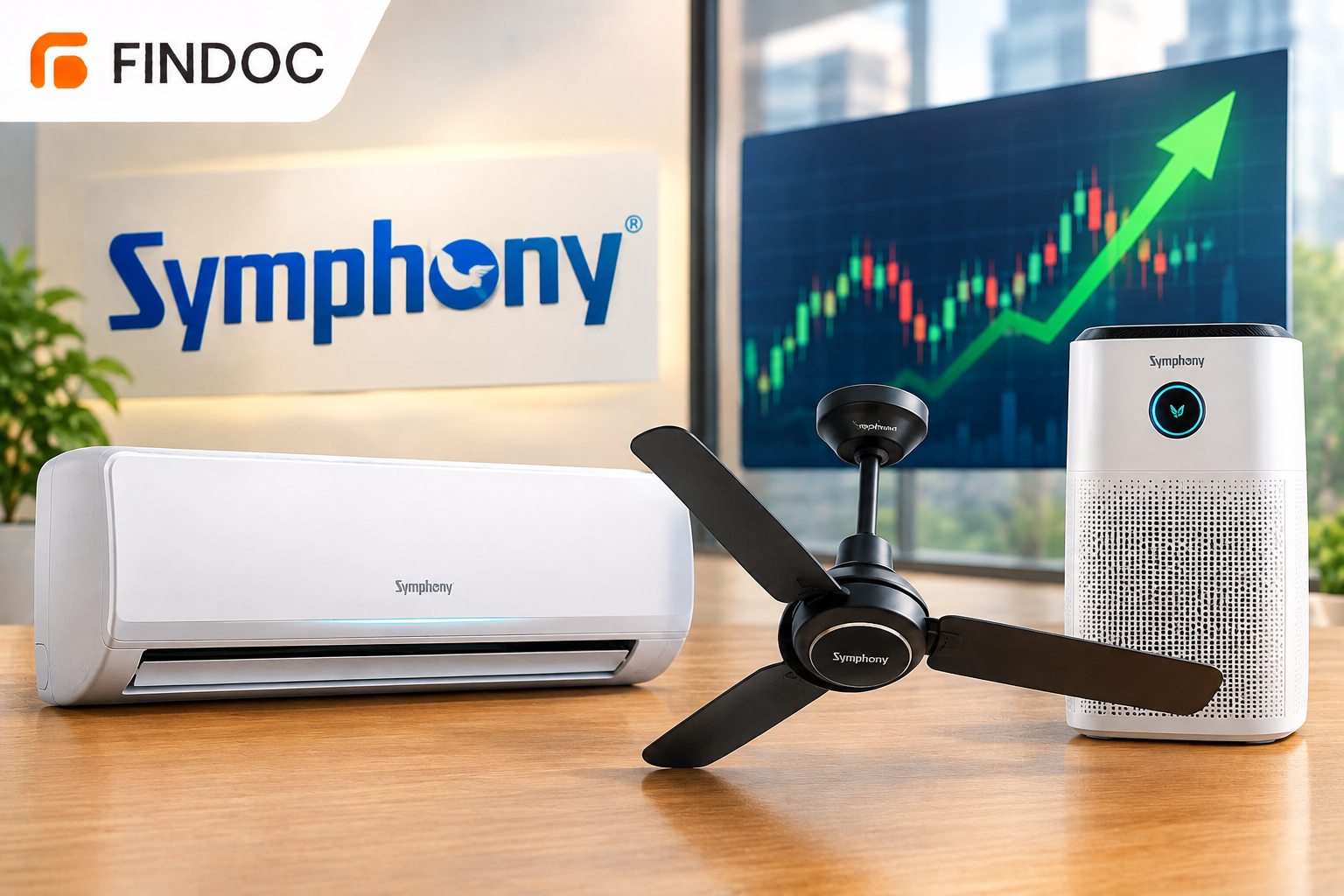
Symphony Limited told the stock exchanges on 7 September 2026 that it plans to sell room air conditioners, BLDC ceiling fans and air purifiers in India from the December 2026 quarter. The stock jumped sharply the next morning.
What Symphony Told NSE and BSE
The company filed the disclosure under Regulation 30 of the SEBI Listing Regulations on 7 September 2026, after trading hours. Regulation 30 is the rule that requires a listed company to tell the exchanges about any event that could move its share price.
Symphony said it proposes a calibrated and phased entry into three new categories in India: room air conditioners, BLDC ceiling fans and air purifiers. BLDC stands for brushless direct current, a motor type used in fans that consumes far less electricity than an ordinary ceiling fan.
Products will be introduced selectively across ranges, markets and channels starting from the December 2026 quarter, which is Q3 of FY 2026-27. The pace and scale will be calibrated to consumer response, execution readiness and satisfactory commercial and operating outcomes. The filing was signed by Mayur Barvadiya, Company Secretary and Head of Legal.
| Parameter | What the company disclosed |
|---|---|
| New categories | Room air conditioners, BLDC ceiling fans, air purifiers |
| Market | India |
| Start of rollout | December 2026 quarter (Q3 FY 2026-27) |
| Business model | Asset-light |
| Manufacturing | No in-house capacity planned at present |
| Funding | Internal accruals |
| Disclosure | Regulation 30, SEBI Listing Regulations, 7 September 2026 |
Why the Stock Moved So Sharply on Tuesday
Symphony shares opened strong on 8 September 2026, the first session after the filing. On BSE the stock climbed 13.51% to ₹652.25 against the previous close of ₹574.60, lifting market capitalisation to roughly ₹4,367 crore.
By 9:57 AM IST about 1.45 lakh shares had changed hands on BSE, worth around ₹9.29 crore in turnover. The move cooled as the session went on: at about 12:31 PM IST the stock was quoted at ₹612.95 on NSE, up close to 6.9%.
The size of the reaction owes something to how weak the stock had been. Symphony has lost roughly 34% over the past one year, and its RSI was reported at 29.3 on Tuesday morning. RSI, or Relative Strength Index, is a momentum reading on a 0 to 100 scale, and a value under 30 is generally described as oversold. The rally also came on a day when the broader market was trading lower.
What Asset-Light Actually Means Here
Symphony said it has no current plan to invest in in-house manufacturing capacity for these products. In plain terms, it is not building AC or fan factories; production is expected to sit with outside manufacturing partners.
Spending on product development, inventory, brand-building, channel and service readiness and working capital will be met from internal accruals, which are simply profits the company has already earned and kept. No fresh borrowing or share issue has been announced for this plan.
Symphony has run an asset-light, low working capital model in its cooler business for years, so this is an extension of an existing approach rather than a change of direction.
Escaping the Summer-Only Cycle
Air coolers sell mainly between March and June, which makes Symphony’s India revenue heavily seasonal and dependent on how hot a given summer turns out to be. Room ACs, ceiling fans and air purifiers sell across more months of the year.
The company said the expansion is consistent with its stated focus on strengthening its Beyond India Summer Products portfolio, while further reinforcing its leadership in the Indian household air cooler category. It expects the move to widen its addressable market in adjacent consumer-durable categories, using existing strengths in cooling, brand-building, distribution, consumer insights and after-sales service.
These are crowded categories. Established consumer-durables companies such as Voltas, Blue Star and Havells already sell room ACs and fans in India, so Symphony enters as a challenger in segments where it has no track record.
The Financial Backdrop: Q1 FY 2026-27 Numbers
On 4 August 2026 Symphony reported consolidated revenue from operations of ₹378 crore for the June 2026 quarter, up 8% from ₹350 crore a year earlier. Consolidated EBITDA rose 26% to ₹48 crore from ₹38 crore. EBITDA is earnings before interest, tax, depreciation and amortisation, a common measure of operating profit.
Consolidated net profit was ₹40 crore, slightly below ₹42 crore in the year-ago quarter. Management said that after adjusting for a one-time non-cash expense of ₹5 crore in June 2026 and ₹9 crore of higher exceptional income in June 2025, comparable EBITDA works out to ₹53 crore against ₹38 crore.
What to Watch from Here
This is a statement of intent, not a launch. Symphony has not disclosed product ranges, price points, launch dates within the quarter, manufacturing partners or how much money it expects to spend.
Three things will show whether the plan converts into numbers: what actually reaches shelves from the December 2026 quarter, the margins earned in categories where pricing pressure is high, and how well outsourced supply chains cope with electronics that are more complex than evaporative coolers.
Anyone who holds or tracks these shares needs a demat account, where shares are held electronically with a depository such as NSDL or CDSL. Company filings on the NSE and BSE websites, along with day-to-day price action on any online trading platform, are the simplest way to follow how the rollout progresses from here.
Investments in the securities market are subject to market risks. This article is for information only and is not investment advice.
Leave a Reply