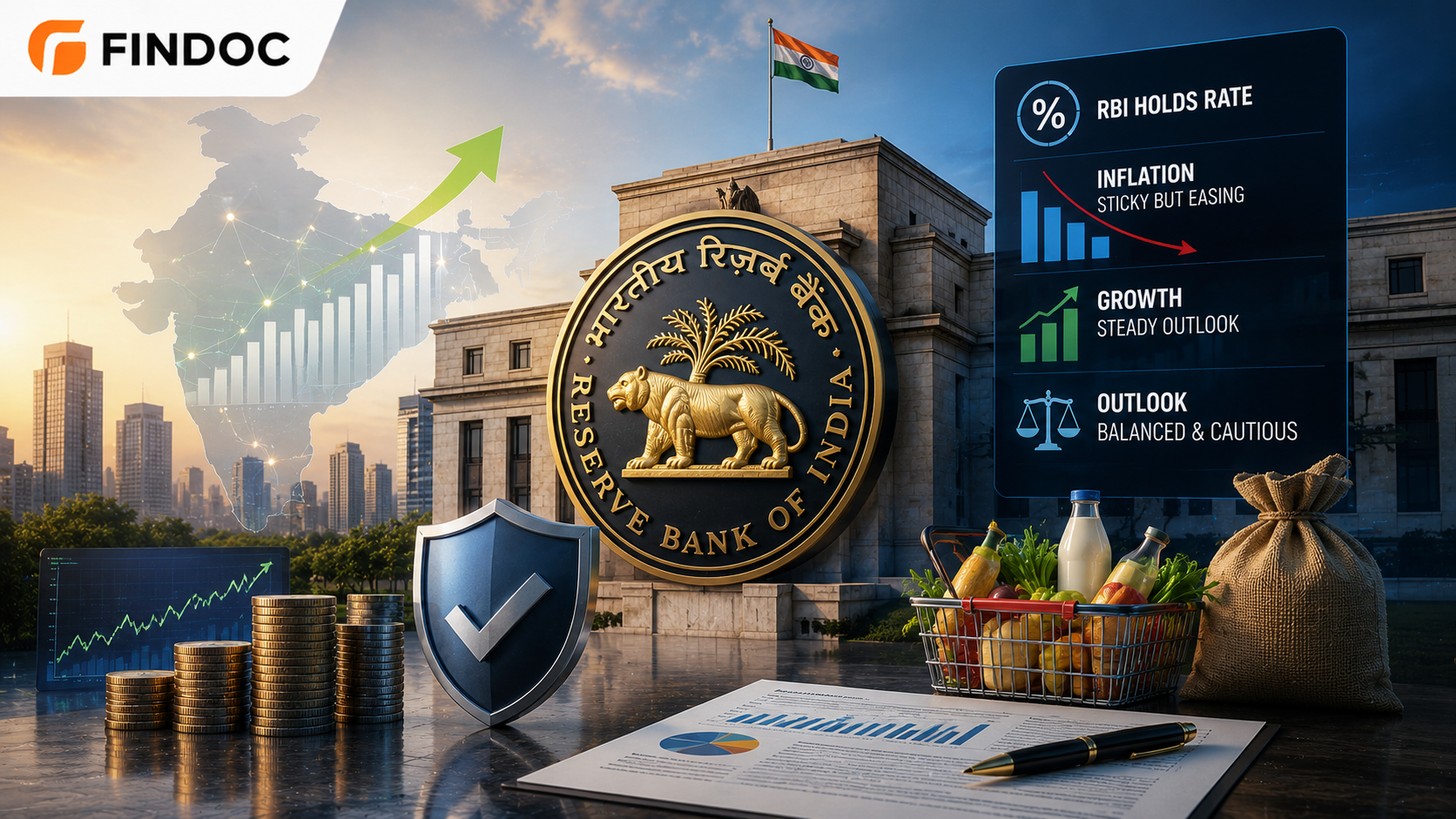
India’s macroeconomic backdrop remains broadly stable, with robust GDP growth offset by persistent but moderating inflation and a range-bound rupee, shaping a cautiously constructive outlook for domestic markets. Over the past 24 hours, commentary from policymakers and market participants has reinforced expectations that the Reserve Bank of India (RBI) will maintain its restrictive monetary stance for longer, even as headline growth and high-frequency indicators point to resilient domestic demand. For institutional investors, the key questions now centre on the timing and pace of RBI’s eventual pivot, the trajectory of CPI and WPI inflation, and implications for equity valuations and bond yields.
Key Highlights
- Real GDP growth is expected to stay above 7% in FY27, though the pace is moderating from post-pandemic highs.
- CPI inflation remains in the upper half of RBI’s 2–6% band, driven by volatile food prices, while core inflation is more subdued.
- RBI is widely expected to extend the pause on the repo rate, prioritising price stability over growth support.
- The rupee trades in a tight range against the US dollar, with RBI intervention and strong services exports helping anchor volatility.
- Indian equities remain near record levels, with financials, domestic cyclicals, and select consumption names in focus as macro conditions evolve.
GDP Momentum and Inflation Dynamics in India’s Macro Snapshot
India’s growth narrative remains fundamentally intact, although the phase of post-pandemic catch-up is now giving way to more measured expansion. Recent market commentary has coalesced around real GDP growth remaining in the 7–7.5% zone for FY27, supported by government capex, steady services exports, and a gradual recovery in private investment. High-frequency indicators such as GST collections, power demand, and mobility data continue to point to resilient underlying activity, even as global trade headwinds and elevated real rates act as a partial drag on capex-heavy sectors.
Inflation remains the key macro variable constraining policy flexibility. Headline CPI has been oscillating in the upper half of the RBI’s 2–6% tolerance band, with most recent readings hovering slightly above 4.5–5% on a year-on-year basis. Within this, food inflation remains the principal swing factor, driven by cereals, pulses and vegetables, reflecting weather-related supply disruptions and structural pressures in protein and horticulture. In contrast, core inflation (excluding food and fuel) has softened materially from previous peaks, aided by subdued goods prices and still-cautious discretionary consumption. This divergence underpins RBI’s insistence that while the disinflation process is underway, the job is not yet complete.
WPI inflation has largely normalised after the deflationary prints seen in some earlier months. It now shows moderate positive readings, capturing higher input costs in sectors such as metals, chemicals and basic manufacturing. The narrowing wedge between CPI and WPI inflation indicates that pass-through of input cost increases to retail prices is largely contained but remains a monitoring point for consumer staples and industrials. For listed companies on the BSE and NSE, this environment of stable but non-benign input costs reinforces the importance of pricing power and operating leverage in sustaining margins. Investors focused on stock investment strategies within Indian equities should closely track this CPI-WPI divergence as a leading indicator of sector-level margin trends.
RBI Policy, Rupee Trajectory and Market Reaction
RBI’s monetary policy stance remains firmly focused on anchoring inflation expectations, with the central bank repeatedly emphasising its “withdrawal of accommodation” framework. The policy repo rate is currently in restrictive territory relative to neutral estimates, and traders in the OIS and G-sec markets are pricing only a shallow and back-loaded rate-cut cycle, contingent on CPI staying durably near 4%. Recent public commentary by senior bankers and economists suggests broad consensus that a near-term rate cut is unlikely; instead, the focus is on liquidity management via VRRRs, OMOs, and fine-tuning of durable liquidity to contain money-market volatility and support orderly transmission.
The rupee has traded in a relatively tight, managed range against the US dollar in recent sessions, reflecting a combination of strong services exports, resilient remittance inflows, and active RBI intervention in the FX market. Onshore, USD/INR has been held in a narrow band, with intraday volatility muted compared to many emerging-market peers. While portfolio flows into Indian equities have been somewhat choppy, domestic institutional investors (DIIs) — led by mutual funds and insurers — have provided a strong counterbalance, helping the Nifty 50 and Sensex stay close to their historic highs.
On the equity side, the macro mix of high real rates, steady growth and gradually easing inflation is favouring quality financials, domestic cyclicals and select consumption names. Large private-sector banks and well-capitalised NBFCs are benefiting from healthy credit growth and stable asset quality, even as they navigate margin pressure from higher funding costs. In the broader market, sectors with pricing power — such as premium discretionary consumption, autos and select industrials — are positioned to gain from a combination of moderating input costs and resilient demand, while rate-sensitive segments like real estate and durables remain more directly exposed to the timing of the RBI pivot. Retail participation in these market dynamics has grown steadily as access to a reliable trading platform has become more widespread among Indian investors.
Key Macro and Market Metrics for Investors
Investors are closely tracking a set of macro and market indicators to gauge the balance of risks between growth, inflation and policy. The table below summarises the current qualitative picture and implications for Indian markets.
| Indicator | Current Trend | Market Implication |
|---|---|---|
| Real GDP Growth | Moderating from post-pandemic peaks but likely above 7% in FY27 | Supports earnings growth for cyclicals, infra and financials; underpins premium valuations for Nifty 50 and Sensex constituents |
| CPI Inflation | In upper half of 2–6% band; food remains volatile, core subdued | Limits scope for early rate cuts; favours companies with strong pricing power and low input cost sensitivity |
| WPI Inflation | Normalised to low positive territory after earlier deflation | Suggests stabilising input costs; supportive for industrial margins if demand holds |
| RBI Policy Stance | Repo rate on extended pause; stance: withdrawal of accommodation | Keeps real rates restrictive; flattens rate-cut expectations curve; supports INR stability but caps rate-sensitive multiple expansion |
| Rupee vs USD | Range-bound with low volatility; supported by RBI and services exports | Reduces FX risk for FIIs; positive for external-debt issuers; sustains carry trade interest in INR assets |
| G-sec Yields | Elevated but off recent peaks; curve relatively flat at long end | Attractive carry for long-only bond investors; supports rotation into quality duration plays when rate-cut cycle nears |
| Equity Indices (Sensex, Nifty 50) | Near record highs with sectoral rotation | Valuations rich vs EM peers; earnings delivery and macro stability are critical for further re-rating |
For institutional investors, the key is to interpret these macro signals in portfolio-construction terms. A sustained RBI pause with high real rates supports strategies overweight quality financials, export-oriented IT and pharma with solid balance sheets, and domestic consumption plays where volume growth can offset pricing normalisation. At the same time, sectors with stretched valuations and high sensitivity to funding costs warrant more selective exposure until there is greater clarity on the inflation-policy trajectory. Those looking to participate in India’s evolving market cycle can open demat account through SEBI-registered brokers to access both equity and debt instruments across BSE and NSE.
Market Outlook
The forward-looking picture for India’s economy is one of resilient growth, gradually easing inflation, and a central bank that remains firmly data-dependent. If monsoon dynamics remain broadly normal and food inflation moderates in the coming months, CPI could edge closer to the 4% target, opening space for a calibrated pivot in policy rates later in the fiscal year. However, risks from global commodity prices, especially crude, and from renewed supply shocks in food cannot be discounted. For the rupee, continued RBI intervention combined with India’s improving external metrics suggests a bias towards stability rather than large directional moves.
For Indian markets, this environment argues for patience and selectivity. Equity valuations are not cheap by historical or cross-market standards, making near-term returns heavily dependent on earnings delivery and margin resilience. Bond investors can benefit from elevated real yields and a favourable carry backdrop, particularly at the 3–7 year segment of the curve, while keeping duration flexible ahead of any definitive policy shift. Overall, the macro setup is supportive of India’s status as a structural overweight within global EM allocations, provided investors remain alert to inflation and policy inflection points.
Conclusion
India’s macro-financial landscape is entering a more mature phase of the cycle: post-pandemic growth tailwinds are normalising, inflation is trending lower but not yet comfortably anchored, and RBI is signalling an extended period of vigilance rather than a rapid move to accommodation. For institutional investors, this demands a more nuanced approach than the broad-based beta trade of prior years. Monitoring the interplay of GDP momentum, CPI and WPI trends, RBI communication, and rupee stability will be critical to calibrating exposure across Sensex and Nifty 50 sectors. In a world of heightened global uncertainty, India offers a rare combination of solid growth and improving macro stability, but the premium it commands in global portfolios will remain contingent on continued policy discipline and credible inflation control.
Leave a Reply