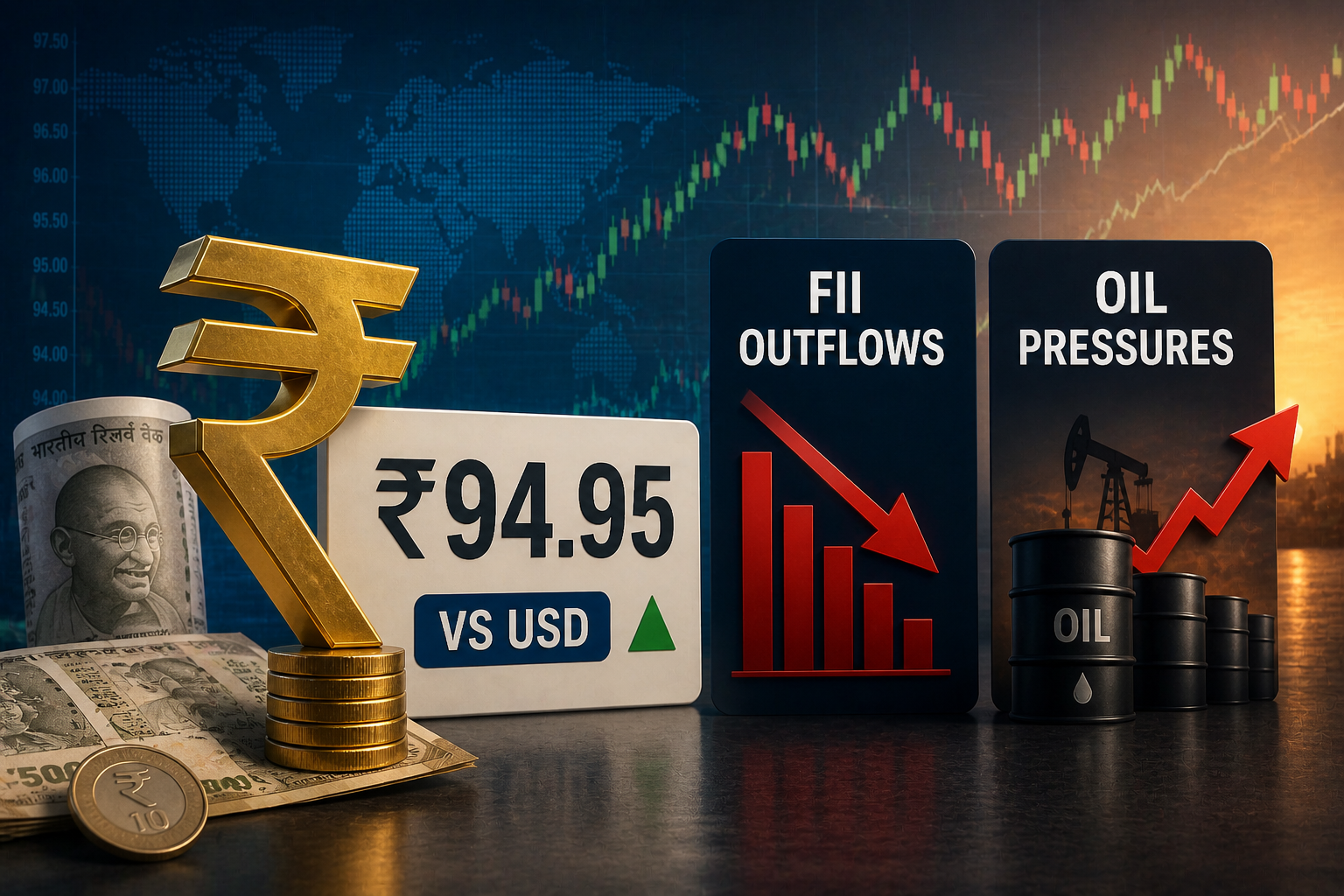
The Indian Rupee opened weaker at 94.95 against the US Dollar on Monday, May 4, 2026, reflecting ongoing pressures from foreign institutional investor outflows exceeding $19 billion this year and elevated crude oil prices above $100 per barrel amid Middle East tensions. This marks a decline of 4 paise from Friday’s close of 94.92, with the currency nearing its recent record low of 95.34 touched on April 30.
Investors face immediate concerns over support levels around 94.80, RBI intervention limits due to a record $103 billion forward book, and broader impacts on equity markets, import costs, and inflation as FII selling persists alongside hawkish Fed signals and risks in the Strait of Hormuz.
The Rupee commenced trading at 94.95, down 4 paise from the prior close, amid sustained FII outflows and crude oil above $100. Year-to-date, it has depreciated 5.31%, one of the sharpest in recent years. Analysts identify immediate support at 94.80, with resistance at 96 if breached.
Key Highlights
- Rupee opens at 94.95, down 4 paise from 94.92 close; record low 95.34 on April 30
- 5.31% YTD depreciation amid $19B+ FII outflows, crude >$100, hawkish Fed
- RBI forward book at $103B record, import cover <9 months limiting interventions
- Support at 94.80; next battle at 96 if breached
- Linked to Hormuz easing (Brent $108) and US-Iran talks
Current Data and Technical Levels
Market data underscores the Rupee’s vulnerability as it navigates FII selling and global commodity shocks. The USD/INR pair has trended higher since breaching 95 in late March, forming a multi-week ascending channel with accelerated momentum post-April 30 peak.
Technical indicators show the 50-day moving average at 94.20 providing prior support, now tested amid rising oil-linked volatility.
| Metric | Value | Notes |
|---|---|---|
| Opening Rate | 94.95 | +4 paise weaker |
| YTD Change | -5.31% | Worst in years |
| Key Support | 94.80 / 94.50 | Importer buying zone |
| Key Resistance | 96 / 97 | Crude >$125 trigger |
| RBI Forward Book | $103.06B | Record short position |
| FII Outflows 2026 | >$19B | Primary pressure |
This table highlights critical thresholds for traders monitoring NSE and BSE forex counters. A break below 94.50 could signal deeper corrections toward 95, while sustained Brent crude above $108 exerts upward pressure on the pair.
Why Is the Rupee Weakening? Core Drivers
FII outflows surpassing $19 billion in 2026 form the primary drag, creating a feedback loop with elevated crude prices near $126 per barrel—a four-year high driven by Middle East tensions, including risks in the Strait of Hormuz. Hawkish Federal Reserve stance, with rates held at 3.5%-3.75% and mounting dissents, bolsters the Dollar, amplifying INR pressure.
RBI faces constraints with its forward book at a record $103.06 billion, reducing import cover to under 9 months and limiting spot interventions. Anindya Banerjee notes the 96 level as a psychological barrier, while Gaura Sengupta highlights shrinking reserves amid persistent outflows.
Global factors like BoE warnings of oil at $130 pushing UK inflation above 6% mirror potential INR import bill spikes.
Investor Impact on Stocks, Imports, and Inflation
Equity markets opened mixed, with Nifty and Bank Nifty range-bound despite a slight crude dip, as FII selling targets IT and energy sectors vulnerable to currency swings. Higher import costs, particularly for oil comprising 80% of India’s energy needs, fuel factory PMI sluggishness at 54.7 in April, pressuring margins for BSE-listed refiners like Reliance Industries.
Inflation risks rise with passthrough from Brent at $108, impacting consumer staples and autos. Gold and silver gain safe-haven appeal, with MCX prices correlating inversely to INR weakness. SEBI-regulated portfolios face volatility, as rupee depreciation erodes real returns for unhedged FII exposures.
Expert Analysis and Outlook
Recovery hinges on crude falling below $95, potential FII inflows from Hormuz de-escalation or US-Iran progress, and softer Fed rhetoric. Analysts forecast a 94.50-95.50 range through May, assuming no major supply disruptions. Macro risks include war-escalated costs and PMI trends signaling output constraints.
Historically, similar crises like 2013 taper tantrum saw INR hit 68.80, with RBI deploying $20 billion in interventions; today’s $103 billion forward book offers tools but tests reserve adequacy. Middle East oil reliance, with China diversifying imports, underscores India’s exposure at 53% from the region.
Actionable Guidance for Retail Investors
Track 94.80 support alongside Brent below $105 for short-term stabilization signals. Diversification via RBI-approved hedged funds provides exposure management, balancing risks from forex volatility. Export-oriented stocks in pharma and IT may benefit from weaker INR, though sector rotation remains key.
To participate effectively, investors can open free demat account online through SEBI-registered intermediaries for seamless NSE/BSE access. Platforms offering multi-asset tools rank among the best stock trading and investing platform in India for real-time forex and equity monitoring.
Markets anticipate RBA rate decision and US data this week, with oil dynamics and FII flows dictating INR trajectory. Neutral policy from global centrals amid Middle East uncertainty supports Dollar strength, while domestic PMI and RBI liquidity measures warrant close watch for equity ripple effects.
Investors should prioritize risk assessment across forex, commodities, and equities, maintaining balanced portfolios amid these interconnected pressures. Vigilance on key levels and global triggers enables informed positioning in line with SEBI guidelines.
| Popular Stock Market Indices | |
|---|---|
| Nifty Realty | India VIX |
| BSE Largecap | Nifty Commodities |
| BSE SmallCap | BSE Bankex |
| BSE MidCap | BSE Sensex |
| Nifty Midcap 50 | NIFTY MidCap 100 |
Leave a Reply