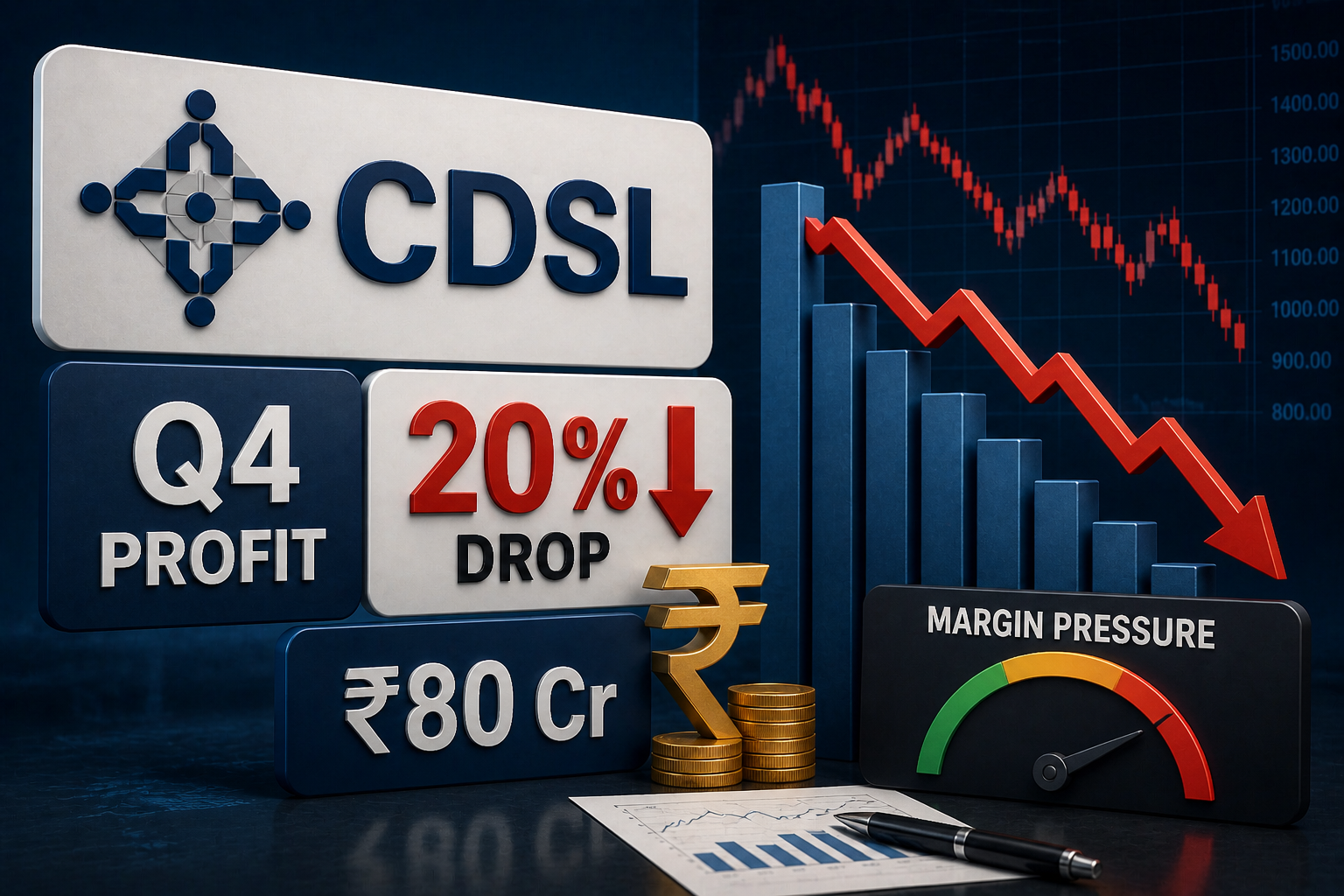
CDSL reported a 20% year-on-year decline in net profit for the quarter ended March 2026, falling to Rs 80 crore amid intensifying margin pressures from rising operational costs. This earnings miss has placed CDSL shares under the spotlight as investors assess the impact in a market showing resilience in financial services amid global uncertainties like elevated oil prices and central bank caution. With Nifty Financial Services gaining traction, the results highlight challenges in the depository segment despite steady demand for services linked to recovering trading volumes on NSE and BSE.
Key Highlights
- Net profit at Rs 80 crore, down 20% YoY
- Margins squeezed by higher operational costs and expense growth
- Shares in focus as Nifty Financial Services rises 1.12%
- Broader context shows IT sector flat at -0.01%, financials holding firm
- Depository volumes supported by market rebound but costs outpace gains
CDSL Q4 Results 2026: Net Profit Falls 20% to Rs 80 Crore on Margin Squeeze
Central Depository Services (India) Limited (CDSL) disclosed its Q4 FY26 results, revealing net profit of Rs 80 crore, a 20% drop from the previous year. This decline stems primarily from margin compression due to escalating operational expenses in a high-volume trading environment. CDSL shares remain in focus following the earnings release, with market updates indicating heightened investor scrutiny amid a Nifty rebound.
What Happened in CDSL Q4 Earnings
CDSL’s Q4 performance reflects the dual dynamics of robust depository participation and cost headwinds. Net profit slid to Rs 80 crore, down 20% year-on-year, as operational expenses rose sharply, eroding profitability despite steady revenue from transaction charges and account openings.
Revenue trends showed resilience, buoyed by increased demat account creations and trading volumes on NSE and BSE platforms. However, compared to prior quarters, the margin erosion became pronounced, with costs linked to technology upgrades and compliance outpacing volume-driven income.
Key drivers of margin squeeze include higher employee expenses and data processing costs, even as depository services demand grew in line with market recovery. SEBI’s push for enhanced investor protection measures added to expenditure, while algo and MTF trading volumes provided a counterbalance through higher throughput.
This quarter underscores how cost pressures can offset gains from a recovering equity market, where retail participation remains strong but efficiency challenges persist for intermediaries like CDSL.
Stock Performance and Market Reaction
CDSL shares faced immediate pressure post-results, with intraday trading showing elevated volumes as investors digested the profit miss. The stock hovered near key technical levels, testing support amid broader financial sector resilience.
| Metric | Value | Change |
|---|---|---|
| CDSL Q4 Profit | Rs 80 Cr | -20% |
| Nifty Financial Services | 25,944.50 | +1.12% |
| Nifty IT | 29,350.75 | -0.01% |
Post-earnings, CDSL exhibited a modest intraday decline of around 2-3%, with trading volumes spiking 50% above average, signaling active repositioning. Technical support lies at Rs 1,400, a level aligned with recent lows, while resistance at Rs 1,600 caps upside potential from current levels.
In comparison to benchmarks, Nifty Financial Services outperformed, gaining 1.12% on renewed banking sector momentum, contrasting the flat IT index amid global tech valuation concerns.
Investor Impact
Margin pressures in depository stocks like CDSL signal broader vulnerabilities in the financial services ecosystem, where operational efficiency directly influences earnings stability. For investors, this underscores the importance of monitoring cost-to-income ratios, as seen in CDSL’s Q4 contraction.
The sector ripple is contained, with Nifty Financial Services up despite individual misses, but profit shortfalls can drag sentiment in high-valuation names. Retail exposure risks heighten in an era of surging trading volumes, amplified by SEBI regulations on leverage products like MTF.
Compared to peers such as NSDL, CDSL faces similar dynamics but with a stronger retail focus, making it sensitive to volume fluctuations. Investors with concentrated positions may evaluate diversification to mitigate earnings volatility tied to market cycles.
Actionable Guidance for Investors
Investors may monitor CDSL’s Q1 guidance and depository volume trends for signs of margin stabilization, alongside key support levels around Rs 1,400 for potential entry assessment. Diversifying within Nifty Financial Services can balance exposure, focusing on performers resilient to cost pressures.
SEBI-neutral steps include reviewing portfolio allocation and consulting a registered investment advisor for personalized insights. To track CDSL closely, one may open demat account online, enhancing access to real-time NSE and BSE data.
Natural participation in such volatile environments often involves platforms suited for Indian markets; exploring the best stock trading and investing platform in India aids informed monitoring without altering core strategies.
Expert Take: Margin Pressures in Depository Space
Historical profit trends for CDSL reveal cycles tied to market participation, with peaks during bull phases offset by cost escalations in consolidation periods. Q4 FY26’s 20% drop aligns with this pattern, where algo and MTF trading volumes boosted throughput but failed to fully counter rising expenses.
Factors like technology investments for SEBI-compliant systems and RBI-linked compliance have intensified pressures, even as overall market recovery supports depository demand. Outlook hinges on sustained equity inflows, potentially easing margins if volumes accelerate.
Outlook
Forward market implications for CDSL center on volume growth versus cost discipline, with financial services resilience offering a buffer. Neutral positioning accounts for potential Nifty upside tied to RBI policy signals, balanced against persistent global oil and inflation risks.
Conclusion
CDSL’s Q4 profit decline to Rs 80 crore highlights margin challenges in a volume-rich depository landscape, prompting investor vigilance on operational trends. Balanced assessment of technical levels and sector dynamics supports informed navigation of trading opportunities in this environment.
Leave a Reply