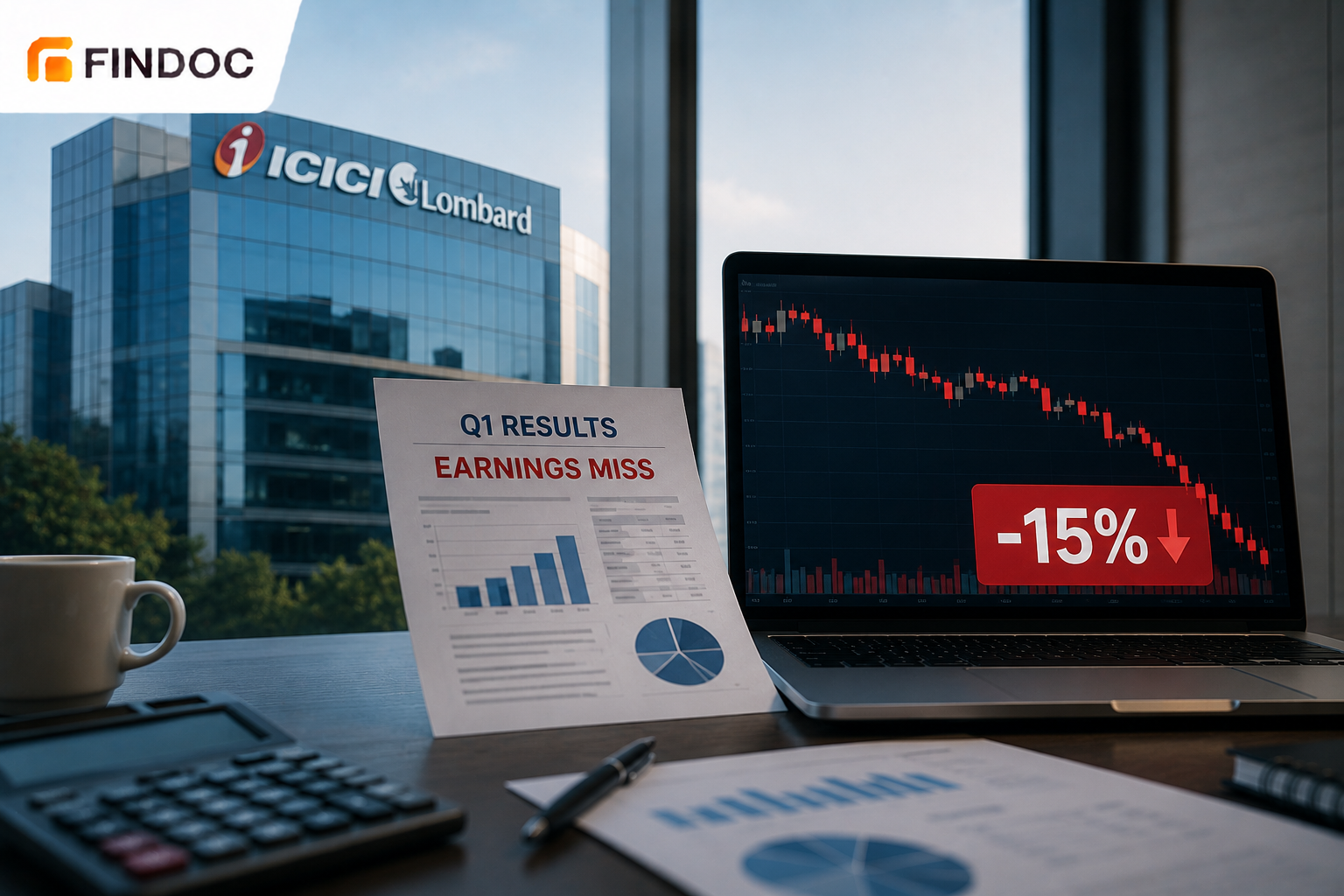
ICICI Lombard General Insurance shares suffered their steepest single-day decline since the COVID-19 market crash on Thursday, July 16, 2026. The stock hit a fresh 52-week low after its June-quarter earnings fell well short of analyst expectations. The sharp selloff reflects growing investor anxiety over the company’s near-term profitability trajectory.
What Changed
The stock tumbled approximately 15% in a single session, triggering significant concern across the insurance sector. Brokerages responded swiftly by slashing target prices and downgrading their ratings on the stock. The magnitude of the move signals that the earnings miss was not marginal, it was broad-based and alarming to the market.
| Metric | Detail |
|---|---|
| Stock Decline (Single Day) | ~15% |
| 52-Week Low | Hit on July 16, 2026 |
| Earnings Period | Q1 FY27 (June Quarter) |
| Brokerage Action | Multiple downgrades and target price cuts |
| Last Comparable Decline | COVID-19 market crash |
Why It Matters for Investors
ICICI Lombard is one of India’s largest private general insurers. Therefore, its performance is closely watched as a bellwether for the broader non-life insurance sector. A 15% single-day drop is extraordinary and signals deep structural concerns, not just a temporary earnings blip.
Analysts highlighted four key pressure points: weak underwriting performance, higher-than-expected claims, regulatory headwinds, and slower premium growth. Together, these factors paint a challenging picture for the company’s ability to generate consistent profits in the near term. For investors who open demat account online to access insurance sector stocks, understanding these dynamics is critical before taking positions.
Potential Financial Impact
Weak underwriting directly erodes the insurer’s combined ratio, a key measure of profitability. Higher claims inflate costs and compress margins simultaneously. Slower premium growth limits the company’s ability to offset these cost pressures through revenue expansion. As a result, return on equity and earnings per share estimates for FY27 are likely to face meaningful downward revisions across the Street.
Regulatory headwinds add another layer of uncertainty. Changes in pricing norms or product structures imposed by IRDAI can affect revenue visibility. This makes near-term earnings forecasting particularly difficult for both analysts and investors.
Expert or Market Reaction
Multiple brokerages moved quickly to reassess their views. Downgrades and target price reductions were broad-based, suggesting that analyst consensus had shifted meaningfully in a single session. This type of coordinated negative reaction from the institutional community typically amplifies selling pressure beyond the initial shock.
Market participants also flagged that the claims environment has been deteriorating across the general insurance industry. However, ICICI Lombard’s miss was sharper than peers, indicating company-specific execution challenges may also be at play. Investor confidence, once shaken at this scale, typically takes multiple quarters of consistent delivery to rebuild.
Broader Context
India’s general insurance sector has faced a complex operating environment in recent periods. Motor and health insurance, two large segments for ICICI Lombard, have seen rising claims frequency. In addition, regulatory changes around product pricing and commission structures have added cost unpredictability for insurers.
| Challenge | Sector Impact |
|---|---|
| Rising Claims | Margin compression across motor and health |
| Regulatory Changes | Pricing and product structure uncertainty |
| Slower Premium Growth | Limits revenue offset against cost pressures |
| Weak Underwriting | Deteriorating combined ratio |
Meanwhile, competition from public sector insurers and newer digital-first players continues to intensify. This structural pressure limits pricing power and makes it harder for established players to pass on cost increases to customers.
Key Risks and Factors to Consider
Investors should weigh several risks carefully before reassessing positions in ICICI Lombard. The near-term earnings recovery path is unclear. Claims trends and regulatory dynamics remain fluid, and premium growth revival will require time to materialize.
- Claims environment: Sustained high claims in motor and health could keep margins under pressure through FY27.
- Regulatory risk: Further IRDAI policy changes may create additional revenue and cost headwinds.
- Underwriting discipline: Management must demonstrate improvement in the combined ratio over coming quarters.
- Valuation reset: Post-correction valuations may look more attractive, but a rerating requires earnings stabilization first.
- Competitive pressure: Market share defense against aggressive peers adds execution complexity.
What Investors Should Watch Next
- Management commentary on claims trends and whether corrective underwriting actions are already underway.
- Q2 FY27 premium growth data, which will indicate whether the top-line slowdown is reversing.
- IRDAI regulatory announcements that could affect pricing structures or product guidelines.
- Revised brokerage consensus targets and whether further downgrades emerge in the coming weeks.
- Investors using a top stock market trading and investing platform should monitor sector-wide claims data to distinguish ICICI Lombard-specific issues from broader industry trends.
Conclusion
ICICI Lombard’s 15% single-day crash marks a significant reset in market expectations. Weak underwriting, higher claims, regulatory headwinds, and slower premium growth have collectively undermined the near-term earnings outlook. The scale of brokerage downgrades confirms this is a material development, not a minor miss.
However, the company remains one of India’s leading private general insurers with an established franchise and distribution network. A recovery is possible, but it will require consistent execution over multiple quarters. Until earnings visibility improves, the stock is likely to remain under pressure. Investors should prioritize fundamental analysis over price-driven decisions in this environment.
- Key Takeaway 1: The 15% fall reflects a fundamental miss, weak underwriting and rising claims have damaged near-term earnings visibility significantly.
- Key Takeaway 2: Regulatory headwinds and slower premium growth add layers of uncertainty that make a quick earnings recovery unlikely.
- Key Takeaway 3: Monitoring management guidance and Q2 claims data will be essential before drawing conclusions about the stock’s recovery timeline.
Leave a Reply