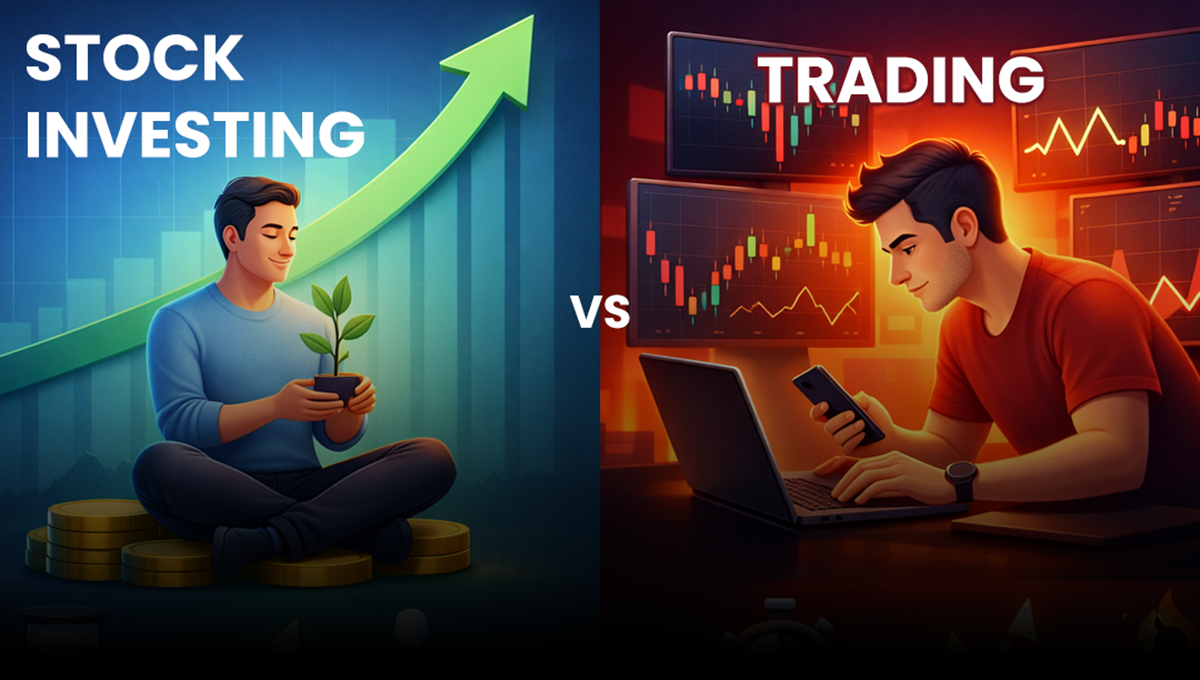
The stock market offers multiple ways to participate, and one of the most common comparisons that new investors try to understand is trading vs investing. Although both involve dealing in securities, they differ significantly in purpose, time horizon, and the level of involvement required. This distinction can be difficult for new investors to understand, especially when they are still learning how the market functions or planning to open free demat account online to get started. Findoc provides clear and reliable financial insights that help readers assess these methods with greater clarity before making informed decisions.
What is Investing?
Investing refers to purchasing shares or other financial assets with the intention of holding them for a long period. The objective is long-term capital growth supported by the performance of the underlying business. Investors typically focus on stability, sustained value appreciation, and the potential to earn passive income through dividends. This approach is suitable for individuals seeking predictable, long-term outcomes rather than frequent short-term market activity. Understanding investing is essential when evaluating the broader discussion of trading vs investing, as each method requires a different outlook and risk preference.
Also Read: What is Online Stock Trading?
Types of Investing
Different investing styles allow individuals to choose an approach that aligns with their financial goals, time horizon, and comfort with risk. Below are the most commonly followed methods.
1. Value Investing
Value investing involves selecting companies that appear to be priced below their intrinsic value. Investors evaluate financial statements, earnings patterns, long-term prospects, and competitive advantages to identify opportunities where the market’s current valuation may not reflect the company’s true potential.
2. Growth Investing
Growth investing focuses on businesses expected to expand faster than the market average. These companies may operate in sectors with strong innovation or rising consumer demand. The emphasis is on future potential rather than immediate profitability, making this approach suitable for those who prioritise long-term appreciation.
3. Dividend Investing
Dividend investing involves selecting companies that regularly distribute a portion of their profits to shareholders. Individuals who prefer a steady income stream often favour this method, as it provides both periodic payouts and the possibility of long-term capital growth.
4. Buy and Hold Investing
The buy-and-hold approach involves retaining investments over several years, regardless of short-term market fluctuations. Investors rely on the long-term resilience of high-quality businesses and allow compounding to work over time. This method is one of the clearest illustrations of the difference between trading and investing, as it requires far less frequent decision-making.
5. Socially Responsible Investing
SRI integrates personal or institutional values into investment choices. Investors consider environmental practices, governance standards, and ethical policies alongside financial performance, choosing companies that align with both their principles and long-term objectives.
6. Contrarian Investing
Contrarian investing involves taking positions against prevailing market sentiment. Investors identify situations where widespread pessimism or temporary reactions have pushed prices away from a company’s long-term fundamentals, creating scope for future appreciation.
Additional Read: Beginner’s Guide to Share Market Basics in India

What is Trading?
Trading refers to buying and selling securities with the intention of benefiting from short-term price movements. It involves active market tracking, the use of technical indicators, and quick decision-making. Because prices can change rapidly, trading carries higher risk and demands more involvement than long-term investing. Understanding how trading works is important when evaluating the difference between trading and investing, as both follow very different objectives and time horizons.
Also Read: What is Trading Account?
Types of Trading
Different trading styles suit varying levels of expertise, risk tolerance, and time commitment. The main categories include:
1. Day Trading
Day trading involves opening and closing positions within the same trading session. Traders avoid carrying positions overnight to eliminate exposure to after-hours market developments. This method requires continuous monitoring, quick execution, and a high degree of risk management.
2. Swing Trading
Swing trading focuses on short- to medium-term price movements. Positions are typically held for a few days or weeks, depending on how the trend develops. This style combines elements of technical analysis with broader market observations, allowing traders to operate with a slightly longer time horizon than intraday trading.
3. Scalping
Scalping is an ultra-short-term approach aimed at capturing very small price movements across a high volume of trades. Each trade lasts only a few seconds or minutes. Scalpers rely on precision, strict discipline, and fast execution, as the margins for error are significantly lower.
4. Position Trading
Position trading involves holding positions for several weeks or months, depending on momentum and broader market conditions. Although the holding period is longer than other trading styles, the approach remains centred on technical indicators and trends rather than long-term company fundamentals.
5. Momentum Trading
Momentum traders focus on securities showing strong upward or downward movement. Positions are taken when a clear directional trend is identified and closed once momentum begins to weaken. This approach requires careful entry and exit planning to manage risk effectively.
6. Algorithmic Trading
Algorithmic trading uses automated systems that execute trades based on pre-defined rules and programmed strategies. These algorithms analyse data, detect patterns, and react quickly to market changes, reducing the impact of human emotion and enabling efficient order execution.
Also Read: Top Algorithmic Trading Strategies
7. Options Trading
Options trading involves the use of derivative contracts that provide the right, but not the obligation, to buy or sell an underlying asset at a specified price. Traders use options for directional strategies, hedging, and risk management with greater flexibility. Understanding how options behave under different market conditions is critical, given their complexity and time sensitivity.
Main Differences Between Investing and Trading
The difference between trading and investing becomes clearer when examined in terms of their underlying purpose, time commitment, and risk exposure. The following comparison outlines these factors in a structured manner to help readers understand how the two approaches operate.
| Factor | Investing | Trading |
|---|---|---|
| Purpose | Long-term wealth creation | Short-term profit |
| Time Frame | Years or decades | Seconds to months |
| Risk Level | Generally lower | Higher due to price volatility |
| Approach | Patient, long-term participation | Active, short-term participation |
| Primary Analysis | Fundamental analysis (company health) | Technical analysis (price charts & volume) |
| Trade Frequency | Low | High |
| Profit Source | Dividends and long-term value appreciation | Short-term price movements |
| Emotional Discipline | Patience and consistency | Speed and discipline under pressure |
| Diversification | Usually more diversified | Often concentrated in specific opportunities |
| Suitable For | Long-term financial goals | Short-term opportunities and high-frequency strategies |
Who Should Consider Investing and Who Should Consider Trading?
The choice between investing and trading depends on financial goals, risk appetite, and the level of involvement an individual is prepared for. The points below outline situations where each approach may be appropriate.
You should consider investing if:
- Your objective is long-term wealth creation
- You prefer not to monitor the markets frequently
- Your goals include retirement planning, property purchase, or education funding
- You are comfortable with low to moderate risk
- You prefer gradual, consistent growth over time
- You value the potential for dividend income
You should consider trading if:
You aim to benefit from short-term market movements
- You can track market conditions actively
- You understand price charts, technical indicators, and market trends
- You are comfortable taking higher risk
- You can make quick, disciplined decisions
- You have sufficient capital to manage frequent trades
A clear understanding of these factors helps individuals choose an approach that reflects their financial objectives, and the structured market information available through Findoc supports this evaluation naturally and effectively.
Limitations of Trading and Investing
Every approach to the market has its constraints, and recognising these helps individuals set realistic expectations and choose methods aligned with their financial comfort and goals.
Limitations of Trading
- Involves a higher level of risk due to rapid price movements
- Requires continuous monitoring of market conditions
- Demands a strong technical understanding and disciplined execution
- Can lead to emotional stress because of frequent decision-making
Limitations of Investing
- Capital growth typically occurs over a long period
- Requires patience and the ability to stay invested during volatility
- Short-term market declines can be challenging for some investors to manage emotionally
Evaluating these limitations provides a clearer perspective on how trading vs investing differ in expectations and commitment, allowing individuals to make choices that match their financial outlook.
Additional Read: What Is the India Volatility Index?
Conclusion
Investing and trading offer two distinct ways to participate in the markets, each serving different objectives and levels of involvement. Choosing between them depends on financial goals, risk tolerance, and preferred time horizon. Findoc provides clear, structured financial information that helps readers better understand these approaches and make decisions that align with their long-term plans.
Frequently Asked Questions
Neither method is universally better. Trading focuses on short-term price movements and carries higher risk, while investing aims for long-term growth with comparatively lower volatility. The suitable choice depends on personal goals.
Yes. Trading is one way of participating in the stock market and involves buying and selling securities more frequently to benefit from short-term movements.
No. Trading is based on short-term price changes, whereas investing is centred on long-term value and business performance.
Trading generally involves higher risk because prices can change quickly. Investing carries lower relative risk due to its long-term approach.
Investing is generally suited to long-term financial goals. Trading may be appropriate for individuals who can manage higher risk and follow market movements more closely.
Yes. Many individuals use both approaches, investing for long-term goals while taking selective short-term trading opportunities, provided each method aligns with their risk tolerance and financial objectives.
Leave a Reply