How to Read Intraday Candlestick Chart Patterns?
Intraday analysis requires timely, structured information on price movements. Intraday candlestick patterns provide this by presenting market activity in a clear visual format, showing how prices fluctuate within shorter time intervals. These formations help illustrate shifts in buying and selling pressure throughout the trading day and are an essential part of technical analysis. Findoc explains these concepts in a systematic and accessible manner, enabling readers to understand how intraday patterns contribute to short-term market analysis.
For beginners looking to participate actively in the markets, learning these patterns becomes even more valuable once they open demat account online, as it helps them make informed intraday decisions from day one.
What Are Intraday Trading Chart Patterns?
Intraday trading chart patterns are recognisable formations created by candlesticks on a price chart, showing how the market behaves within shorter time intervals. These patterns reflect shifts in buying and selling activity and help present intraday movement in an organised visual structure.
Every candlestick shows four things for that time period:
- Opening price
- Closing price
- Highest price
- Lowest price
When many candles are viewed together, they form identifiable intraday chart patterns. These patterns help in analysing short-term market behaviour and understanding how price movement develops during the trading day.
Also Read: What is Intraday Trading?
Common Intraday Chart Patterns
Intraday chart patterns are recurring candlestick formations observed on short-term price charts. These patterns help analyse how market sentiment evolves during the trading day and offer a structured way to study intraday movement. Individual candles provide immediate price information; multi-candle formations give a broader view of short-term behaviour. Intraday patterns are generally grouped into bullish reversal, bearish reversal and continuation patterns.
Bullish Patterns
Bullish patterns suggest that downward momentum may be slowing and that buyers are becoming more active within the intraday timeframe. Common examples include:
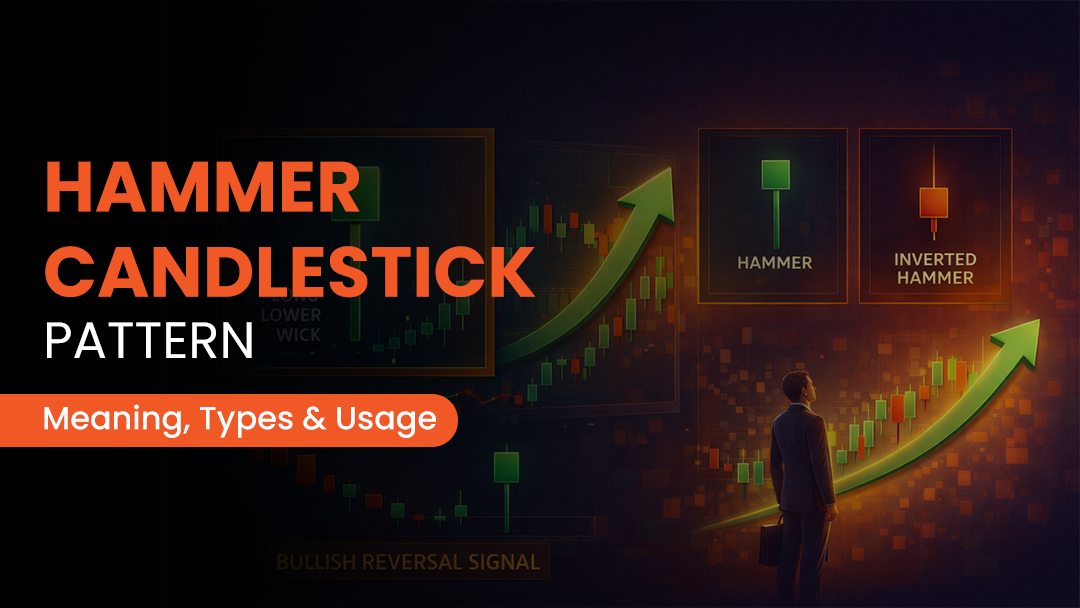
- Hammer: A candle with a small real body and a long lower shadow, indicating that prices moved lower during the period but later recovered.
- Bullish Engulfing: A larger green candle covers the previous red candle, reflecting a shift in intraday sentiment toward buying pressure.
- Morning Star: A three-candle formation that appears after a decline, showing a transition from selling pressure to signs of renewed demand.
Bearish Patterns
Bearish patterns signal that upward momentum may be weakening and that sellers are beginning to exert more influence on the intraday chart.
- Hanging Man: Visually similar to a hammer but appears after an upward movement, indicating intraday selling interest at higher levels.
- Bearish Engulfing: A red candle that completely covers the previous green candle; this reflects increased selling activity within the session.
- Evening Star: A three-candle pattern that appears after an upmove and reflects a shift from buying strength to emerging selling pressure.
Continuation Patterns
This pattern shows that the prevailing intraday trend may remain the same, subject to confirmation from subsequent candles.
- Doji: A candle with minimal body, this represents indecision. When aligned with the broader context, it may support continuation once the next candle confirms direction.
- Three White Soldiers: Three consecutive green candles with progressively higher closes, representing sustained intraday buying interest.
- Three Black Crows: Three successive red candles that close lower each time, reflecting consistent intraday selling momentum.
Additional Read: How to Start Online Trading?

Key Components of a Candlestick Chart
An intraday candlestick chart represents intraday price movement through a set of clearly defined elements. Each candle provides information about how prices behaved within a specific interval. The main components are as follows:
1. The Real Body
The real body reflects the difference between the opening and closing prices for the chosen time period.
- A green body indicates a close above the open.
- A red body indicates a close below the open.
The size of the body shows the extent of buying or selling within that interval.
2. The Wick or Shadow
The wicks extend above and below the real body and mark the highest and lowest prices reached during the session.
- The upper wick represents the intraday high.
- The lower wick represents the intraday low.
These ranges offer insight into price fluctuations beyond the open and close.
3. Candle Extremes
The top and bottom of the candle highlight the key price points for the interval.
- In a green candle, the bottom of the body marks the open and the top marks the close.
- In a red candle, the top of the body marks the open and the bottom marks the close.
These levels help outline the path price has taken within the period.
4. The Trend
A sequence of candles forms visible trends on an intraday chart. Several consecutive green candles may indicate sustained buying interest, while repeated red candles may reflect ongoing selling pressure. Trend direction offers essential context when assessing intraday movement.
5. Pattern Formation
Patterns emerge in the chart when multiple candles appear in a specific pattern. Their collective structure helps identify reversal or continuation tendencies on an intraday trading chart. Multi-candle formations often provide broader insight than individual candles viewed in isolation.
You May Also Like: Best Intraday Indicators to Improve Your Trading Strategy
Steps to Apply Candlestick Patterns in Intraday Trading
Applying intraday candlestick patterns in trading involves a structured analysis of market conditions rather than just relying on any single formation. The following steps show how these patterns are typically assessed within short-term price analysis
1. Identify the Market Environment
Determine whether the price is moving upward, downward, or within a narrow range. Candlestick patterns are more helpful when they are used in the context of an existing trend.
2. Observe Relevant Patterns
A sequence of candles is analysed to identify whether any recognised pattern is developing. The surrounding price action helps determine whether the formation aligns with prevailing market conditions.
3. Refer to Technical Reference Points
Use tools such as support and resistance levels, moving averages, or volume indicators to better understand market conditions. These references help validate whether the observed pattern aligns with broader market behaviour.
4. Define Entry and Exit Zones
Identify the areas on the chart where participation may occur and where positions can be closed. These zones are usually determined by technical levels instead of isolated candles.
5. Apply Stop-Loss Measures
Stop-loss levels are essential for effectively managing potential losses. They establish specific points at which a position is deemed no longer valid from a technical standpoint.
6. Maintain Risk Parameters
It is advisable to limit exposure to a small percentage of available capital. Implementing a consistent risk management framework is essential for mitigating the potential for disproportionate losses during periods of intraday volatility.
Also Read: Understanding Trading, Profit and Loss Account
Conclusion
Intraday candlestick chart patterns offer a structured way to observe short-term market movement and identify how buying and selling activity develops within the trading day. These formations help present price behaviour in a clear visual format and support a more organised approach to analysing intraday trends. When assessed with confirmation and broader market context, they contribute meaningfully to technical interpretation. Findoc explains these concepts concisely and systematically, enabling readers to understand how intraday patterns fit into overall market analysis.
Frequently Asked Questions
The colour of the next candlestick cannot be predicted with certainty. Market participants analyse price structure, support and resistance levels, volume behaviour, and overall trend context to assess potential direction, but outcomes remain probabilistic rather than guaranteed.
The 3-candle rule involves observing three consecutive candles moving in the same direction before evaluating short-term momentum. This approach helps reduce reliance on isolated candles that may not accurately reflect broader price behaviour.
Patterns such as Hammer, Engulfing formations, Doji variations, and Morning Star structures are frequently used in intraday analysis. Their effectiveness depends on confirmation, volume support, and alignment with the prevailing market trend.
The 3-5-7 rule refers to analysing price behaviour over groups of three, five, or seven candles. These groupings help identify short-term momentum shifts and provide a structured way to observe whether strength or weakness is developing in the market.
The 1% rule is a risk management guideline that limits exposure on a single position to no more than 1% of total trading capital. Its objective is to control downside risk and support long-term consistency.
Intraday trading carries higher risk due to rapid price movements within short timeframes. Beginners may find these fluctuations challenging without sufficient preparation. A disciplined approach, risk control, and structured analysis are essential in such environments.
Candlestick patterns tend to be more reliable in stocks with higher liquidity and trading volume. In low-volume stocks, price movements can be erratic, making pattern-based analysis less consistent.