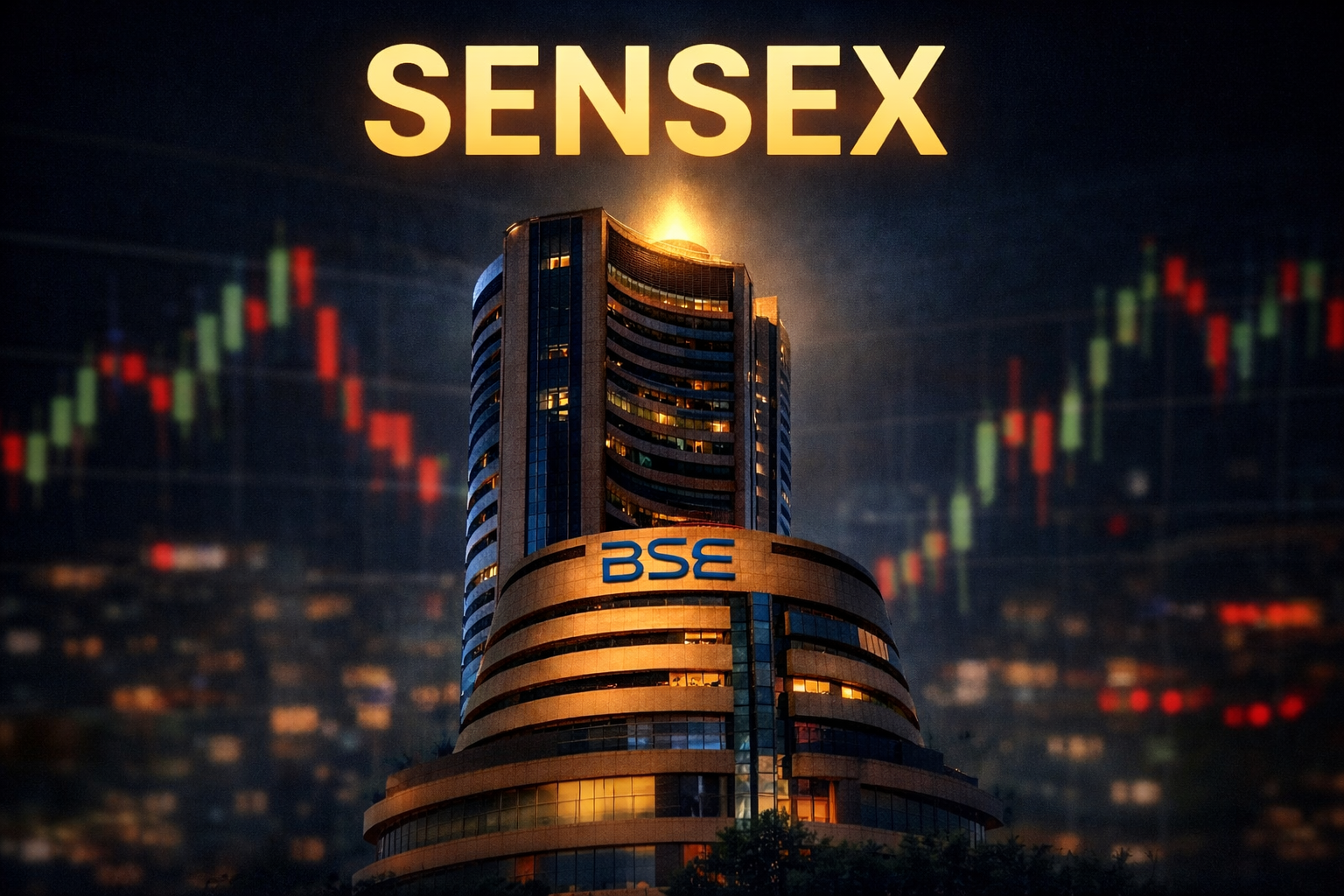
SENSEX is one of the most widely followed indicators of the Indian stock market and reflects the overall performance of the country’s equity space. It is a benchmark index that tracks 30 large, financially strong companies listed on the Bombay Stock Exchange (BSE), representing key sectors of the Indian economy. When investors look for the meaning of SENSEX, they are essentially seeking insight into broader market direction and investor sentiment. The term SENSEX stands for Sensitive Index, highlighting how closely it responds to movements in share prices, economic developments, corporate results, and global events.
Due to its sensitivity and wide representation, SENSEX is often used as a reliable gauge of market trends and economic confidence in India.
History and Evolution of the SENSEX Index
The history of SENSEX dates back to 1986, when it was introduced by the Bombay Stock Exchange. At the time, it was India’s first stock market index designed to provide a clear snapshot of market performance.
In its early years, SENSEX used a simple market capitalisation method. As the market evolved, the index methodology was refined to better reflect real market conditions. A major milestone in the SENSEX evolution came in 2003, when the calculation method shifted to free-float market capitalisation.
How SENSEX Is Linked to the Bombay Stock Exchange (BSE)?
SENSEX is closely connected to the Bombay Stock Exchange and functions as its flagship index. Often referred to as BSE SENSEX, it represents the performance of select companies listed and traded on the exchange. This relationship explains how SENSEX reflects trends within the broader SENSEX share market:
- Exclusive BSE listing: Only companies listed on the Bombay Stock Exchange are eligible for inclusion in SENSEX, reinforcing its direct association with the exchange.
- Index governance by BSE: The BSE oversees the composition, calculation methodology, and periodic review of the index to ensure accuracy and relevance.
- Market performance indicator: Movements in SENSEX capture price changes in 30 large and influential companies, offering a snapshot of overall market sentiment.
- Reflection of broader trends: As these companies span key sectors, their performance often mirrors wider developments across the Indian equity market.
Through this structure, SENSEX serves as a reliable reference point for understanding market direction and investor confidence.
Composition of SENSEX: The 30 Companies That Form the Index
SENSEX is made up of 30 companies that rank among the top Indian companies in terms of size, liquidity, and market influence. These SENSEX companies are drawn from a wide range of sectors, including banking, information technology, energy, consumer goods, pharmaceuticals, and manufacturing. Their collective performance provides a balanced view of the Indian equity market.
Key characteristics of SENSEX companies include:
- Strong market capitalisation
- High trading liquidity
- Established operating and financial history
- Significant representation of core economic sectors
The composition of SENSEX is reviewed periodically and may change to remain relevant. The criteria for SENSEX selection are applied to ensure fairness, transparency, and accuracy, including:
- Mandatory listing on the Bombay Stock Exchange
- Consistent trading volumes and liquidity
- Large free-float market capitalisation
- Sectoral balance within the index
- A proven compliance and governance record
These selection criteria help preserve SENSEX as a reliable and credible market benchmark.
How SENSEX Is Calculated and Why the Methodology Matters?
To calculate the SENSEX, the Bombay Stock Exchange uses the free-float market capitalisation method. This approach considers only those shares that are available for public trading, while excluding promoter holdings, government stakes, and other restricted shareholdings. As a result, the index reflects actual market participation rather than total company ownership.
The importance of SENSEX lies in this calculation methodology, as it ensures a more accurate representation of market movements. By focusing on free-float shares, the index avoids distortion caused by large but infrequently traded holdings.
Free-float market capitalisation refers specifically to the portion of a company’s equity that is actively traded in the open market. Its use in SENSEX calculation helps to:
- Reflect real-time market activity more effectively
- Reduce the overrepresentation of closely held companies
- Improve comparability across different sectors and firms
This methodology aligns SENSEX with global best practices followed by major international indices.
Why SENSEX Matters: Its Economic Importance and Market Impact
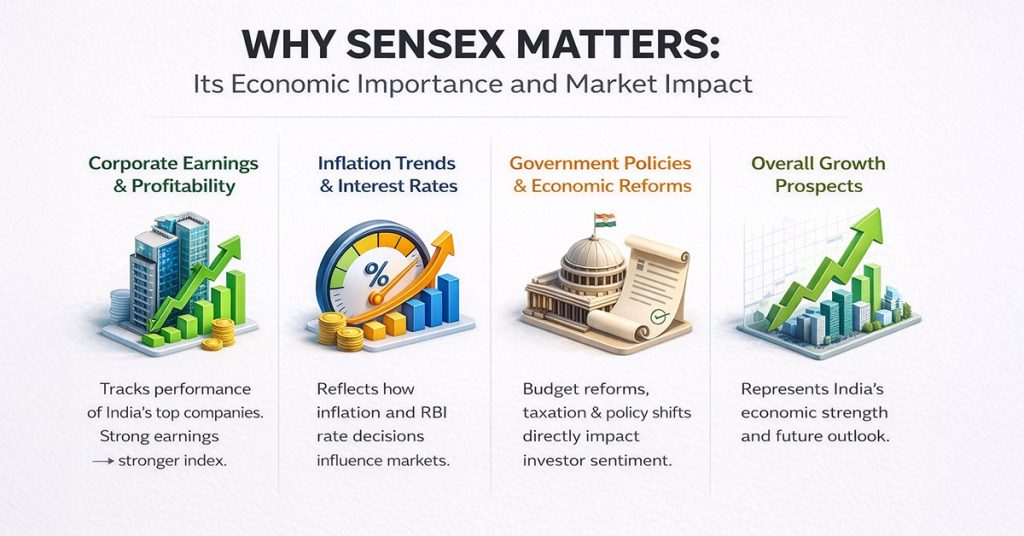
The economic impact of SENSEX goes well beyond daily stock price movements. Changes in the index influence investor confidence, market sentiment, and broader financial discussions, often shaping expectations around growth and stability. A consistently rising index is commonly associated with economic optimism, while sustained declines may reflect underlying concerns within the economy.
The importance of SENSEX also stems from its role as a widely accepted benchmark. Fund managers, analysts, and institutional investors rely on it to assess portfolio performance and compare returns across investment products.
SENSEX is frequently viewed as a barometer of the Indian economy, as it reflects investor perceptions of key factors such as:
- Corporate earnings and profitability
- Inflation trends and interest rate expectations
- Government policies and economic reforms
- Overall growth prospects
When economic conditions are favourable, improved corporate performance is often mirrored in a stronger SENSEX. Conversely, economic uncertainty typically leads to higher volatility in the index.
Ways to Invest in SENSEX: Investment Options Explained
Investors cannot directly purchase the SENSEX index, but they can invest in SENSEX through financial products designed to track its performance. These options provide exposure to the broader market without requiring the selection of individual stocks.
Common ways to invest in SENSEX include:
- SENSEX ETF: Exchange-traded funds that replicate the index and are bought and sold on stock exchanges like regular shares
- Index mutual funds: Funds structured to mirror SENSEX returns over the long term by holding the same constituent stocks
To access these investment options, investors need a trading and demat setup, and many choose to open demat account online for faster onboarding and seamless participation in the equity market. These options are often preferred for their diversification, transparency, and cost efficiency compared to actively managed funds.
Understanding SENSEX Trends and Market Movements With Findoc
Monitoring SENSEX market trends allows investors to see how various factors influence the Indian stock market. Key influences include:
- Changes in interest rates and monetary policy
- Corporate earnings reports and performance
- Government regulations and policy announcements
- Global economic developments and geopolitical events
Through SENSEX analysis with Findoc, these market movements are broken down in a structured and clear manner. This approach helps investors:
- Interpret index fluctuations without confusion
- Identify patterns and trends in the SENSEX share market
- Make better and more disciplined investment decisions
By understanding these trends, investors can align their strategies with prevailing market conditions and long-term economic outlooks.
Conclusion
SENSEX continues to be a vital indicator of the Indian stock market and investor sentiment. Since its inception in 1986, it has evolved into a benchmark that reflects the performance of major companies across key sectors of the economy. Understanding how SENSEX is constructed, how it responds to market movements, and its broader significance helps investors make better decisions.
Beyond tracking share prices, it provides insights into economic trends and market confidence, making it an essential reference for both new and experienced participants in India’s equity markets.
Frequently Asked Questions
SENSEX companies are reviewed periodically by the BSE to ensure the index reflects the market accurately. Changes are made based on liquidity, market capitalisation, sector representation, and performance of listed firms.
SENSEX tracks 30 leading companies listed on the Bombay Stock Exchange, whereas NIFTY tracks 50 major companies on the National Stock Exchange, serving as distinct benchmarks for the Indian stock market.
Investors cannot buy the SENSEX directly. However, exposure is possible through SENSEX ETFs or index mutual funds, which replicate the index’s performance and offer diversified market participation.
SENSEX movements are influenced by corporate earnings, macroeconomic data, interest rate changes, government policies, and global events, reflecting overall investor sentiment and expectations about the Indian economy.
While SENSEX comprises large-cap companies, it provides market insights relevant to all investors, helping assess trends, benchmark portfolios, and understand the broader health of the Indian equity market.
Global developments such as economic trends, geopolitical events, and international market fluctuations impact investor sentiment, often leading to volatility in SENSEX and influencing trading behaviour in the Indian share market.
Leave a Reply