findocblog

Category: IPOs

  • Amagi Media Labs IPO: Complete Guide to Price, Dates & Financials

    Amagi Media Labs IPO: Complete Guide to Price, Dates & Financials

    Amagi Media Labs IPO: Complete Guide to Price, Dates & Financials

    If you have ever streamed a free movie on your smart TV or watched a specialized sports channel on an app without a cable subscription, you have likely interacted with the technology behind Amagi Media Labs. As the global media landscape shifts aggressively from traditional cable to internet-based streaming, the “plumbing” that makes this transition possible has become big business.

    Amagi Media Labs is positioning itself at the center of this revolution. As a Software-as-a-Service (SaaS) unicorn, they provide the cloud technology that allows broadcasters and content owners to launch, distribute, and monetize channels across the globe. Now, they are bringing this growth story to the public markets.

    For retail investors, the upcoming Initial Public Offering (IPO) presents an opportunity to invest in the infrastructure of the streaming boom. However, with the company transitioning from a high-growth, high-burn phase into operational profitability, understanding the financial nuances is critical.

    In this detailed guide, we will break down the Amagi Media Labs IPO, analyzing the price band, the company’s path to profitability, and the risks and rewards you need to consider before adding this stock to your portfolio.

    IPO Snapshot: Key Dates and Numbers

    Before diving into the business model, let’s look at the essential details of the offer. Amagi Media Labs is looking to raise approximately ₹1,789 Crore through a mix of fresh equity and an Offer for Sale (OFS). Investors interested in participating can Apply now while reviewing the key dates and pricing structure outlined below.

    Here is the tentative schedule and pricing structure you need to know:

    • IPO Opening Date: Tuesday, January 13, 2026
    • IPO Closing Date: Friday, January 16, 2026
    • Price Band: ₹343 to ₹361 per share
    • Lot Size: 41 Shares
    • Total Issue Size: ₹1,789 Crore
    • Face Value: ₹5 per share
    • Tentative Listing Date: Wednesday, January 21, 2026

    Understanding the Issue Structure
    It is important for investors to distinguish where the money is going.

    • Fresh Issue (₹816 Crore): This capital goes directly into the company. Amagi plans to use ₹550 Crore of this for technology and cloud infrastructure expansion, specifically scaling their AI-led ad tech. The rest will fund inorganic growth (acquisitions) and general corporate purposes.
    • Offer for Sale (OFS): The remaining portion involves existing investors—such as Accel India, Norwest Venture Partners, and early shareholders—selling part of their stake. The company does not receive proceeds from this portion.

    What Does Amagi Media Labs Actually Do?

    Amagi is not a content creator; they are a technology enabler. They operate what is known as a “glass-to-glass” cloud platform. This means they handle the entire lifecycle of a video broadcast, from the camera lens (glass) to the viewer’s screen (glass).

    Traditionally, TV stations required massive, expensive hardware, satellites, and on-premise servers to broadcast content. Amagi replaces all of that with the cloud. They allow media companies to spin up new channels, distribute them to platforms like Roku or Apple TV, and insert targeted ads, all through a web-based dashboard.

    The Three-Sided Marketplace

    Amagi’s business model is robust because it serves three distinct groups, creating a network effect:

    1. Content Providers: Studios and networks (like Lionsgate, Fox, and NBC) use Amagi to manage and play out their video feeds.
    2. Distributors: Streaming platforms (like Roku, VIZIO, and Rakuten TV) use Amagi to receive content formatted perfectly for their apps.
    3. Advertisers: Brands use Amagi’s dynamic ad-insertion technology to place ads into these streams in real-time.

    As more content providers join, more distributors want to carry those channels. As viewership grows, advertisers are willing to pay more for ad slots. Amagi sits in the middle, monetizing every part of this flow.

    Revenue Model: How Amagi Makes Money

    For a retail investor, understanding how a SaaS company generates cash is vital, especially when evaluating long-term sustainability alongside factors like the Amagi Media Labs Share Price. Amagi has moved beyond simple subscription fees to a diversified revenue model.

    • Fixed Subscription Fees: Clients pay a monthly recurring fee to use the Amagi CLOUDPORT platform to manage and broadcast their channels. This provides steady, predictable cash flow.
    • Usage-Based Fees: Similar to a utility bill, some clients pay based on the hours of content they process or stream.
    • Revenue Share (Ad Tech): This is a high-growth area. Through its “Thunderstorm” product, Amagi inserts ads into streams. They take a cut of the ad revenue generated (based on impressions and fill rates).
    • Event-Based Pricing: For massive one-off events, like the Olympics or elections, Amagi charges specific fees for orchestration and dynamic ad management.

    Financial Health: From Burn to Profitability

    SaaS companies often run losses for years to capture market share. Amagi fits this profile but is currently at a turning point.

    Revenue Growth
    The company has demonstrated impressive top-line growth. Revenue from operations jumped from ₹680 Crore in FY23 to ₹1,162 Crore in FY25. This represents a Compound Annual Growth Rate (CAGR) of 30.7%.

    The Profitability Turnaround
    Historically, Amagi prioritized growth over profit, resulting in losses in FY23 and FY24. However, the data for FY25 and H1 FY26 shows a significant shift:

    • Gross Margins: Expanded to nearly 69.6% in H1 FY25. As they scale, their cost of delivering services (COGS) decreases relative to revenue.
    • EBITDA: The company transitioned from a negative EBITDA margin of -50% in FY23 to a positive 2.02% in FY25.
    • Net Profit: Amagi turned profitable in the first half of FY26, posting a Profit After Tax (PAT) of ₹64.70 million.

    Balance Sheet Strength
    A key indicator of safety for retail investors is debt. Amagi maintains a debt-free balance sheet. Their net worth has risen to ₹859 Crore, and the fresh issue will further fortify their cash reserves for future acquisitions or R&D.

    Industry Tailwinds: Why Now?

    The timing of this IPO aligns with a massive structural shift in the media industry.

    The Rise of FAST
    FAST stands for Free Ad-Supported Streaming TV. Consumers are experiencing “subscription fatigue” from paying for Netflix, Disney+, Hulu, and others. As a result, they are flocking to free, linear channels that look like traditional TV but are streamed over the internet.
    The FAST market is projected to double from $6.6 billion in 2024 to $13.3 billion by 2029. Amagi is a dominant player in enabling these FAST channels.

    Legacy Migration
    Believe it or not, 90% of global broadcast operations still rely on old-school, on-premise hardware. This is expensive and inflexible. Media companies are desperate to cut costs and are migrating to the cloud. Amagi’s cloud solutions can reduce Total Cost of Ownership (TCO) by 35-50%, making them an attractive partner during economic downturns.

    SWOT Analysis for Investors

    Before placing a bid, weigh the strengths against the potential risks.

    Strengths

    • Customer Stickiness: Amagi boasts a Net Revenue Retention (NRR) of 126.9%. This means that for every $100 a customer spent last year, they are spending $126.90 this year. Existing clients are growing with the platform.
    • Global Clientele: They serve 45% of the top 50 global media companies.
    • Technology Moat: With over 10 granted patents and AI capabilities for ad-yield optimization, their tech stack is difficult for competitors to replicate quickly.

    Weaknesses

    • Geographic Concentration: A massive 72.86% of their revenue comes from the Americas. While they are a global company, they are heavily dependent on the US economic climate.
    • Client Concentration: Losing a major partner like Roku or a top-tier studio could impact revenues significantly.
    • High Employee Costs: While decreasing as a percentage of sales, employee benefits still make up nearly 60% of expenses due to the high cost of tech talent.

    Opportunities

    • International Expansion: With under 2% of revenue coming from the Middle East and only 6.7% from Asia-Pacific, there is a massive runway to expand into emerging markets.
    • New Verticals: The technology used for TV can be adapted for e-sports, education, and healthcare streaming.

    Threats

    • Competition: Legacy hardware vendors are trying to build cloud solutions, and tech giants (like Amazon or Google) could theoretically build competing tools.
    • Ad Market Volatility: Since a portion of revenue is tied to ad impressions, a global recession that causes brands to cut ad spend would directly hurt Amagi’s bottom line.

    Conclusion

    Amagi Media Labs represents a classic “picks and shovels” play on the streaming industry. Rather than betting on which streaming service will win the content war, investing in Amagi is a bet on the infrastructure that powers all of them.

    The company checks several boxes for growth investors: high revenue growth, a debt-free balance sheet, expanding margins, and a clear path to profitability. The transition from loss-making to profit-generating in FY26 is a strong signal of operational maturity.

    However, the valuation and the risks associated with US market dependency should be considered. This IPO is best suited for investors with a moderate-to-high risk tolerance who believe in the long-term shift toward ad-supported streaming and cloud broadcasting.

    As always, ensure this investment aligns with your broader financial goals and portfolio diversification strategy.

    Frequently Asked Questions (FAQ)

    To participate in the IPO, you need to bid for a minimum of one lot. With a lot size of 41 shares and the upper price band at ₹361, the minimum investment would be ₹14,801.

    Yes, the company has recently turned a corner. While they posted losses in FY23 and FY24 due to heavy investment in growth, they reported a Net Profit of ₹64.70 million in the first half of FY26.

    Amagi competes with legacy broadcast hardware providers who are pivoting to the cloud, as well as niche SaaS players. However, Amagi distinguishes itself by offering an end-to-end “glass-to-glass” platform rather than just isolated solutions.

    Amagi is currently a growth-stage company. It is reinvesting its profits back into technology, infrastructure, and acquisitions to capture more market share. Therefore, it is unlikely to pay dividends in the near future.

    This is an industry term indicating that Amagi handles the video signal from the moment it is captured (the camera lens glass) to the moment it is viewed (the TV or phone screen glass), handling processing, distribution, and monetization in between.

    Disclaimer: This blog is intended solely for educational and informational purposes and should not be construed as investment advice or a recommendation. While efforts have been made to ensure the accuracy and reliability of the information and data presented, no representation or warranty, express or implied, is made regarding its completeness or correctness. Readers are advised to independently verify all information and consult a qualified financial advisor before making any investment decisions. Investments in the securities market are subject to market risks. Please read all relevant offer documents and disclosures carefully before investing.

  • Bharat Coking Coal IPO 2026: Comprehensive Review of Financials & Growth Potential

    Bharat Coking Coal IPO 2026: Comprehensive Review of Financials & Growth Potential

    India’s infrastructure ambitions are massive, and steel is the backbone of that growth. While many investors focus on steel manufacturers, smart retail investors often look upstream to the raw materials that make steel production possible. This brings us to the upcoming initial public offering (IPO) of Bharat Coking Coal Limited (BCCL). As a subsidiary of the state-owned giant Coal India Limited, BCCL holds a unique and dominant position in the energy sector.

    Scheduled to open for subscription in January 2026, this IPO represents a significant opportunity for the public to own a stake in India’s largest producer of coking coal. But is this public sector undertaking (PSU) a solid addition to your portfolio? To help you make an informed decision, we are breaking down the company’s business model, analyzing its financial health, and evaluating the long-term growth prospects.

    IPO Snapshot: Key Dates and Details

    Before analyzing the fundamentals, let’s look at the logistical details of the offer. The IPO is structured entirely as an Offer for Sale (OFS), meaning the promoter, Coal India Limited, is selling a portion of its stake to the public. BCCL itself will not receive proceeds from this issue.

    Here are the essential details you need to mark on your calendar:

    • IPO Open Date: January 9, 2026
    • IPO Close Date: January 13, 2026
    • Price Band: ₹21 to ₹23 per share
    • Lot Size: 600 Shares
    • Total Issue Size: ₹1,071 Crore
    • Tentative Listing Date: January 16, 2026
    • Listing Exchanges: BSE and NSE

    For retail investors, the entry point is accessible, with the price band set between ₹21 and ₹23, and interested investors can apply now during the offer period to participate in the listing.

    Company Overview: The Coking Coal Monopoly

    To understand the value of BCCL, you must understand the difference between thermal coal and coking coal. While thermal coal is used to generate electricity, coking coal is an irreplaceable ingredient in steel manufacturing.These fundamentals form the basis of the Bharat Coking Coal Ltd. IPO details for investors evaluating the company.

    Bharat Coking Coal Limited is the undisputed leader in this space. As of FY25, the company accounted for 58.50% of domestic coking coal production. More importantly, BCCL is the only source of prime coking coal in India. This gives the company a significant competitive moat.

    Operational Footprint

    BCCL operates primarily in the Jharia coalfield in Jharkhand and the Raniganj coalfield in West Bengal. These are historic mining zones with rich deposits. The company currently manages:

    • 34 Operational Mines: A mix of opencast, underground, and mixed projects.
    • 5 Operational Washeries: Located at Moonidih, Madhuband, Dahibari, Patherdih I, and Madhuband NLW.

    The company is also backed by a massive resource base of approximately 7.91 billion tonnes, providing high visibility for long-term production.

    Revenue Model

    BCCL generates revenue through three main channels:

    1. Raw Coal: Sales of coking coal to steel plants and non-coking coal to power plants.
    2. Washed Coal: Coal that has been processed to reduce ash content, fetching a higher price.
    3. By-products: Sales of middlings, slurry, and rejects.

    The clientele is impressive, consisting largely of Public Sector Undertakings (PSUs) and major power producers like SAIL, NTPC, and Damodar Valley Corporation.

    Industry Landscape: The Demand for Steel

    The investment case for BCCL is closely tied to India’s steel industry. The government has set an ambitious target to reach a crude steel capacity of 300 million tonnes per annum (MTPA) by FY31. Since coking coal is a non-substitutable input for steel, demand is expected to remain robust.

    Currently, India imports about 90% of its coking coal requirements, mostly from Australia and the USA. This high import dependence is a strategic vulnerability for the country. Under the “Atma-Nirbhar Bharat” (Self-Reliant India) initiative, the government is pushing hard for import substitution.

    This is where BCCL plays a critical role. By expanding its production and washing capabilities, BCCL aims to replace expensive imported coal with domestic supply. This macro-economic tailwind provides a long runway for growth.

    Financial Analysis: A Deep Dive

    For a retail investor, the numbers tell the real story. Let’s analyze BCCL’s financial performance over the last few years to gauge its stability and profitability.

    Revenue Trends

    BCCL has shown consistent sales performance.

    • FY23 Sales: ₹132,809 Million
    • FY24 Sales: ₹140,453 Million
    • FY25 Sales: ₹139,984 Million

    While sales were relatively flat in FY25, projections for the future are optimistic. Revenue is forecast to grow to ₹153,798 Million in FY26 and ₹172,995 Million in FY27. This growth is expected to be driven by increased production volumes and better realization per tonne.

    Profitability and Margins

    The company has seen a significant improvement in its operating margins.

    • EBITDA Margin: Jumped from 4% in FY23 to 15% in FY24, stabilising at 13% in FY25.
    • Net Profit: Rose from ₹6,647 Million in FY23 to ₹12,401 Million in FY25.

    It is worth noting that FY25 saw a dip in profit compared to FY24 (which was ₹15,644 Million). This was largely due to external headwinds, including excessive rainfall that hampered production and offtake. However, cost efficiency measures helped mitigate the impact.

    Balance Sheet Strength

    One of the most attractive features of BCCL for a risk-averse retail investor is its debt-free balance sheet. The company has no long-term borrowings and has successfully eliminated accumulated losses as of FY24. This financial resilience allows the company to invest in modernization without the burden of high interest payments.

    Key Ratios

    • Return on Net Worth (RoNW): Stood at 20.83% in FY25, indicating efficient use of shareholder equity.
    • Return on Capital Employed (ROCE): A healthy 30.13% in FY25, showing strong returns on the capital invested in the business.
    • Earnings Per Share (EPS): ₹2.7 in FY25, projected to rise to ₹3.3 in FY26 and ₹3.7 in FY27.

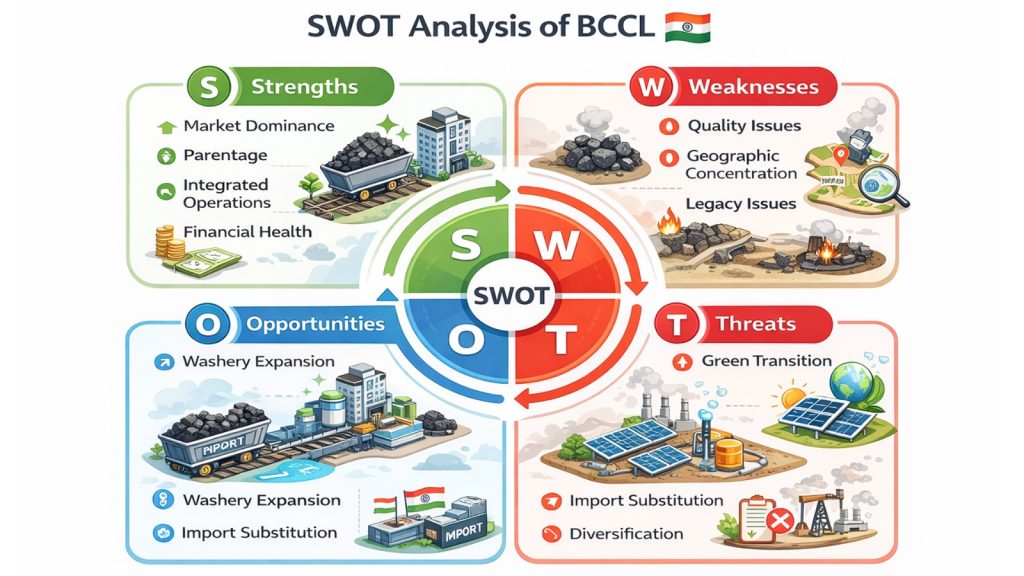
    SWOT Analysis

    Bharat Coking Coal IPO 2026

    Every investment carries risks and rewards. Here is a breakdown of BCCL’s position:

    Strengths

    • Market Dominance: Largest producer of coking coal in India.
    • Parentage: Backed by Coal India Limited, ensuring financial and technical support.
    • Integrated Operations: Strong rail and road connectivity in mining zones.
    • Financial Health: Zero long-term debt and strong cash flow generation potential.

    Weaknesses

    • Quality Issues: Domestic coal has high ash content, requiring washing/beneficiation before it can be used in steel production.
    • Geographic Concentration: Operations are concentrated in Jharia and Raniganj, making the company vulnerable to regional disruptions.
    • Legacy Issues: The Jharia coalfield faces environmental challenges, including underground mine fires and land subsidence.

    Opportunities

    • Washery Expansion: BCCL is adding 7.00 MTPA of new washery capacity. This will improve the quality of coal, making it more competitive against imports.
    • Import Substitution: As steel demand rises, domestic steelmakers are eager to source local coal to reduce costs.
    • Diversification: The company is expanding into Coal Bed Methane (CBM) and solar power, opening new revenue streams.

    Threats

    • Green Transition: The long-term global shift toward renewable energy and India’s net-zero 2070 target poses a structural risk to the coal industry.
    • Regulatory Changes: Stricter environmental norms could increase compliance costs.
    Bharat Coking Coal IPO 2026

    Every investment carries risks and rewards. Here is a breakdown of BCCL’s position:

    Strengths

    • Market Dominance: Largest producer of coking coal in India.
    • Parentage: Backed by Coal India Limited, ensuring financial and technical support.
    • Integrated Operations: Strong rail and road connectivity in mining zones.
    • Financial Health: Zero long-term debt and strong cash flow generation potential.

    Weaknesses

    • Quality Issues: Domestic coal has high ash content, requiring washing/beneficiation before it can be used in steel production.
    • Geographic Concentration: Operations are concentrated in Jharia and Raniganj, making the company vulnerable to regional disruptions.
    • Legacy Issues: The Jharia coalfield faces environmental challenges, including underground mine fires and land subsidence.

    Opportunities

    • Washery Expansion: BCCL is adding 7.00 MTPA of new washery capacity. This will improve the quality of coal, making it more competitive against imports.
    • Import Substitution: As steel demand rises, domestic steelmakers are eager to source local coal to reduce costs.
    • Diversification: The company is expanding into Coal Bed Methane (CBM) and solar power, opening new revenue streams.

    Threats

    • Green Transition: The long-term global shift toward renewable energy and India’s net-zero 2070 target poses a structural risk to the coal industry.
    • Regulatory Changes: Stricter environmental norms could increase compliance costs.

    Yes, BCCL is a wholly-owned subsidiary of Coal India Limited, which is a Maharatna PSU under the Ministry of Coal, Government of India.

    Thermal coal is burned to create steam for electricity generation. Coking coal (metallurgical coal) is baked in a furnace to create coke, which is used to smelt iron ore into steel. BCCL specializes in coking coal.

    This IPO is an Offer for Sale (OFS). This means existing shares held by the promoter (Coal India) are being sold to the public. The money goes to the promoter, not the company’s treasury.

    The minimum investment for a retail investor is one lot. With a lot size of 600 shares and a price band of ₹21-₹23, the minimum investment would be between ₹12,600 and ₹13,800.

    No, as of the latest financial reports, BCCL has a debt-free balance sheet with no long-term borrowings.

    Disclaimer: This blog is intended solely for educational and informational purposes and should not be construed as investment advice or a recommendation. While efforts have been made to ensure the accuracy and reliability of the information and data presented, no representation or warranty, express or implied, is made regarding its completeness or correctness. Readers are advised to independently verify all information and consult a qualified financial advisor before making any investment decisions. Investments in the securities market are subject to market risks. Please read all relevant offer documents and disclosures carefully before investing.

  • Gujarat Kidney & Super Speciality IPO: Complete Review & Details

    Gujarat Kidney & Super Speciality IPO: Complete Review & Details

    The Indian healthcare sector has witnessed significant attention from investors in recent years, driven by rising health awareness, increasing insurance penetration, and government initiatives. Amidst this sectoral growth, regional healthcare providers are carving out niches in specific geographies and specialties.

    One such entity, Gujarat Kidney and Super Speciality Limited (GKSL), is set to launch its Initial Public Offering (IPO). Operating primarily in the state of Gujarat, the company focuses on secondary and tertiary care with a specific leadership position in renal sciences.

    This blog post provides a comprehensive review of the Gujarat Kidney and Super Speciality Limited IPO. We will examine the company’s business model, financial performance, industry landscape, and the specific details of the offer. Whether you are a seasoned investor or exploring the market for the first time, this guide aims to provide the neutral, factual information you need to understand this upcoming opportunity.

    About Gujarat Kidney and Super Speciality Limited

    Gujarat Kidney and Super Speciality Limited is a regional healthcare services provider based in Gujarat, India. The company operates a network of mid-sized multi-speciality hospitals. While they offer a broad range of medical services, they have established a distinct reputation in renal sciences (kidney care), including urology and nephrology.

    Core Business Model

    The company operates on an “asset-light” model. Instead of investing heavily in owning real estate for every facility, they often utilize leased premises or management contracts. This strategy allows the company to focus its capital on medical equipment, technology, and clinical teams rather than land and buildings. This approach is generally designed to improve the Return on Capital Employed (ROCE) and allow for faster expansion compared to traditional heavy-asset models.

    Medical Specializations

    GKSL categorizes its services into two main verticals:

    1. Secondary Care: General surgical services and routine medical treatments.
    2. Tertiary Care: High-end super-specialty treatments.

    Their leadership in renal sciences is significant, covering six urology sub-specialties. Beyond kidney care, the hospital chain has expanded its capabilities into cardiology, orthopedics, and advanced laparoscopic procedures.

    Operational Presence

    The company’s operations are concentrated in the central region of Gujarat. They currently operate seven multi-speciality hospitals and four in-house pharmacies. Their facilities are strategically located in:

    • Vadodara
    • Godhra
    • Bharuch
    • Borsad
    • Anand

    As per the Red Herring Prospectus (RHP), the total bed capacity across their network stands at 490 beds. This network allows them to serve a mix of urban and semi-urban populations, capturing patient flow from Tier-2 and Tier-3 cities where competition from large national chains is often lower.

    Revenue Mix

    Understanding who pays for the services is crucial for analyzing a hospital’s cash flow. GKSL has a payer mix dominated by self-paying patients:

    • Self-Payers: ~69%
    • Insurance/TPAs: ~21%
    • Government Schemes (e.g., PMJAY): ~10%

    A high percentage of self-payers often indicates strong brand trust in the local community, as patients are willing to pay out-of-pocket for services.

    Gujarat Kidney and Super Speciality Limited IPO Details

    The IPO is a Book Built Issue, meaning the price is discovered within a range rather than being fixed in advance. The issue comprises entirely of a fresh issue of shares, meaning the money raised will go into the company for growth and debt reduction, rather than to existing shareholders selling their stake.

    Here are the key schedules and figures you need to know:

    Feature Details
    IPO Open Date Monday, December 22, 2025
    IPO Close Date Wednesday, December 24, 2025
    Price Band ₹108 to ₹114 per share
    Lot Size 128 Shares
    Total Issue Size ₹250.8 Crores (approx)
    Fresh Issue ₹250.8 Crores (2.20 Crore shares)
    Offer For Sale (OFS) Nil
    Face Value ₹2 per share
    Listing Exchanges BSE, NSE
    Basis of Allotment Friday, December 26, 2025 (Tentative)
    Initiation of Refunds Monday, December 29, 2025 (Tentative)
    Credit to Demat Monday, December 29, 2025 (Tentative)
    Listing Date Tuesday, December 30, 2025 (Tentative)

    Investor Categories

    The allocation of shares is divided among different investor categories:

    • Qualified Institutional Buyers (QIB): Not more than 75% of the net offer.
    • Non-Institutional Investors (NII): Not less than 15% of the net offer.
    • Retail Individual Investors (RII): Not less than 10% of the net offer.

    This structure suggests that institutional participation is expected to be the primary driver of the book building process.

    Objectives of the Issue

    The company proposes to utilize the Net Proceeds from the Fresh Issue for the following specific goals:

    1. Inorganic Growth (Acquisitions): A significant portion (approx ₹77 Crores) is allocated for the proposed acquisition of Parekhs Hospital Private Limited in Ahmedabad. This marks their entry into a major metropolitan market.
    2. Debt Management: Repayment or prepayment of certain outstanding secured borrowings.
    3. Expansion of Stake: Increasing shareholding in their subsidiary, Harmony Medicare Private Limited, Bharuch.
    4. New Facilities: Capital expenditure for setting up a new women-focused hospital in Vadodara.
    5. Technology Upgrade: Purchase of the MAKO SmartRobotics™ System for their Vadodara facility, enhancing their orthopedic capabilities.
    6. General Corporate Purposes: To cover general operating expenses and other corporate needs.

    Industry Overview

    To understand the potential of GKSL, it is helpful to look at the broader landscape of the Indian healthcare industry.

    Market Size and Growth

    According to IBEF, India’s hospital market was valued at approximately US$ 98.98 billion in 2023. It is projected to grow at a Compound Annual Growth Rate (CAGR) of 8.0% from 2024 to 2032, potentially reaching an estimated value of US$ 193.59 billion.

    Key Drivers

    Several factors are fueling this growth:

    • Demographics: An aging population and a rise in lifestyle-related non-communicable diseases (NCDs) are increasing the demand for tertiary care.
    • Bed Density: India currently has a shortage of hospital beds relative to its population. The country aims to achieve a target of 3 beds per 1,000 people, necessitating the addition of millions of new beds by 2025.
    • Policy Support: Government initiatives like Ayushman Bharat (PM-JAY) have expanded healthcare access to millions, although GKSL currently derives only about 10% of its revenue from such schemes.
    • Medical Tourism: India is becoming a hub for affordable, high-quality medical procedures, attracting international patients.

    Regional Opportunity

    Gujarat specifically faces a shortfall in hospital beds compared to global norms. This gap presents an expansion opportunity for regional players like GKSL to penetrate Tier-2 and Tier-3 cities where large national corporate hospitals may not yet have a deep presence.

    Financial Performance

    Investors should carefully review the company’s financial history. GKSL has shown a sharp increase in revenue and profitability in the most recent fiscal year, largely driven by its acquisition strategy.

    Note: The figures below represent restated consolidated financial information.

    Parameter FY 2023 FY 2024 FY 2025
    Revenue from Operations Nil ₹4.77 Cr ₹40.24 Cr
    Profit After Tax (PAT) (Loss ₹0.006 Cr) ₹1.71 Cr ₹9.49 Cr
    EBITDA Margin 40.86% 41.12%
    Return on Net Worth (RoNW) 1.67% 15.86% 36.61%

    Analysis: The massive jump in FY25 revenue (from ₹4.77 Cr to ₹40.24 Cr) is attributed to the integration of acquired hospitals and the full-year operations of new units. The company maintains healthy EBITDA margins above 40%, which is competitive for the hospital sector.

    To view the current market performance of the company after it lists, you can check the Guj. Kidney & Super Share Price page.

    Strengths of the Company

    1. Leadership in Renal Sciences: The company has a specialized niche in nephrology and urology, which serves as a differentiator in the crowded multi-specialty market.
    2. Asset-Light Model: By leasing properties rather than buying land, the company can expand faster and maintain a better Return on Capital Employed (ROCE).
    3. Strategic Locations: Their presence in high-growth districts of Gujarat (like Bharuch and Anand) positions them to capture patient volume that might otherwise travel to Ahmedabad or Mumbai.
    4. Acquisition Track Record: The company has successfully acquired and integrated units like Ashwini Medical Centre and Harmony Medicare, demonstrating an ability to grow inorganically.
    5. High Retention: The RHP indicates low attrition rates among doctors and nurses, which is critical for maintaining service quality in healthcare.

    Risks and Considerations

    Every investment carries risk. Here are some specific concerns related to GKSL:

    1. Geographical Concentration: The company is entirely dependent on the Gujarat market. Any adverse regulatory changes or economic downturns specific to the state could impact operations.
    2. Integration Risk: A significant portion of the IPO proceeds is for acquiring Parekhs Hospital. Mergers and acquisitions carry the risk of integration challenges, culture clashes, or lower-than-expected synergies.
    3. Regulatory Hurdles: The healthcare sector is subject to strict regulations regarding pricing (e.g., caps on stent prices), biomedical waste, and licenses. Non-compliance can lead to severe penalties.
    4. Competition: The company faces competition from large listed peers like Yatharth Hospital and GPT Healthcare, as well as unorganized local nursing homes.
    5. Dependence on Key Personnel: As a specialized service provider, the business relies heavily on the reputation and availability of its specialist doctors.

    For New Investors:

    If you do not have a Demat account yet, you will need to create one to participate in the stock market. You can Open Demat Account easily with Findoc to get started.

    Once your account is active, you can Apply Now for this and other upcoming IPOs.

    Conclusion

    The Gujarat Kidney and Super Speciality Limited IPO offers investors an opportunity to invest in a growing regional healthcare chain with a specific focus on renal sciences. The company’s asset-light model and acquisition-led growth strategy have resulted in a significant jump in financial performance in FY25.

    However, potential investors must weigh these strengths against the risks of geographical concentration and the challenges inherent in integrating new acquisitions. The healthcare sector is capital-intensive and highly regulated, requiring consistent operational efficiency to maintain margins.

    As always, investors should review the Red Herring Prospectus (RHP) carefully and consider their own financial goals and risk tolerance before participating in the issue.

    Frequently Asked Questions

    The minimum investment is for 1 lot, which contains 128 shares. At the upper price band of ₹114, the minimum investment amount is ₹14,592.

    Based on the issue size of over ₹250 crore and the allocation structure across QIB, NII, and Retail categories, this is a Mainboard IPO. The shares will be listed on both BSE and NSE.

    The tentative date for the finalization of the basis of allotment is Friday, December 26, 2025.

    The face value of each equity share is ₹2.

    MUFG Intime India Limited is the registrar for the IPO. Investors can check their allotment status on the registrar’s official website.

    Disclaimer: This blog is intended solely for educational and informational purposes and should not be construed as investment advice or a recommendation. While efforts have been made to ensure the accuracy and reliability of the information and data presented, no representation or warranty, express or implied, is made regarding its completeness or correctness. Readers are advised to independently verify all information and consult a qualified financial advisor before making any investment decisions. Investments in the securities market are subject to market risks. Please read all relevant offer documents and disclosures carefully before investing.

  • KSH International IPO Explained: Company Fundamentals, Financials & What to Track Ahead

    KSH International IPO Explained: Company Fundamentals, Financials & What to Track Ahead

    The primary market is buzzing with activity, and another interesting public offer is on the horizon. KSH International Ltd., a prominent name in the magnet winding wire industry, is set to launch its Initial Public Offering (IPO). This blog post breaks down everything you need to know about the KSH International IPO, from key dates and financials to the company’s core business and what to look for as the issue progresses.

    This detailed review will help you understand the company’s fundamentals before you consider participating in the IPO. Investors planning to participate may Apply now during the issue window after reviewing the relevant details.

    KSH International IPO: Key Details at a Glance

    The most crucial information for any IPO investor is the timeline and issue details. KSH International’s IPO is a main-board issue combining a fresh issue of shares and an offer for sale (OFS) by existing shareholders. To place an IPO application, investors must Open a Demat Account prior to submitting their bid.

    Here are the essential details presented in a simple table:

    IPO Details Information
    IPO Open Date Tuesday, 16 December 2025
    IPO Close Date Thursday, 18 December 2025
    Price Band ₹365 to ₹384 per equity share
    Lot Size 39 equity shares
    Minimum Investment (Retail) ₹14,976 (at upper price band)
    Total Issue Size ₹710.00 crore
    Fresh Issue ₹420.00 crore
    Offer for Sale (OFS) ₹290.00 crore
    Listing Platform BSE and NSE
    Tentative Allotment Date Friday, 19 December 2025

    The company plans to use the net proceeds from the fresh issue to repay certain borrowings, purchase and set up new machinery, install a rooftop solar power plant, and for general corporate purposes.

    Understanding the Business: Who is KSH International?

    Founded in 1979, KSH International Limited has established itself as the third-largest manufacturer and the largest exporter of magnet winding wires in India. Operating under the brand ‘KSH’, the company supplies critical components to original equipment manufacturers (OEMs) across various high-growth sectors, and post listing, investors can monitor market movements through the KSH International Share Price on the stock exchanges.

    Key Business Areas:

    • Power & Renewables: Supplying wires for transformers and other power grid equipment.
    • Railways & Automotive: Providing components for motors and electrical systems in transportation.
    • Industrials & Appliances: Catering to a wide range of industrial machinery and consumer appliances.

    Competitive Strengths:

    • Leading Market Position: A strong foothold in the domestic market and a leader in exports to over 24 countries, including the USA, Germany, and Japan.
    • Diversified Product Portfolio: The company offers a comprehensive suite of products like enamelled copper/aluminium wires, paper-insulated conductors, and continuously transposed conductors.
    • Strategic Manufacturing: Three manufacturing facilities in Maharashtra with an upcoming fourth plant set to boost capacity.
    • Strong Customer Relationships: KSH International is an approved supplier for major public and private entities like PGCIL, NTPC, and BHEL.
    • Certifications and Quality: The company holds key industry certifications (ISO 9001, IATF 16949, etc.), which act as high entry barriers for new competitors.

    A Look at KSH International’s Financial Performance

    A company’s financial health is a critical factor for evaluation. KSH International has demonstrated steady growth in its revenue and profitability over the past few years. Let’s look at the numbers.

    (Data is for Restated Consolidated Financials, Amounts in ₹ Crore)

    Period Ended FY2025 FY2024 FY2023
    Total Income 1,938.19 1,390.50 1,056.60
    Profit After Tax (PAT) 67.99 37.35 26.61
    Total Assets 744.91 482.71 359.18
    Total Borrowings 360.05 206.81 120.35

    The data shows a 39% increase in revenue and an 82% rise in Profit After Tax between FY2024 and FY2025, highlighting strong operational performance.

    Key Performance Indicators (KPIs) as of March 31, 2025:

    Metric Value
    Return on Equity (RoE) 22.77%
    Price-to-Earnings (P/E) Ratio (Post-IPO) 28.68 (upper price band)
    Debt-to-Equity Ratio 1.17
    PAT Margin 3.51%

    These indicators suggest a healthy return on equity and a valuation that appears to be in line with its growth. However, the debt-to-equity ratio is something to keep an eye on, though the IPO proceeds are intended to reduce borrowings.

    What to Track Ahead: GMP, Subscription, and More

    Once an IPO is launched, several factors can influence its performance. Here’s what you should monitor:

    • KSH International IPO GMP (Grey Market Premium): The GMP is an unofficial indicator of the premium the shares might command upon listing. While not always accurate, the ksh international ipo gmp today provides a speculative sentiment.
    • Subscription Status: Tracking the demand from Qualified Institutional Buyers (QIBs), Non-Institutional Investors (NIIs), and Retail Individual Investors (RIIs) can offer insights into market interest. High subscription levels often signal strong demand.
    • Market Sentiment: Broader market conditions play a significant role in the success of an IPO. Positive market trends can support a strong listing, while volatility can have the opposite effect.
    • Analyst Reviews: Keep an eye on the Ksh international ipo review from various brokerage houses and financial experts.

    You can check the KSH International share price post-listing on the NSE and BSE websites. The company’s official KSH International DRHP (Draft Red Herring Prospectus) is also a valuable resource for in-depth information.

    Conclusion

    The KSH International IPO offers investors a chance to be part of a leading company in the magnet winding wire manufacturing sector. With strong fundamentals, a growing export market, and a solid financial track record, ksh international presents an interesting opportunity. However, it is essential to review all available information and assess the risks before making any decisions.

    Frequently Asked Questions 

    The KSH International IPO is a main-board public offering of 1,84,89,583 equity shares aiming to raise ₹710.00 crore. The issue includes a fresh issue and an offer for sale, with a price band of ₹365 to ₹384 per share.

    The IPO opens for subscription on December 16, 2025, and closes on December 18, 2025.

    Investors can apply through their brokerage accounts using UPI or ASBA via their bank’s net banking portal. Applicants should follow instructions provided by their broker.

    The lot size is 39 shares. A retail investor must apply for a minimum of one lot, amounting to ₹14,976 at the upper price band of ₹384.

    The tentative listing date on the BSE and NSE is Tuesday, December 23, 2025.

    Detailed information is available in the RHP and DRHP on SEBI and stock exchange websites. Career-related details can be found by searching for KSH International Pvt Ltd careers.

    Disclaimer: This blog is intended solely for educational and informational purposes and should not be construed as investment advice or a recommendation. While efforts have been made to ensure the accuracy and reliability of the information and data presented, no representation or warranty, express or implied, is made regarding its completeness or correctness. Readers are advised to independently verify all information and consult a qualified financial advisor before making any investment decisions. Investments in the securities market are subject to market risks. Please read all relevant offer documents and disclosures carefully before investing.

  • ICICI Prudential AMC IPO: A Detailed Look at the Company and its Offer

    ICICI Prudential AMC IPO: A Detailed Look at the Company and its Offer

    The Indian primary market is set to witness a significant event with the upcoming Initial Public Offering (IPO) of ICICI Prudential Asset Management Company Limited. As one of India’s largest asset managers, the company’s public listing is drawing considerable attention from market participants. This blog provides a detailed, factual overview of the ICICI Prudential AMC IPO, covering its business model, financial performance, industry landscape, and the specifics of the offer. If you haven’t yet, you can Open Demat Account easily to participate in this or any upcoming IPOs.

    Company Overview: A Leader in India’s Asset Management Space

    ICICI Prudential Asset Management Company Limited (IPAMC) stands as a prominent player in the Indian financial services sector. Jointly promoted by ICICI Bank Limited, one of India’s largest private sector banks, and Prudential Corporation Holdings Limited (PCHL), a major international financial services group, the company benefits from strong parentage and brand equity.

    As the investment manager for the ICICI Prudential Mutual Fund, IPAMC has established itself as one of the country’s leading asset management companies. It boasts a vast customer base, serving 15.5 million customers as of September 2025. The company’s leadership is evident in its market share; it is the largest AMC in India by active mutual fund quarterly average assets under management (QAAUM), holding a 13.3% market share as of September 30, 2025.

    With a wide-reaching presence, IPAMC operates a pan-India network of 272 offices. This physical footprint is significantly enhanced by the extensive distribution support from its promoter, ICICI Bank, which has 7,246 branches across the country. The company is also expanding its international presence, with operations in IFSC GIFT City and the Dubai International Financial Centre (DIFC) to cater to Non-Resident Indians (NRIs) and Middle East investors.

    The Business Model: How ICICI Prudential AMC Generates Revenue

    IPAMC’s business is structured around a fee-based revenue model, directly linked to the assets it manages. The company’s operations are segmented into four main verticals, each catering to a different investor segment and contributing to its diversified income streams.

    1. Mutual Funds

    This is the cornerstone of IPAMC’s business. The company offers an extensive range of 143 mutual fund schemes, the largest in the industry, covering various asset classes like equity, debt, and hybrid funds. The primary revenue from this vertical comes from management fees, which are charged as a percentage of the net assets under management.

    • Equity-Oriented Schemes: These funds typically carry higher management fees compared to debt or liquid funds. A significant portion of the company’s Assets Under Management (AUM) is in equity, with equity AUM constituting 55.8% of the total mutual fund QAAUM as of September 2025. This focus supports higher profitability. The popularity of the ICICI Prudential Mutual Fund brand is a key driver for this segment.
    • Systematic Investment Plans (SIPs): The company sees strong and stable inflows through SIPs and Systematic Transfer Plans (STPs), which amounted to ₹48 billion in September 2025. This provides a steady and predictable source of AUM growth.

    2. Portfolio Management Services (PMS)

    Catering primarily to High-Net-Worth Individuals (HNIs), the PMS vertical offers customized investment portfolios. The revenue model for PMS includes:

    • Management Fees: A percentage of the net assets managed.
    • Performance Fees: Additional fees earned based on the portfolio’s outperformance against a pre-defined hurdle rate.

    3. Alternative Investment Funds (AIFs)

    AIFs are specialized investment vehicles designed for sophisticated investors. IPAMC’s AIF offerings are a growing and profitable part of its business. Similar to PMS, revenue is generated through management and performance fees. The combined QAAUM for the alternates business, including PMS and AIFs, stood at ₹729.3 billion.

    4. Offshore Advisory Services

    IPAMC provides advisory services to offshore funds and clients, earning fees as a percentage of the assets under advisory. This vertical supports markets in Japan, Taiwan, Hong Kong, and Singapore, and targets international investors looking to participate in the Indian growth story.

    A Glimpse into the Asset Management Industry Outlook

    The Indian asset management industry is poised for significant growth, driven by several favorable macroeconomic and demographic factors. Understanding this landscape is crucial to contextualizing the position of a company like ICICI Prudential AMC.

    Low Penetration and High Growth Potential

    India’s mutual fund penetration, measured as AUM to GDP ratio, was 17.9% in FY25. This is considerably lower than the global average, indicating a substantial runway for growth. The industry is projected to grow at a Compound Annual Growth Rate (CAGR) of 16–18% between Fiscal 2025 and Fiscal 2030.

    The Rise of Financialization

    There is a noticeable shift in Indian household savings, moving from physical assets like real estate and gold towards financial assets. Mutual fund investments have grown from ₹1.6 trillion in FY22 to ₹4.7 trillion in FY25, reflecting this trend. A young, working population and rising income levels are expected to accelerate this financialization of savings.

    Dominance of Retail and Systematic Investing

    Individual investors are a powerful force in the market, contributing 60.9% of the total mutual fund AUM as of September 2025. This retail participation is a positive indicator, as individual investors often have longer investment horizons and a preference for higher-yield equity schemes. Furthermore, the growing popularity of SIPs provides stability to AUM growth, with SIP AUM projected to grow at a 25–27% CAGR over the next five years.

    Digital Disruption and Accessibility

    Technology is transforming how people invest. The widespread adoption of UPI and the proliferation of fintech platforms have made investing more accessible, transparent, and cost-effective. IPAMC has been at the forefront of this trend, with 95.3% of its mutual fund purchase transactions being executed digitally in the first half of FY26.

    ICICI Prudential AMC IPO Details

    Here are the key details of the upcoming public offer, as specified in the company’s filings. Staying updated on the ICICI Prudential AMC IPO date and other specifics is important for anyone following the market.

    • IPO Open Date: 12th December 2025
    • IPO Close Date: 16th December 2025
    • Tentative Allotment Date: 17th December 2025
    • Initiation of Refunds: 18th December 2025
    • Credit of Shares to Demat Account: 18th December 2025
    • Tentative Listing Date: 19th December 2025
    • Issue Price Band: ₹2061 to ₹2165 per share
    • Lot Size: 6 Shares
    • Total Issue Size: ₹10,602 Crore
    • Face Value: ₹1 per share

    or those looking to participate, the cut-off time for UPI mandate confirmation is 5 PM on 16 December 2025. Applicants planning to apply for th ICICI Prudential AMC IPO e IPO should ensure they complete the process before this deadline. Apply for the IPO now.

    Objective of the Issue

    It is important to understand why a company is raising funds through an IPO. In the case of the ICICI Prudential AMC IPO, the issue is entirely an Offer for Sale (OFS).

    This means that the company itself, ICICI Prudential AMC, will not receive any proceeds from the public offer. The entire ₹10,602 crore will go to the selling shareholder, which is Prudential Corporation Holdings Limited (PCHL). PCHL is divesting a portion of its stake in the company through this IPO.

    The primary objectives listed in the ICICI Prudential AMC IPO DRHP are:

    1. To allow PCHL to sell up to 48,972,994 Equity Shares.
    2. To achieve the benefits of listing the Equity Shares on the stock exchanges, which include enhanced brand visibility, increased credibility, and the creation of a liquid public market for the shares.

    The offer also includes a reservation of up to 2,448,649 Equity Shares for eligible shareholders of ICICI Bank. Market participants will be closely watching the ICICI Prudential AMC IPO shareholder quota record date today for eligibility.

    Strengths of ICICI Prudential AMC

    The company’s prospectus highlights several key strengths that define its market position.

    Market Leadership and Profitability

    IPAMC is the largest AMC by active mutual fund QAAUM and the most profitable AMC in India for FY25, capturing a 20% share of the industry’s operating profit before tax. Its Profit After Tax (PAT) has grown at an impressive 32.2% CAGR between FY23 and FY25.

    Strong and Stable Individual Investor Franchise

    The company manages the largest individual investor franchise in India, with ₹6,610.3 billion in Monthly Average Assets Under Management (MAAUM). The steady flow of SIP/STP investments provides stability and predictability to its AUM growth.

    Diversified Product Suite

    With 143 mutual fund schemes and a growing alternates business (PMS and AIFs), the company caters to a wide spectrum of investor needs, from retail investors to HNIs and institutional clients. This diversification reduces reliance on a single product category.

    Powerful Promoter Backing and Distribution Network

    The strong brand equity of ICICI Bank and Prudential enhances market credibility. The extensive distribution network, leveraging ICICI Bank’s branches, a large base of mutual fund distributors, and digital channels, provides deep market penetration.

    Experienced Management Team

    The company is led by a stable leadership team with an average of over 25 years of experience in the financial services industry. This experience contributes to strong governance, disciplined risk management, and proven execution capabilities.

    Potential Risks for the Business

    Every business operation comes with its own set of risks. A thorough ICICI Prudential AMC IPO review requires looking at these factors.

    Sensitivity to Market and Macroeconomic Factors

    The company’s revenue is directly tied to its AUM, which is susceptible to market volatility. Macroeconomic headwinds, changes in interest rates, inflation, and geopolitical risks could lead to a reduction in AUM and, consequently, lower fee income.

    Regulatory Changes

    The asset management industry is heavily regulated by SEBI. Any changes in regulations, such as caps on Total Expense Ratios (TER), product restrictions, or new compliance requirements, could compress margins and impact profitability.

    Competition

    The financial services landscape is highly competitive. IPAMC faces competition from other large AMCs, banks, insurance companies, and emerging fintech platforms offering direct indexing and other investment solutions. This could potentially erode market share.

    Dependence on Reputation and Key Personnel

    The company’s business is built on trust. Any adverse publicity concerning its promoters or the company itself could negatively affect business flows. Additionally, the business is dependent on its experienced management team, and high employee attrition could disrupt operations.

    Performance Risk

    A portion of the company’s AUM has underperformed its benchmarks. Sustained underperformance could trigger redemptions from investors, leading to a decline in AUM.

    Recent Financial Performance: A Snapshot

    A look at the company’s financials reveals a story of robust growth. For the fiscal year 2025, ICICI Prudential AMC reported strong performance:

    • Total Income: Rose by 32.4% to ₹49,797 million.
    • Profit After Tax (PAT): Increased to ₹26,507 million.
    • Earnings Per Share (EPS): Stood at ₹53.6 for FY25, up from ₹41.5 in FY24.
    • Return on Net Worth (RoNW): The company reported a high RoNW of 82.8% in FY25.

    Growth was driven primarily by higher management fees from an increase in average AUM. The company remains debt-free and well-capitalized, which supports its ongoing growth initiatives. Observers tracking the ICICI Prudential AMC share price history post-listing will likely refer back to these fundamental numbers. The ICICI Prudential AMC share price will be determined by market forces after its debut.

    Conclusion

    The ICICI Prudential AMC IPO is a significant event, offering a closer look at one of India’s leading asset management firms. The company’s market leadership, strong brand parentage, diversified business model, and robust financial track record are notable highlights. At the same time, potential investors should be mindful of the risks associated with market volatility, regulatory changes, and intense competition.

    As the ICICI Prudential AMC IPO approaches, it provides an opportunity for market participants to understand the dynamics of the asset management industry and the factors that drive its growth. For comprehensive information on this and other upcoming public offerings, you can visit the IPO page.

    Frequently Asked Questions

    ICICI Prudential AMC is one of India’s largest asset management companies. It manages mutual funds and also offers PMS, AIFs, and offshore advisory services.

    The IPO opens on December 12, 2025, and closes on December 16, 2025. The tentative listing date is December 19, 2025.

    The price band is ₹2061 to ₹2165 per share. The minimum lot size is 6 shares.

    The total issue size is ₹10,602 crore and is entirely an Offer for Sale (OFS).

    Disclaimer: This blog is intended solely for educational and informational purposes and should not be construed as investment advice or a recommendation. While efforts have been made to ensure the accuracy and reliability of the information and data presented, no representation or warranty, express or implied, is made regarding its completeness or correctness. Readers are advised to independently verify all information and consult a qualified financial advisor before making any investment decisions. Investments in the securities market are subject to market risks. Please read all relevant offer documents and disclosures carefully before investing.

  • Nephrocare Health Services IPO: A Deep Dive into India’s Largest Dialysis Provider

    Nephrocare Health Services IPO: A Deep Dive into India’s Largest Dialysis Provider

    The Indian healthcare sector is witnessing another significant milestone. Nephrocare Health Services Limited, widely recognized by its brand name “NephroPlus,” is heading to the primary markets. As India’s largest dialysis service provider, this IPO has garnered attention from retail investors and market analysts alike.

    This blog breaks down the essential details of the Nephrocare Health Services IPO. We will explore the company’s business model, financial health, and the specific objectives behind this public issue. Whether you are tracking the Nephrocare health ltd share price potential or just studying the healthcare sector, this guide provides the factual data you need.

    Company Overview: Who is Nephrocare Health?

    Nephrocare Health Services Limited operates under the brand “NephroPlus.” It stands as India’s and Asia’s largest dialysis service provider. The company has built a massive network, operating 519 clinics across four countries as of H1 FY26.

    Their core mission is delivering comprehensive dialysis care. This isn’t limited to just in-clinic treatments. They offer haemodialysis, home dialysis, mobile dialysis solutions (Dialysis on Wheels), and allied pharmacy services.

    Headquartered in Hyderabad (Nephrocare Health Services Pvt Ltd Hyderabad), the company has expanded far beyond its home base. They have a significant presence in Tier II and Tier III cities, which account for nearly 77% of their Indian network. This strategic focus ensures they reach underserved markets where quality renal care is often scarce.

    Global Footprint

    While their roots are in India, their reach is international.

    • India: 468 clinics
    • Philippines: 41 clinics (expanded via acquisitions)
    • Uzbekistan: 4 clinics (includes the world’s largest dialysis center in Tashkent)
    • Nepal: 6 clinics
    • Saudi Arabia: Recent JV expansion entered in FY24

    Business Model: How NephroPlus Operates

    Understanding a healthcare company requires looking at how they generate revenue. Nephrocare operates on an asset-light, scalable model. This allows them to expand rapidly without the heavy capital expenditure typically associated with building hospitals from scratch.

    They utilize three distinct clinic formats:

    1. Captive Clinics (Brownfield)

    This is a core part of their strategy, comprising 272 units. Here, NephroPlus sets up clinics inside existing private hospitals. They sign long-term revenue-sharing agreements (typically 7–15 years).

    • Benefit: The hospital provides the space and utilities. NephroPlus brings the expertise and equipment. This lowers the initial setup cost significantly.

    2. PPP Clinics (Public Private Partnership)

    With 180 units across India and Uzbekistan, this model partners with governments. The government provides the space, while NephroPlus invests in equipment and manages operations.

    • Scale: This segment includes massive projects, such as the 165-bed center in Tashkent.

    3. Standalone Clinics (Greenfield)

    These are clinics located in leased commercial premises, fully developed by NephroPlus. This segment also houses their Home Haemodialysis (HHD) and Dialysis on Call (DoC) services.

    Industry Outlook: The Dialysis Market

    The context of this IPO is crucial. The global dialysis market is projected to reach USD 106.2 billion by 2029. But the story in India is even more compelling.

    The Indian dialysis market is expected to grow from USD 818 million in 2024 to USD 1,979 million by 2029. This represents a robust CAGR of 19.3%.

    Several drivers fuel this growth:

    • Rising Disease Burden: Chronic Kidney Disease (CKD) is increasing, driven largely by diabetes and hypertension.
    • Unmet Needs: Currently, only about 1 in 15 End Stage Renal Disease (ESRD) patients in India access dialysis. The gap between demand and supply is massive.
    • Government Support: Schemes like PMJAY and PMNDP are making dialysis more affordable, increasing patient volume for organized players like Nephrocare Health Services Ltd.

    Nephrocare Health Services IPO Details

    If you are tracking the Nephrocare health services IPO review, here are the confirmed details from their Red Herring Prospectus (RHP).

    Feature Details
    IPO Open Date 10th December 2025
    IPO Close Date 12th December 2025
    Face Value ₹ 2 per share
    Price Band ₹ 438 to ₹ 460 per share
    Lot Size 32 Shares
    Total Issue Size ₹ 871 Crore
    Listing Date (Tentative) 17th December 2025

    Objective of the Issue

    Why is the company raising funds now? The Nephrocare Health Services IPO has specific goals for the “Fresh Issue” component of the funds.

    1. Expansion: They plan to use ₹1,291.06 million to open 167 new dialysis clinics in India. This includes a mix of 69 greenfield and 98 brownfield setups.
    2. Debt Reduction: A significant portion, ₹1,359.99 million, is allocated for the repayment or prepayment of certain borrowings.
    3. General Corporate Purposes: The remaining funds will handle general operational needs.

    Note: The IPO also includes an Offer for Sale (OFS), where existing investors are selling shares. The company does not receive proceeds from the OFS.

    Key Strengths of Nephrocare Health

    When analyzing Nephrocare Health Services Pvt Ltd, several strengths stand out in their RHP.

    • Market Leadership: They are the clear leader in India. In Fiscal 2024, they were 4.4 times larger than their next organized competitor by operating revenue.
    • Asset-Light Model: Their reliance on Brownfield and PPP models reduces capital intensity, allowing for faster scaling compared to traditional hospitals.
    • Tier II & III Penetration: With over 77% of clinics in smaller cities, they have captured markets that larger hospital chains often miss.
    • Standardized Quality: Their proprietary “RenAssure” protocols ensure clinical quality across hundreds of locations, supported by NABH and JCI certifications.
    • Vertical Integration: Centralized procurement helps them manage costs efficiently, contributing to improved margins.

    Risks and Concerns

    Every business faces challenges. Here are the key risks associated with the Nephrocare Health Services IPO.

    • Contract Renewal Risk: A large chunk of revenue (36.51% in H1 FY26) comes from captive clinics inside hospitals. These contracts have expiry dates and cancellation clauses.
    • Dependence on PPP: Similarly, government partnerships accounted for nearly 31% of revenue. These are subject to tender competitions and policy changes.
    • Talent Shortage: Dialysis requires skilled technicians. The healthcare sector faces a constant struggle with attrition and staff shortages.
    • Competition: While they are leaders now, they face competition from global giants like Fresenius and DaVita, as well as domestic players.

    Recent Financial Performance

    Financial health is the backbone of any IPO analysis. Nephrocare has shown a turnaround in recent years.

    Revenue Growth:

    • FY23: ₹4,145.25 Million
    • FY25: ₹7,483.44 Million
    • Revenue grew at a CAGR of 31.47% from FY23 to FY25.

    Profitability (PAT):

    • FY23: Loss of (₹117.89) Million
    • FY25: Profit of ₹670.96 Million
    • H1 FY26: Profit of ₹142.28 Million

    EBITDA Margins:
    Margins improved significantly from 11.11% in FY23 to 22.05% in FY25, showcasing the benefits of their scale and cost-efficiency measures.

    For a deeper look into the company’s financials and comparison with peers, you can visit the Company Profile for Nephrocare Health.

    Conclusion

    Nephrocare Health Services Limited presents a unique profile in the Indian stock market. It is a specialized, single-specialty healthcare provider with a massive footprint. The company has successfully transitioned from losses to profitability while maintaining aggressive growth.

    The shift toward organized dialysis care and government support provides a strong tailwind. However, reliance on third-party contracts remains a key monitorable for investors. As the Nephrocare health services IPO allotment date approaches, market participants will be watching the subscription numbers closely.

    For the latest updates on this and other upcoming public issues, keep an eye on our dedicated IPO section.

    FAQs

    The Grey Market Premium (GMP) fluctuates daily depending on market sentiment. It is not an official or regulated price. Investors should refer to trusted financial news sources for updated Nephrocare Health Services IPO GMP information.

    After the allotment is finalized (tentatively on 15th December 2025), you can check the status on the registrar’s website or through your broker’s IPO section.

    Yes. Nephrocare Health Services Limited operates its dialysis clinics under the brand name “NephroPlus.”

    The price band has been fixed at ₹438 to ₹460 per equity share.

    Yes. Nephrocare operates in India and internationally across the Philippines, Uzbekistan, Nepal, and through a Joint Venture in Saudi Arabia.

    Their official corporate and patient service details are available on their main website, commonly listed under the brand name “NephroPlus.”

    Both belong to the healthcare sector, but their business models differ significantly. Park Medi World operates in broader medical services, while Nephrocare is a specialized dialysis care provider. Comparisons should be based on their unique operations, financials, and growth outlooks.

    Yes. With rapid expansion, Nephrocare offers career opportunities for technicians, nurses, and corporate professionals. Job openings can be found on their official careers portal.

  • Park Medi World IPO: Should You Invest in This Healthcare Giant

    Park Medi World IPO: Should You Invest in This Healthcare Giant

    The Indian healthcare sector is experiencing a significant growth spurt, and a major player is about to enter the stock market. Park Medi World, also known as Park Hospitals, is launching its Initial Public Offering (IPO), creating a new opportunity for investors. As one of North India’s largest private hospital chains, this IPO is drawing considerable attention. Let’s explore the details of the Park Medi World IPO and determine if it’s the right investment for your portfolio.

    For those looking to make a quick decision, here is the most crucial information about the Park Medi World IPO.

    • IPO Dates: The subscription period opens on December 10, 2025, and closes on December 12, 2025.
    • Price Band: The IPO price is set between ₹154 and ₹162 per share.
    • Lot Size: Investors must bid for a minimum of 92 shares in a single lot.
    • Investment: A minimum investment of ₹14,904 is required for one lot at the upper price band.
    • Total Issue Size: The company aims to raise ₹920 crores through this public issue.
    • Listing Date: The shares are expected to be listed on the BSE and NSE on December 17, 2025.

    Building Interest: What is Park Medi World?

    Founded in 2011, Park Medi World Limited has established itself as the second-largest private hospital chain in North India, boasting a capacity of 3,000 beds. The company operates a network of 14 multi-super specialty hospitals under the “Park” brand, with a strong presence in Haryana, Delhi, Punjab, and Rajasthan.

    Park Hospitals offer a wide range of over 30 specialty services, including cardiology, oncology, neurology, and orthopedics. Their focus on providing high-quality, affordable healthcare has made them a trusted name in the region, particularly in Tier-2 and Tier-3 cities.

    A Look at the Financials

    A company’s financial health is a key indicator for investors. Park Medi World has shown steady growth. Between the financial years ending March 31, 2024, and March 31, 2025, the company’s revenue increased by 13%, and its profit after tax (PAT) jumped by an impressive 40%. This financial stability is a positive sign for potential investors.

    Period Ended Assets (₹ Cr) Total Income (₹ Cr) Profit After Tax (₹ Cr)
    Mar 31, 2025 2,133.70 1,425.97 213.22
    Mar 31, 2024 1,912.10 1,263.08 152.01
    Mar 31, 2023 1,592.82 1,272.18 228.19

    Creating Desire: Why Consider Investing in the Park Hospital IPO?

    Every investment comes with its own set of potential rewards and risks. A thorough Park Medi review reveals several factors that make this IPO an attractive proposition.

    Strengths and Opportunities

    • Regional Dominance: Park Medi World is the largest private hospital chain in Haryana. This strong foothold in a key North Indian market provides a competitive edge.
    • Strategic Use of Funds: A significant portion of the IPO proceeds, around ₹380 crores, will be used to repay outstanding debts. Lowering debt can lead to improved profit margins and a healthier balance sheet.
    • Expansion Plans: The company plans to use the funds for capital expenditure, including developing new hospitals and expanding existing ones. This signals a clear path for future growth.
    • Affordable Care Model: By targeting the middle-class segment with quality healthcare at accessible prices, Park Hospitals caters to a vast and growing demographic.

    Potential Risks and Challenges

    • Geographical Concentration: The company’s heavy reliance on the North Indian market makes it vulnerable to regional economic or regulatory shifts.
    • Intense Competition: The healthcare sector is competitive, with established players like Fortis and Apollo also having a strong presence. Park Medi will need to continue innovating to maintain its market share.
    • Dependency on Professionals: Like any hospital, its success is tied to its ability to attract and retain skilled doctors, nurses, and other medical staff.

    Take Action: How to Apply for the Park Medi World IPO

    If the Park Medi World IPO aligns with your investment goals, applying is a straightforward process. You can apply for the IPO through your existing demat and trading account. Platforms like Findoc offer easy access to apply for ongoing IPOs. To learn more about the application process, you can explore detailed guides on IPO investment strategies.

    The key steps generally involve:

    1. Logging into your trading platform.
    2. Navigating to the IPO section.
    3. Selecting the Park Medi World IPO and entering your bid details (lot size and price).
    4. Submitting your application using your UPI ID.
    5. Approving the fund-blocking mandate on your UPI app.

    Conclusion

    The Park Medi World IPO presents a compelling opportunity to invest in a leading player within India’s booming healthcare industry. The company’s strong market position, solid financials, and clear growth strategy are all promising indicators. While it’s essential to consider the associated risks, a detailed review suggests this could be a valuable addition to a long-term investment portfolio. Analyzing the Park Medi World IPO GMP (Grey Market Premium) closer to the opening date can also provide insights into market sentiment.

    For a deeper dive into the sector, consider reading about healthcare sector analysis to understand the broader trends influencing this investment.

    Frequently Asked Questions

    The IPO opens on December 10, 2025, and closes on December 12, 2025. The allotment is expected on December 15, and listing is scheduled for December 17, 2025.

    The price band is ₹154 to ₹162 per share.

    The minimum investment is ₹14,904 for one lot of 92 shares at the upper price band.

    The Draft Red Herring Prospectus (DRHP) is available on the SEBI website as well as on the websites of the lead managers handling the IPO.

    You can check the allotment status on the registrar’s website, Kfin Technologies Ltd., after the allotment date.

  • Meesho IPO: Key Details, Share Price, and Allotment Status

    Meesho IPO: Key Details, Share Price, and Allotment Status

    The Indian e-commerce landscape is set to witness a significant event as Meesho, a leading value-focused marketplace, announces its Initial Public Offering (IPO). This much-anticipated move involves a substantial issue size, combining a fresh issue of shares with an offer for sale (OFS) from existing investors. For those tracking market developments, the Meesho IPO presents a noteworthy opportunity to observe the public debut of a major tech player that has reshaped online retail in smaller Indian cities and towns.

    This guide provides a comprehensive overview of the Meesho IPO, covering all essential information from the issue size and price band to the allotment timeline and company financials.

    All You Need to Know About the Meesho IPO

    The Meesho IPO is a book-built issue with a total size of ₹5,421.20 crores. It consists of a fresh issue of 38.29 crore shares, which amounts to ₹4,250.00 crores, and an offer for sale of 10.55 crore shares, valued at ₹1,171.20 crores. This public offering will be listed on both the Bombay Stock Exchange (BSE) and the National Stock Exchange (NSE).

    Here are the core details of the offering:

    • IPO Open Date: December 3, 2025
    • IPO Close Date: December 5, 2025
    • Price Band: ₹105 to ₹111 per share
    • Lot Size: 135 Shares
    • Minimum Investment (Retail): ₹14,985 (at the upper price band)
    • Face Value: ₹1 per share

    Meesho IPO Timeline: Mark Your Calendar

    Staying updated with the IPO timeline is crucial for any potential investor. Below is the tentative schedule for the Meesho public offering.

    Event Date
    IPO Opening Wednesday, December 3, 2025
    IPO Closing Friday, December 5, 2025
    Basis of Allotment Finalization Monday, December 8, 2025
    Initiation of Refunds Tuesday, December 9, 2025
    Credit of Shares to Demat Account Tuesday, December 9, 2025
    Tentative Listing Date Wednesday, December 10, 2025
    UPI Mandate Confirmation Cut-off 5:00 PM on December 5, 2025

    Share Allotment and Reservation Structure

    The IPO has a specific reservation structure for different investor categories to ensure fair distribution.

    • Qualified Institutional Buyers (QIB): Not less than 75% of the offer
    • Non-Institutional Investors (NII / HNI): Not more than 15% of the offer
    • Retail Individual Investors (RII): Not more than 10% of the offer

    Understanding Meesho’s Business and Financials

    Founded in 2015, Meesho Ltd has established itself as a multi-sided technology platform that connects consumers, sellers, logistics partners, and content creators. The company operates a value-focused e-commerce marketplace that enables sellers to reach a wide consumer base with a diverse range of affordable products. Meesho’s zero-commission model for sellers has been a key differentiator, helping reduce operational costs and allowing for competitive pricing.

    The company’s asset-light business model means it does not hold inventory or own logistics assets, making it capital-efficient. Its technology-driven approach, incorporating AI and machine learning, enhances user experience through personalization, efficient logistics via its Valmo network, and data-driven business insights.

    A Glimpse into Meesho’s Financial Performance

    While Meesho has demonstrated strong revenue growth, it remains a loss-making entity. Understanding the company’s financial health is important for evaluating its market position.

    (Figures in ₹ Crore)

    Period Ended 31 Mar 2025 31 Mar 2024
    Total Income 9,900.90 7,859.24
    Profit After Tax (PAT) (3,941.71) (327.64)
    Total Assets 7,226.09 4,160.99
    Net Worth 1,561.88 2,301.64

    Note: The significant increase in losses for FY25 is partly attributed to one-time costs associated with shifting the company’s headquarters.

    Objectives of the IPO Issue

    The net proceeds from the fresh issue will be utilized to strengthen the company’s strategic position and fund its growth initiatives. The primary objectives are:

    1. Cloud Infrastructure Investment: ₹1,390 crores to be invested in its subsidiary, MTPL, for enhancing cloud infrastructure.
    2. AI and Technology Development: ₹480 crores for salaries of AI, machine learning, and technology teams.
    3. Marketing and Brand Initiatives: ₹1,020 crores for marketing and brand-building efforts.
    4. Inorganic Growth and General Corporate Purposes: Funding acquisitions, strategic initiatives, and other corporate needs.

    How to Check Your Meesho IPO Allotment Status

    Once the basis of allotment is finalized on December 8, 2025, you can check your allotment status through the registrar’s website or the stock exchange portals. Kfin Technologies Ltd. is the official registrar for this IPO.

    To check the status:

    1. Visit the Kfin Technologies IPO status page.
    2. Select “Meesho IPO” from the dropdown menu.
    3. Enter your Application Number, Demat Account number, or PAN.
    4. Complete the captcha and click “Submit.”

    The status will indicate whether you have been allotted shares. If not, the refund process will begin on December 9, 2025.

    Conclusion

    The Meesho IPO is a major event in the Indian stock market, reflecting the growth story of the country’s e-commerce sector, particularly in value-focused retail. With a strong brand presence and a unique business model, the company aims to leverage the public markets to fuel its next phase of expansion. Investors should carefully review the company’s financials, objectives, and market risks before making any decisions. As with any IPO, it is essential to stay informed about all developments related to the allotment and listing.

    Frequently Asked Questions

    The total issue size of the Meesho IPO is ₹5,421.20 crores, including a fresh issue of ₹4,250 crores and an offer for sale (OFS) of ₹1,171.20 crores.

    The IPO will be open for subscription from December 3, 2025, to December 5, 2025. The tentative listing date on the BSE and NSE is December 10, 2025.

    The price band is ₹105 to ₹111 per share. The minimum investment for retail investors is one lot of 135 shares, amounting to ₹14,985 at the upper price band.

    You can apply via your brokerage account using UPI or ASBA payment methods. A valid Demat account is required to participate in the IPO.

    The promoters of Meesho are its co-founders, Vidit Aatrey and Sanjeev Kumar.

    No. Meesho is currently loss-making and reported a loss after tax of ₹3,941.71 crores for the financial year ending March 31, 2025.

    You can check the allotment status on the registrar’s website, Kfin Technologies Ltd., or on the BSE and NSE websites after the allotment is finalized on December 8, 2025.

  • Excelsoft Technologies IPO 2025 – Complete Details and Market Outlook

    Excelsoft Technologies IPO 2025 – Complete Details and Market Outlook

    Get ready for one of the most talked-about IPO events this month! Excelsoft Technologies, a global vertical SaaS company, plans to launch its maiden public issue from November 19 to 21, 2025.

    The company’s book-building issue totals Rs 500 crore, which includes a fresh issuance of Rs 180 crore and an offer-for-sale worth Rs 320 crore. The Excelsoft Technologies IPO 2025 has set its price band between Rs 114 and Rs 120 per share [-2]. Retail investors need to invest a minimum of Rs 15,000. The company’s financial performance stands out with its total revenue growing 24% to Rs 248.8 crore in FY25. Their profit after tax jumped an impressive 172% to Rs 34.69 crore compared to last fiscal year.

    Let’s get into all the key details of the Excelsoft Technologies IPO in this piece. We’ll cover its structure, Grey market premium, business model, and how they plan to use the raised funds. This guide will help you make an informed investment decision, whether you’re an experienced investor or just starting with IPOs.

    Excelsoft Technologies IPO 2025: Key Dates and Offer Structure

    Here’s a detailed look at Excelsoft Technologies’ IPO structure and important dates that investors need to know.

    IPO opening and closing dates

    Excelsoft Technologies Ltd IPO starts on November 19, 2025, and runs through November 21, 2025. The company will announce its basis of allotment on November 24, 2025. Investors can expect both their refunds and share credits to demat accounts on November 25, 2025. The shares will start trading on the BSE and NSE on Wednesday, November 26, 2025.

    Issue size and share breakdown

    The company’s IPO is a ₹500 crore book-building issue. It combines a fresh issue of 1.5 crore shares worth ₹180 crore with an offer-for-sale (OFS) of 2.67 crore shares valued at ₹320 crore. The total public offering stands at 4.17 crore equity shares. The IPO reservation splits into three categories: QIBs get 50%, NIIs receive at least 15%, and retail investors have a minimum 35% allocation.

    Price band and lot size

    The IPO’s price band ranges from ₹114 to ₹120 per share. Retail investors need to buy at least one lot of 125 shares, which costs ₹15,000 at the upper price band. They can apply for up to 13 lots (1,625 shares) worth ₹1,95,000. Small HNIs have the option to bid for 14-66 lots, while big HNIs can start their bids from 67 lots (8,375 shares).

    Registrar and lead manager details

    MUFG Intime India Private Limited serves as the IPO’s registrar. Anand Rathi Advisors Limited manages the entire process as the sole book-running lead manager. Investors can find support and answers to their IPO-related questions on the registrar’s official website.

    Grey Market Premium (GMP) and Listing Expectations

    The Grey market premium helps investors gage sentiment before an IPO launch. Let’s get into what current trends tell us about market expectations for Excelsoft Technologies.

    Latest Excelsoft Technologies IPO GMP

    Excelsoft Technologies’ Grey market premium reached ₹16 per share on November 18, 2025. The unofficial market shows a fluctuating pattern. The GMP stood higher at ₹20 on November 17 and touched ₹30 on November 16. The premium has been volatile, and reports indicate dramatic drops during mid-November.

    What GMP indicates for listing price

    The current GMP of ₹16 combined with the upper price band of ₹120 points to an estimated listing price of ₹136 for Excelsoft Technologies shares. Investors who receive allotments could see potential listing gains of 13.33%. Previous estimates with a higher GMP of ₹30 suggested a listing price of ₹150, which would have meant a 25% premium. These figures show evolving market sentiment as we near the subscription window.

    How reliable is GMP for investors?

    Investors should know that Grey market premiums are not official data – they come from speculation in unofficial markets. Excelsoft’s GMP swings from 25% to zero at times show how unreliable these unofficial indicators can be.

    Basing investment decisions on GMP figures alone carries risks. While GMP offers a glimpse into potential listing performance, it overlooks vital factors like business model strength, financial performance, and market conditions on the listing date.

    Smart investors looking at this upcoming IPO should see GMP as just one piece of the puzzle. It shouldn’t be the only factor that determines your investment in Excelsoft Technologies IPO 2025.

    Business Model and Financial Performance

    Excelsoft Technologies’ upcoming IPO showcases a specialized business model that has made the company a revolutionary force in the learning and assessment technology market.

    Overview of Excelsoft’s SaaS offerings

    Since 2000, Excelsoft has grown into a global vertical SaaS company that focuses on the learning and assessment market. The company’s main products are AI-powered assessment platforms, online proctoring solutions, learning management systems, and student success platforms. Their star products SARAS eAssessment, EasyProctor, OpenPage, EnablED, and CollegeSPARC come with subscription/per-user pricing and multi-year enterprise contracts. The company excels at developing AI-based products and services. Their Large Language Models (LLMs) help their products stand out in digital assessments and proctoring.

    Client base and global presence

    Excelsoft now works with 76 clients in 19 countries as of August 2025. Big names like Pearson Education, AQA Education, and Brigham Young University-Idaho trust their services. North America brings in the biggest chunk of money – 60.65% of FY25 revenue. Their clients stick around too. Data from Q1 FY26 shows that 24 clients have stayed with them for over 10 years.

    Revenue and profit growth trends

    The company’s numbers tell an impressive story. Revenue jumped from ₹195.10 crore in FY23 to ₹233.29 crore in FY25. Their profit after tax soared by 172% year-over-year to ₹34.69 crore in FY25. This big leap in profit shows how well they’ve improved their operations and scaling ability.

    Key financial metrics from FY24 and FY25

    The company keeps its gross margins healthy at 55-62%. Their EBITDA margin hit 31.40% in FY25, beating many competitors. Returns looked good too – ROCE rose to 16.11% and ROE reached 10.38% in FY25. The net-debt-to-equity ratio improved by a lot, dropping from 0.37 in FY23 to just 0.05 in FY25. This shows how well they manage their balance sheet. These strong numbers make their upcoming IPO really interesting for investors who want to get into the education technology sector.

    Use of Proceeds and Strategic Goals

    The Excelsoft Technologies IPO 2025 brings an important question to investors’ minds: how will the company employ the funds from its public offering?

    Investment in Mysore facility and infrastructure

    Excelsoft plans to use ₹71.97 crore (39.98%) of the fresh issue proceeds to buy land and build a new facility at their Mysore property. The company’s registered office already operates from Hootagali Industrial Area, Mysore, and this expansion will improve its operational capacity by a lot. The company will also put ₹39.51 crore (21.95%) into upgrading its current Mysore facility, which includes better external electrical systems.

    IT upgrades and digital transformation

    The company will direct ₹54.63 crore (30.35%) toward IT infrastructure improvements. This includes software, hardware, and communications & network services. These investments make sense given Excelsoft’s AI-based products and services, particularly their Large Language Models that deepen their commitment to digital assessments and proctoring solutions.

    General corporate purposes

    Excelsoft has set aside ₹13.89 crore (7.72%) for general corporate purposes. This money gives the company room to expand business, launch marketing campaigns, and handle working capital needs as new opportunities come up.

    How these investments arrange with growth plans

    These strategic choices support Excelsoft’s vision to scale product development and build reliable infrastructure that meets their global clients’ needs. The company serves 76 clients in 19 countries, and its expansion plans aim to improve its worldwide delivery of fully compliant digital learning solutions. This upcoming IPO is not just about raising funds – it’s the life-blood of Excelsoft’s long-term growth strategy.

    Conclusion

    The Excelsoft Technologies IPO is definitely a great chance to invest in the education technology sector. Their numbers tell an impressive story – 172% profit growth and a solid 24% revenue increase that shows the company’s financial strength. They serve 76 clients in 19 countries, which proves global acceptance of their AI-powered learning and assessment solutions.

    Smart investors should think over a few key points before jumping in. The Grey Market Premium has shifted between ₹30 and ₹16, which shows mixed market sentiment. The company plans to use IPO funds for facility expansion and IT infrastructure – a solid plan that ended up making sense for long-term value creation.

    Excelsoft Technologies is a standout among new IPOs. The company’s 15-year-old business model, high client retention, and clear growth path make it special. Their AI-powered assessment platforms fit perfectly in today’s growing educational technology market. Investors who want to tap into the SaaS education sector might find this IPO attractive, given the strong financials and worldwide client base.

    The subscription window opens from November 19-21. Take time to research this opportunity based on your investment goals and risk comfort level. Getting the full picture of the company’s strengths and challenges will help you decide if you want to be part of this much-anticipated public offering.

    FAQs

    The IPO opens on November 19, 2025, and closes on November 21, 2025. The basis of allotment will be announced on November 24, with shares expected to be listed on November 26, 2025.

    Excelsoft Technologies is looking to raise ₹500 crore through its IPO, which includes a fresh issue of ₹180 crore and an offer-for-sale of ₹320 crore.

    The company has set the price band for its IPO between ₹114 and ₹120 per share.

    Excelsoft Technologies has shown strong financial growth, with total revenue increasing by 24% to ₹248.8 crore in FY25 and profit after tax surging by 172% to ₹34.69 crore compared to the previous fiscal year.

    The company plans to use the IPO proceeds primarily for expanding and upgrading its Mysore facility, investing in IT infrastructure upgrades, and general corporate purposes to support its growth strategy.

  • Not Every IPO Turns Into Profit: How to Check If It’s Worth Investing

    Not Every IPO Turns Into Profit: How to Check If It’s Worth Investing

    The IPO fever makes investors dream big, but reality often hits hard. Many retail investors jump into IPOs based on hype, brand names, and subscription numbers. They rarely ask if the issue deserves their money.

    This approach to investing brings disappointment. Many IPOs that got subscribed more than five times now trade below their issue price. You need to look beyond basic numbers to understand what makes an IPO tick. High subscription rates and Gray Market Premiums get people excited, but they don’t guarantee how the stock will perform after listing.

    A prominent brand name won’t make up for high valuations or weak financials. This is a big deal as it means that an IPO’s price-to-earnings ratio is higher than its listed peers. Such situations often point to overvaluation and limited growth potential after listing.

    What is an IPO and why it matters

    A private enterprise’s transformation into a publicly traded company stands as one of the most important milestones in corporate progress. Initial Public Offering (IPO) happens when a private company first offers its shares to the public. This key event turns a private business with few shareholders into a public entity that trades on stock exchanges.

    Definition of an Initial Public Offering

    A company sells new or existing securities to the public for the first time during an IPO. The company’s shareholders usually include founders, family members, friends, and private investors like venture capitalists before going public. People call this process “floating” or “going public,” and it changes the company’s ownership structure as retail and institutional investors can now buy shares.

    Why companies go public

    Companies launch IPOs mainly to raise capital. The US IPO market welcomes growth-focused companies and accepts those with little to no profit when they go public. 

    Companies can use this new money to fund research and development, buy equipment, expand operations, or clear existing debt.

    IPOs give serial entrepreneurs and early investors a chance to cash out their investments. Public companies also gain better visibility and brand recognition, which could increase their market share. The money raised helps companies buy other businesses – deals they couldn’t afford before.

    Why investors are drawn to IPOs

    Investors see IPOs as a chance to buy shares in companies during their early public days. They like the idea of getting shares at original offering prices, hoping the company will grow. So many investors see IPOs as a way to earn big returns if companies do well after listing.

    IPOs create buzz and excitement that draws both retail and institutional investors. Public companies must follow strict rules and share their financial information openly. This openness builds trust and helps investors make smart choices based on detailed company information.

    The risks behind the hype

    The glamorous world of IPOs hides many potential traps for investors who aren’t careful. These investment opportunities might seem exciting, but you need to understand their risks to make smart decisions.

    Lack of historical data

    Companies entering the market present a basic challenge – they don’t have any historical performance data. You can’t find the same detailed records that 10-year old public companies have, especially about their performance during market cycles or economic downturns. This missing information makes it hard to predict a company’s stability and future. Phil Town puts it well when he says recessions are when “you get to see who’s been swimming naked”.

    Volatility in early trading

    Stock prices swing wildly during the first days of trading based on market sentiment, investor excitement, and common market conditions. One-third of all IPOs lose value on day one, and half of them trade lower by the second day. Prices often shoot up rapidly and then crash down, creating a “whipsaw” effect.

    Lock-up periods and insider selling

    Most IPO agreements restrict major shareholders from selling shares for 90 to 180 days after going public. Stock prices usually drop 1% to 3% permanently when these lock-up periods end and insiders flood the market with shares. U.S. company insiders sold ₹2995.51 billion worth of shares from newly public companies in 2021 alone.

    Overvaluation concerns

    Many companies debut on the market with prices far above their real value. Market excitement, aggressive investment bank marketing, and eager insiders drive these inflated prices. Small investors chase gray market rumors and social media buzz instead of studying company basics. These high valuations hurt retail investors the most when stock prices crash after the debut.

    How to evaluate an IPO before investing

    Smart IPO investment decisions need proper research rather than following market hype. A detailed analysis of key factors helps you spot promising opportunities and avoid disappointments.

    Understand the company’s business model

    The company’s business model should be sustainable and offer expandable solutions. You should read the Red Herring Prospectus (RHP) to understand revenue generation and competitive advantages. The model’s potential as a game-changer matters because companies that challenge traditional business approaches often give better returns. Independent channel checks will verify if the company’s claims hold up.

    Check the company’s financials

    Numbers tell a story when you analyze 3-year trends in sales growth, profit margins, and operating efficiency. Key metrics include revenue growth, debt-to-equity ratio, return on equity, and cash flow patterns. Healthy companies show steady revenue growth, better profit margins, and positive cash flow. On top of that, working capital efficiency and asset turnover ratios optimize long-term profits.

    Review the S-1 filing

    The S-1 registration statement (or DRHP in India) gives detailed information about operations, finances, and planned use of capital. This document shows how the business runs, risk factors, management’s take on finances, and financial statements. The company’s plans for IPO money matter – expansion funds point to better prospects than just paying off debt.

    Assess the management team

    The core team’s qualifications, experience, and track record need careful review. Strong, trustworthy leaders accelerate sustainable growth while poor leadership destroys value. The promoters’ post-IPO shareholding matters too – higher retention shows confidence in the company’s future. Good corporate governance practices ensure management and shareholder interests stay aligned.

    Compare with industry peers

    The final step measures the company against similar listed businesses on key financial metrics. P/E ratio, EV/EBITDA, and price-to-book value comparisons reveal potential overvaluation. This is a big deal as it means that when valuations exceed industry averages without reason, you should be careful. Note that a strong competitive position often leads to better long-term results.

    Red flags and success signals

    Smart investors can spot the difference between promising IPO opportunities and potential disasters by looking for specific signals. Here are some significant indicators they watch before investing their money.

    Warning signs to avoid

    A healthy dose of skepticism helps when evaluating IPOs. Your broker’s aggressive IPO pitch should raise red flags – it often means institutional investors didn’t want it. Companies with too many related party transactions might have transparency problems. Leadership changes should make you wary, especially a new CFO after filing amendments, new auditors, or different law firms. High levels of insider selling point to low confidence in the company’s future.

    Positive indicators of a strong IPO

    The best IPOs show steady revenue growth, better profit margins, and positive cash flow. Companies that use their money for research, marketing, or expansion make better investments than those paying off debt. The company’s future looks bright when insiders keep their shares after the lock-up period ends.

    Examples of failed IPOs

    Paytm stands out among IPO failures with a 27% drop on day one. The company’s complex business model and high valuation led to this outcome. Reliance Power’s heavily marketed 2008 IPO ended up disappointing investors despite early excitement. The market showed little interest in Wanda Sports, which raised less than half its target and struggled after trading began.

    Examples of successful IPOs

    Beyond Meat shows what a great IPO looks like. It became the most successful listing since 2008 for companies raising over ₹16,876 million. DMart’s success story in India saw its 2017 IPO oversubscribed 105 times. The company listed at a 102% premium thanks to its proven business model and investor’s trust in its founder. TCS’s 2004 IPO succeeded because of the company’s strong brand, solid financials, and global reach.

    Conclusion

    IPO investments engage many retail investors, but evaluating them carefully is essential before investing your hard-earned money. Without doubt, the chance to invest early in the next big market success attracts investors. The reality often paints a different picture.

    Smart IPO investing needs solid research as its foundation. You should know the company’s business model, financials, and management quality. The S-1 filing needs a close examination to understand the company’s plans for the raised capital. Companies that allocate money for expansion show better prospects than those using funds to repay debt.

    You should watch for warning signs when looking at potential IPO investments. Too many related party transactions, sudden leadership changes, and heavy insider selling are red flags. Strong investments often show steady revenue growth, better profit margins, and insiders keeping their shares after lock-up periods.

    Market buzz and subscription numbers don’t tell the whole story. A comparison of valuation metrics with industry peers helps you see if the IPO price matches the company’s real value. High valuations often lead to poor performance after listing, as seen with Paytm and Reliance Power.

    Companies like Beyond Meat and DMart prove that IPOs with strong fundamentals can give great returns. These cases are rare exceptions. Most new listings see big price swings in their early days.

    IPOs can be exciting, but they need more homework than 10-year-old public companies. You’ll make better choices with proper analysis and a healthy doubt about market hype. A disciplined strategy that focuses on fundamentals instead of market buzz helps you make smarter decisions about these new public companies.

    FAQs

    To assess an IPO’s investment potential, thoroughly research the company’s business model, financials, and management team. Review the S-1 filing, compare valuation metrics with industry peers, and look for consistent revenue growth and improving profit margins. Be cautious of red flags like excessive related party transactions or significant insider selling.

    No, not all IPOs turn into profitable investments. Many newly listed companies experience significant volatility in their early trading days, and some may underperform or trade below their issue price. Successful IPOs like Beyond Meat or DMart are exceptions rather than the rule.

    Be wary of aggressive pitches from brokers, sudden leadership changes (especially new CFOs or auditors), high percentages of insider selling, and complex business models. Also, be cautious if the company’s valuation significantly exceeds industry averages without justification.

    The lock-up period is crucial to consider. It typically lasts 90 to 180 days, during which major shareholders can’t sell their shares. Pay attention to insider behavior after this period ends. If insiders continue holding their shares, it may signal confidence in the company’s future.

    The planned use of IPO proceeds is a key indicator of a company’s prospects. Generally, companies using funds primarily for expansion, research, or marketing present better investment cases than those focusing on debt repayment. This information can typically be found in the S-1 filing or prospectus.