SIPs might seem like the perfect wealth-building tool, but are they? A monthly investment of ₹5,000 over five years adds up to ₹3 lakh (excluding market returns). The discipline of regular investments sounds great but doesn’t guarantee financial success. Many investors fall into the trap of equating automatic SIP payments with a solid investment strategy.
The biggest problem lies beyond SIPs – it’s the lack of goal-based investing. A financial planner puts it well: “Don’t confuse automation with direction. Discipline without clarity is just expensive guesswork.” This wisdom becomes crucial as investors navigate through India’s best investment plans.
Your surplus funds should work harder through strategic asset allocation. Multiple income streams can flow from dividends, property rentals, and bond interest. SIPs should serve as one piece of your investment puzzle, not the entire picture. A well-rounded approach that combines different investment vehicles paves the way to lasting financial security and growth.
Where SIPs Fit in the Investment Landscape
Systematic Investment Plans (SIPs) have become the gateway to investments for millions of Indians. The number of SIP accounts has grown by a lot, reaching over 6.42 crore accounts by April 2023—up from 4.25 crore in 2021. This surge shows that SIPs are now the life-blood of many investor’s financial experiences. You need to understand how they work, what makes them appealing, and their limitations before making them central to your investment strategy.
What SIPs are and how they work
A Systematic Investment Plan isn’t an investment product. It’s a way to invest in mutual funds through regular, fixed contributions. SIPs let you invest small amounts at set times—usually weekly, monthly, or quarterly instead of putting in a large sum at once.
The way SIPs work is simple yet powerful. Here’s what happens when you set up a SIP:
- Your bank account automatically sends a fixed amount at regular times
- This money buys mutual fund units at the current Net Asset Value (NAV)
- Market conditions determine how many units you get—more units come your way when prices drop and fewer when they rise
This automatic adjustment creates what financial experts call “Rupee Cost Averaging,” which helps reduce market volatility’s effect over time. SIPs also make use of compounding, where your returns create more returns, which can lead to exponential growth over time.
Why they’re popular among new investors
SIPs have caught on with younger investors. About 92% of Gen Z chooses SIPs over one-time investments. People love them because:
Low entry barriers make SIPs available to everyone—you can start with just ₹500 per month. This makes investing possible for people with different income levels.
Disciplined investing comes naturally since the system handles everything automatically. This “set it and forget it” approach helps people stop putting off their financial planning.
Flexibility lets investors change their investment amount, take a break, or stop completely without penalties. This helps a lot during money troubles.
SIPs also give access to professionally managed mutual funds without needing to know everything about markets. New investors find this professional guidance a great way to get started.
Limitations of SIPs when used alone
SIPs have their drawbacks, even with all their benefits:
Market dependency means your returns aren’t guaranteed and change based on how the fund performs. The averaging effect might not stop big losses during long market downturns or sudden crashes.
Not ideal for short-term goals because SIPs work best for building wealth over time. You might want to look elsewhere if you need your money soon.
Underperformance in rising markets happens because your fixed investment buys fewer units as prices keep going up. One-time investments might work better in strong bull markets.
Specific lock-in periods apply to some SIP investments, especially tax-saver mutual funds that lock your money for three years. This makes it hard to get your money during emergencies.
Exit loads and expense ratios can eat into your returns. These small charges can affect your investment growth by a lot over time.
These limitations don’t make SIPs less valuable. They just show why SIPs should be part of a bigger, diverse investment plan that matches your financial goals.
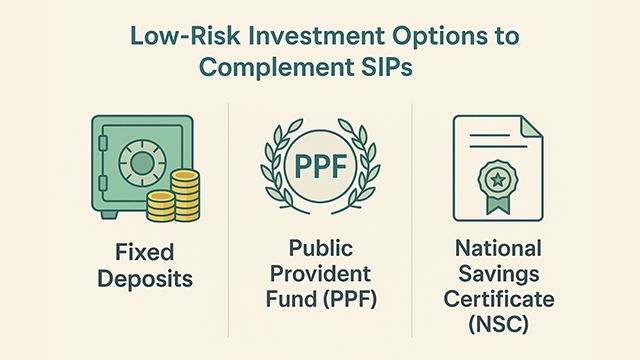
Low-Risk Investment Options to Complement SIPs
SIPs offer growth potential, but you need to balance your portfolio with stable, low-risk options. This creates a safety net when markets fluctuate. Your capital stays protected while you build long-term wealth through diversification. Let’s take a closer look at three low-risk investment vehicles that work well with your SIP investments.
Fixed Deposits
Fixed Deposits (FDs) are one of India’s most trusted investment options. They give you guaranteed returns at a fixed rate throughout the deposit period. Regular citizens earn interest rates between 5-7%, while senior citizens get an extra 0.5%. FDs are predictable – you’ll know your exact earnings when your deposit matures.
FDs stay unaffected by market volatility, which makes them great for balancing SIPs. The structure is simple: you put in a lump sum for a set period, and the bank guarantees your principal plus interest.
You can choose FD terms from 7 days to 10 years. These deposits also let you earn regular income through periodic interest payments – a feature that works well for retirees. Tax-saving FDs with 5-year terms offer deductions up to ₹1.5 lakh under Section 80C.
Public Provident Fund (PPF)
The Public Provident Fund shines as a government-backed savings scheme that combines safety with returns effectively. It currently gives a 7.1% annual interest rate. Your returns usually beat inflation with almost no risk.
PPF’s 15-year lock-in period makes it perfect for long-term goals like retirement or children’s education. You can make partial withdrawals after seven years, which adds some flexibility.
Your PPF account needs a minimum yearly deposit of ₹500, with an upper limit of ₹1.5 lakh per financial year. This lets you adjust your contributions based on your finances. The entire investment qualifies for tax deduction under Section 80C, and you pay no tax on interest or maturity amounts.
National Savings Certificate (NSC)
National Savings Certificates give you another government-backed option with fixed returns and minimal risk. These certificates currently offer 7.7% interest per year, compounded annually. They give you both decent returns and complete safety.
NSCs mature in five years, which is shorter than PPF. You still get tax benefits under Section 80C for investments up to ₹1.5 lakh. This timeframe works well for goals between your short-term needs and long-term plans.
You can buy NSCs at any post office starting at ₹1,000, with no upper limit. Interest earned in the first four years gets reinvested and qualifies for more tax benefits. This means you can claim tax deductions on both your main investment and accumulated interest.
These low-risk options combine with your SIP investments to create a balanced portfolio that handles market volatility while growing steadily. Each tool serves its purpose – FDs give stability and liquidity, PPF offers long-term tax-free growth, and NSCs help with medium-term goals and tax advantages. Together, they are the foundations for your wealth creation experience.
Medium-Risk Investments for Balanced Growth
Medium-risk investments strike an ideal balance between growth and stability as you move up the risk ladder from conservative options. These investments can give you higher returns than fixed deposits while keeping moderate volatility, which makes them great companions to your SIP strategy.
Balanced mutual funds
Balanced or hybrid mutual funds are the perfect example of a medium-risk investment approach that combines equities and debt instruments in a single portfolio. This combination creates the best risk-reward ratio – equities drive growth and debt provides stability.
These balanced funds stick to a preset ratio of stocks and bonds, usually around 60% equity and 40% fixed income. The structure automatically rebalances as market conditions shift. The fund sells overperforming assets and buys underperforming ones to maintain target allocation.
Balanced funds are a great way to get regular income while growing your capital. You get better protection from inflation than pure debt instruments and need less hands-on management. These funds work especially well if you have moderate risk tolerance and want both income and reasonable capital growth – making them perfect for retirees.
Debt funds
Debt mutual funds put most money into fixed-income securities like government bonds, treasury bills, and corporate debt instruments. These funds make money through interest payments and capital appreciation when interest rates go down.
You’ll find several types of debt funds with unique features:
- Short-duration funds: Invest in securities with 1-3 year maturities, ideal for medium-term goals
- Corporate bond funds: Focus on high-rated corporate bonds to get better yields than government securities
- Dynamic bond funds: Adjust portfolio duration based on interest rate trends
Debt funds attract investors with their stable returns compared to equity investments. They beat fixed deposits in post-tax returns when held for at least three years, thanks to indexation benefits. So they work great for goals that are 3-5 years away.
Corporate bonds
Corporate bonds let you loan money directly to companies that pay regular interest in return. These bonds usually yield 8-10% annually, which is almost double what government bonds offer.
The issuer’s creditworthiness largely determines a corporate bond’s risk-reward profile. Investment-grade bonds from financially stable companies carry moderate risk. Higher-yielding “junk bonds” come with greater default risk.
Corporate bonds bring several unique advantages to a balanced portfolio. They create steady income streams through regular interest payments. You also get priority claims on company assets during financial troubles, which makes them safer than stocks. Corporate bonds show lower price swings than equities, which helps stabilize your portfolio during market downturns.
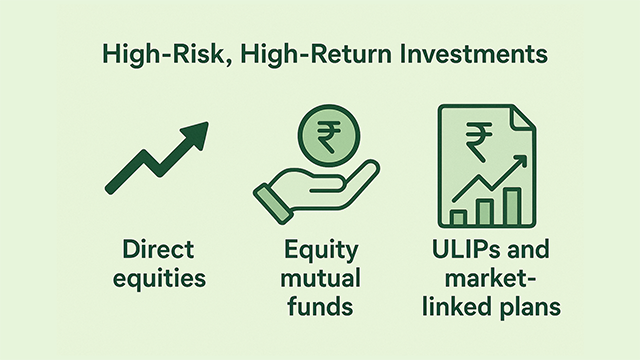
High-Risk, High-Return Investments
High-risk investments can bring great returns if you’re ready to handle uncertainty. Financial experts say you need to take calculated risks to build wealth over time. Higher risks often lead to higher potential returns.
Direct equities
Buying shares of specific companies makes you a partial owner with voting rights. Unlike SIPs that build positions gradually, direct equity needs deep research and a solid grasp of company basics.
Smart investors look at several key factors to evaluate direct equity investments:
- Business models and brand value
- Management quality and corporate governance
- Sector outlook and competitive position
- Financial metrics including P/E ratio, ROE, and ROCE
Direct equities shine because they can appreciate your capital. Yes, it is true that equity investments beat traditional savings options over long periods. All the same, timing plays a crucial role. Staggered investments work better than lump-sum approaches when markets seem overvalued.
Equity mutual funds
Equity mutual funds are perfect if you want high returns without managing stock portfolios yourself. These funds give you professional management and target aggressive growth. The investment focus stays on equity-related assets in companies of all sizes.
These high-risk funds target specific areas:
- Small and mid-cap funds for companies with higher growth potential
- Sector-specific funds in high-growth industries
- Funds with aggressive investment strategies
These funds work best if you can invest for 5-7 years or more and help you stay ahead of inflation. Some funds have shown amazing results—reaching 31.62% annual returns over three years. Market movements can make fund values go up and down quite a bit.
ULIPs and market-linked plans
Unit Linked Insurance Plans (ULIPs) give you a unique high-risk option that combines life insurance with market-linked investments. Your premium splits between insurance coverage and funds you choose—equity, debt, or hybrid options.
ULIPs come with a five-year lock-in period that helps build disciplined investing habits. They offer several benefits:
- Tax benefits under Section 80C for premium payments
- Tax-free switches between fund types
- Tax-free maturity benefits under Section 10(10D)
Equity-focused ULIPs might be riskier but can grow your money better over time. Starting early gives your investments more time to grow. Regular investments help balance out market ups and downs.
How to Choose the Best Investment Plan in India
Building lasting wealth needs a step-by-step approach to picking investment options. Your best investment plans in India should match your personal needs instead of following general advice.
Match investments to your goals
Start by setting clear financial goals. Short-term goals (1 year or less) work well with liquid funds or ultra-short-term debt funds that give low risk with decent returns. Medium-term goals (3-5 years) work better with balanced hybrid funds or short-term debt funds. Long-term dreams like retirement need equity mutual funds or PPF to reach their full growth potential.
Assess your risk appetite
The way you handle risk shapes your investment choices. Here’s what affects your risk comfort level:
- Age (young investors usually handle market ups and downs better)
- Income stability (steady paychecks let you take more risks)
- Your financial duties and emergency savings
- Your market knowledge and experience
- How you react to market changes
Vary for better returns
Smart variation cuts down portfolio swings without losing returns. Good variation means:
- Spreading your money across different types of investments
- Investing in different places to protect against local economic problems
- Spreading across sectors to lower industry risks
Use SIPs as part of a bigger plan
SIPs work best as part of a complete strategy. Look at fund history, costs, and how well the manager has done before picking SIPs. Stay disciplined with your investments whatever the market does to get the best long-term results.
Conclusion
Monthly SIPs alone won’t help you build lasting wealth. SIPs provide a disciplined way to invest, but they’re just one tool in your detailed financial toolkit. Your portfolio becomes more resilient when you add different investment options that match your specific goals.
Successful investors know the value of spreading their money across different investments. Market fluctuations become less worrying with stable options like fixed deposits, PPF, and NSCs. Balanced and debt funds can give you steady growth without too much risk. Direct equities and aggressive mutual funds might suit you if you don’t mind some market ups and downs – they often bring better returns over time.
Clear financial goals should drive your investment choices. You might need quick access to money for short-term plans, while long-term goals work better with stock market investments. Your comfort with risk depends on your age, steady income, and market understanding.
SIPs work best as part of a bigger investment plan. Real financial security comes from spreading your money across different types of investments and staying committed even when markets get shaky.
Building wealth works like a concert where different instruments create beautiful music together. Each investment plays its part in securing your financial future. Your investment experience deserves this all-encompassing approach where SIPs work among other carefully picked options to help you achieve true financial freedom.
FAQs