You may have seen the headlines: “Rupee Hits Historic Low.” It sounds serious, but what does it actually mean when a currency like the Indian Rupee falls against the US dollar? Is it just a problem for big businesses and the government, or does it affect your daily life?
The short answer is: it affects everyone. The value of our rupee has a direct impact on the price of fuel, the cost of studying abroad, and even the price of some groceries.
This post will break down why the rupee is currently in a tough spot. We’ll explore the simple reasons behind its fall in easy-to-understand terms, show you how it trickles down to your household budget, and look at what can be done to help stabilize it.
What Does It Mean When the Rupee Falls?
First, let’s get the basics right. When you hear that the rupee has fallen, it means you need more rupees to buy one US dollar. For example, if the exchange rate goes from ₹85 to ₹90 per dollar, the rupee has weakened or “fallen.” The dollar has become more expensive for us to buy.
Since the US dollar is the world’s primary currency for trade, a weaker rupee makes imported goods more expensive for India. This is the root of the problem.
Key Reasons for the Rupee’s Recent Fall
A currency’s value is a lot like the price of anything else—it’s determined by supply and demand. Right now, the demand for US dollars in India is high, and the supply is not keeping up. Here are the main reasons why.
1. Slowdown in Foreign Investment
Foreign investors bring US dollars into India when they invest in our stock market or set up businesses. This increases the supply of dollars, which helps keep the rupee strong. However, when these investors get worried about the global economy or find better opportunities elsewhere, they pull their money out.
To take their money out, they sell their Indian investments (in rupees) and buy US dollars to send back home. This year, we’ve seen a significant outflow of capital, with foreign investors selling off Indian stocks. This creates a huge demand for dollars, putting pressure on the rupee.
2. A Widening Trade Deficit
The trade deficit is the difference between how much a country imports and how much it exports. India currently imports more than it exports, creating a deficit.
- Expensive Imports: We rely on other countries for crucial things like crude oil, electronics, and machinery. We have to pay for these goods in US dollars. When global prices for commodities like oil and metals rise, our import bill gets bigger.
- Strained Exports: At the same time, challenges like high US tariffs on Indian goods can make our products more expensive for others to buy, hurting our export income.
When our import bill is much higher than our export earnings, we need to buy more dollars than we are earning. This imbalance pushes the rupee’s value down.
3. Limited Intervention from the RBI
The Reserve Bank of India (RBI) is like the guardian of the rupee. It holds a large reserve of foreign currencies, including US dollars. When the rupee starts falling too fast, the RBI can step in and sell some of its dollars in the market. This increases the supply of dollars and helps stabilize the rupee.
Recently, however, the RBI’s intervention has been more limited. Selling too many dollars can drain the country’s precious foreign exchange reserves, which are needed for other essential payments. While the RBI does intervene to prevent extreme volatility, it can’t fight the broader economic trend indefinitely.
How a Weaker Rupee Affects You
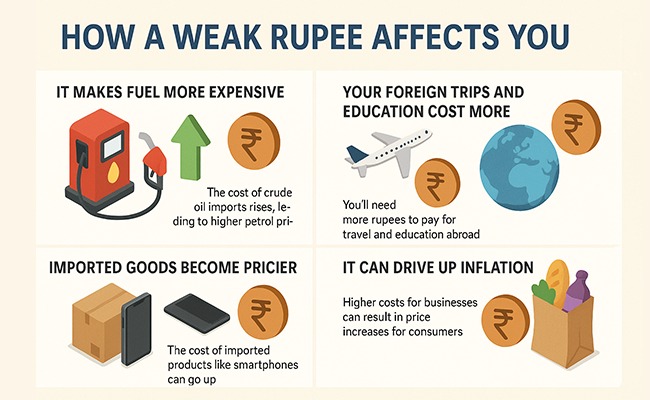
This isn’t just a problem for economists. A falling rupee has real-world consequences for your wallet.
It Makes Fuel More Expensive
India imports over 85% of its crude oil, and all of it is paid for in US dollars. When the rupee falls, oil companies have to spend more rupees to buy the same amount of oil. This extra cost is eventually passed on to you at the petrol pump.
Your Foreign Trips and Education Cost More
Planning a vacation abroad or sending your child to a university in the US, UK, or Europe? A weaker rupee means your budget will need to be bigger. You will have to spend more rupees to get the same amount of dollars, euros, or pounds needed for tuition fees, accommodation, and travel expenses.
Imported Goods Become Pricier
Many products we use daily, from smartphones and laptops to certain appliances, are either fully imported or made with imported components. A weak rupee increases the cost of bringing these items into the country, leading to higher price tags in stores.
It Can Drive Up Inflation
When the costs of fuel and raw materials go up for businesses, they often pass those costs on to consumers. This can lead to a general rise in the prices of goods and services, a phenomenon known as inflation. Everything from your grocery bill to transportation costs can start to creep up.

What Can Be Done to Stabilize the Rupee?
There is no magic wand, but a combination of government policies and RBI actions can help.
- Boosting Exports: The government can introduce policies that make it easier and more profitable for Indian companies to sell their products abroad. This would bring more dollars into the country.
- Attracting Foreign Investment: Creating a stable and attractive business environment encourages long-term foreign direct investment (FDI), which provides a steady flow of dollars.
- Controlling Imports: While we can’t stop importing essential goods like oil, promoting local manufacturing through initiatives like “Make in India” can reduce our dependence on foreign goods in the long run.
- RBI’s Monetary Policy: The RBI can use tools like increasing interest rates to make investing in India more attractive for foreign capital. This can help pull in more dollars, but it’s a delicate balancing act as higher rates can also slow down economic growth.
The road to a stable rupee involves managing these complex factors. For now, the focus remains on navigating the current economic challenges while building a more resilient economy for the future.
Frequently Asked Questions (FAQs)
No. A weaker rupee can benefit exporters because Indian goods and services become cheaper for foreign buyers. Sectors like software services, textiles, and pharmaceuticals often gain from this as it boosts their global competitiveness and sales.
The US dollar is the most widely used currency for global trade and financial transactions. Since crucial imports like crude oil are priced in dollars, the USD/INR rate becomes the primary benchmark for assessing the rupee’s strength.
No. Currency movements happen in cycles. While the rupee may weaken during periods of high inflation, global uncertainty, or rising US interest rates, it can strengthen again when economic fundamentals and external conditions improve.
The RBI intervenes not to fix the rupee at a specific level but to reduce excessive volatility. If the rupee moves too sharply within a short time, the RBI sells or buys dollars to stabilize the market and maintain orderly currency movements.
Individuals cannot directly influence the exchange rate, but they can make informed choices. Supporting local products reduces import dependence, and understanding how currency changes impact travel, investments, and inflation can help with smarter financial planning.