findocblog

Blog

  • How Much Loan Can You Get Against Your Mutual Funds?

    How Much Loan Can You Get Against Your Mutual Funds?

    Mutual fund investments can help you build wealth and serve as collateral for quick funds. Taking loans against mutual funds gives investors a practical way to get cash without selling their portfolio during market ups and downs.

    A loan against mutual funds lets you use your fund units as collateral for secured borrowing. This setup helps you access money quickly while your investments continue to grow. The interest rates are substantially lower than other options – between 8% and 12% per year, compared to unsecured loans that charge 9% to 14%. Your fund type determines how much you can borrow – equity mutual funds typically qualify for 50-70% of their value, and debt mutual funds can get you up to 80-90%.

    Quick processing stands out as a key benefit of these loans. Lenders usually release the money within one to two days. This speed makes them perfect for handling urgent money needs without disrupting your investment plans.

    Why consider a loan against mutual funds?

    Need to tap into your mutual fund portfolio’s value without selling your investments? A loan against mutual funds gives investors several advantages when they need quick cash.

    Quick liquidity without selling investments

    You can get immediate cash by taking a loan against mutual funds without disrupting your investment plans. The funds reach your account within 24 to 48 hours after approval. This makes it a great choice when you need urgent money. You can pledge your mutual fund units as collateral and get quick funds instead of selling investments during market downturns.

    Your investments keep growing because you own the mutual fund units throughout the loan period. You’ll benefit from potential capital appreciation and dividend distributions even after borrowing against them. Your portfolio continues to work for you while you use its value.

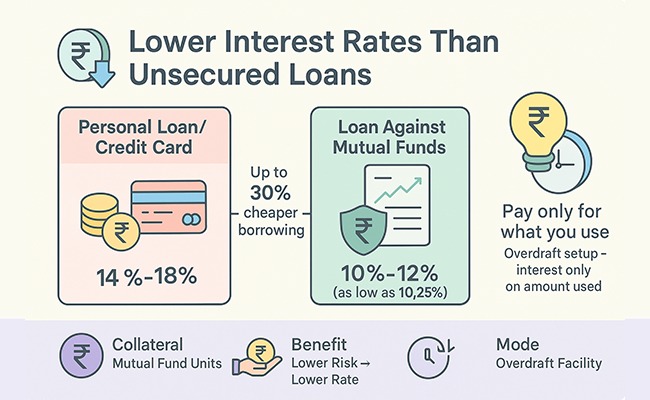
    Lower interest rates than unsecured loans
    Mutual Fund

    The most important financial benefit is how budget-friendly these loans are. Lenders see these loans as less risky than unsecured borrowing options because your mutual fund units act as collateral. The interest rates on loans against mutual funds are much lower than personal loans or credit cards.

    These rates usually range between 10% and 12% per year, and some lenders offer rates as low as 10.25%. Many institutions also set up these loans as overdraft facilities. This means you pay interest only on the amount you use and for the time you use it.

    Ideal for short-term financial needs

    These loans work great for temporary financial needs without affecting your long-term investment goals. Here are some situations where this option makes sense:

    Handling unexpected medical emergencies or family needs
    Making down payments for major purchases like real estate or vehicles
    Supporting business growth or working capital needs
    Combining higher-interest debts into a lower-cost loan
    Paying for educational expenses or planned vacations

    The repayment options are flexible too. Many lenders don’t require fixed EMIs like traditional term loans. You can repay the principal amount anytime during the loan period as per your convenience. This gives you better control over your finances.

    How lenders decide your loan amount

    Lenders look at specific criteria to decide your borrowing limit against mutual funds. You should know these factors to get a good idea of your loan amount before you apply.

    Understanding loan-to-value (LTV) ratios

    LTV ratio is the life-blood of calculating loan amounts. This ratio shows what percentage of your fund’s value you can get as a loan. To name just one example, see a mutual fund portfolio worth ₹10 lakh – with a 50% LTV, you could borrow ₹5 lakh. Different financial institutions offer ratios between 50% and 90%.

    Your borrowing experience depends on LTV ratios in several ways:

    • They set your maximum eligible loan amount
    • Better interest rates usually come with lower LTVs
    • You must maintain this ratio while your loan runs

    Impact of fund type: equity vs debt

    Your choice of mutual fund type plays a big role in your borrowing limit. Market volatility makes equity-based funds riskier, so they come with lower LTV ratios than debt funds:

    • Equity/Hybrid/ETF mutual funds: LTV ratios go up to 50%
    • Debt/FMP mutual funds: You can get higher LTV ratios of 75% to 80%

    Debt funds get better terms because they’re more stable with fewer price swings. SBI lets you borrow up to ₹10 lakh against equity funds and up to ₹5 crores against debt funds. HDFC caps loans at ₹20 lakh for equity funds and ₹1 crore for debt funds.

    Role of credit score and borrower profile

    Mutual Fund

    Notwithstanding that mutual funds serve as collateral, lenders review your creditworthiness:

    Your credit score shapes approval speed, interest rates, and possible loan limits
    Better scores lead to more attractive terms
    Steady income shows you can handle repayments
    Your complete financial picture, including what you own and owe, determines your final approved amount

    Lenders check your credit history mainly to see how well you’ve paid back loans before, not to decide how much to lend.

    Steps to apply and get the loan

    The digital age has made it easier to get loans against mutual funds. Here’s what you need to do after deciding this is the right choice for you.

    Choosing the right lender

    You should start by looking at what different financial institutions have to offer. The loan’s interest rates, loan-to-value ratios, and processing fees need careful attention. Banks now give you flexible ways to repay with minimal penalties. Make sure the lender works with both SOA-based and demat-based mutual funds, since some only deal with specific formats. The lender’s customer service reputation matters too – you’ll want reliable support throughout your loan journey.

    Submitting folio and scheme details

    Most applications now happen digitally without any paperwork. The process starts when you download the lender’s app or visit their website. You’ll submit your PAN and Aadhaar for KYC checks, along with your mutual fund’s registered phone number and email. The next step lets you pick which mutual fund units to use as collateral – both equity and debt funds work fine. SBI and other lenders can wrap this up quickly, often in less than 10 minutes.

    Signing the lien agreement

    A lien lets lenders hold or sell your mutual fund units as security against the loan. Once you’ve picked your funds, you’ll approve the lien marking through OTP verification on RTA portals like CAMS or KFintech. The next steps involve confirming your bank details for loan payments and signing the digital loan agreement.

    Loan disbursement timeline

    Lenders move fast to check your details after you apply. Your money should hit your bank account within hours if everything checks out – some lenders promise to send it in 2-4 hours. SBI takes this a step further by creating an overdraft account right after marking the lien.

    Smart borrowing tips for investors

    Smart decisions about loans against mutual funds need careful planning. Here’s a guide to borrow wisely and protect your investments.

    Compare interest rates and terms

    The smart approach is to shop around instead of accepting the first offer. Interest rates typically range from 10% to 16%, and lenders offer significantly different terms. Processing fees vary between 0.35%-5% of loan amount, and annual maintenance charges can reach 5%. Early repayment policies deserve special attention since some lenders allow penalty-free prepayment. This flexibility can be valuable later.

    Avoid over-leveraging your portfolio

    Smart investors keep loan amounts to 60-70% of their portfolio value, regardless of higher limits offered by lenders. This buffer helps protect against market volatility that might trigger margin calls. A sudden drop in your fund’s value could force you to provide additional collateral or make unexpected payments.

    Plan repayment to avoid forced liquidation

    Your repayment schedule should align with reliable income streams. Defaulting carries serious consequences – lenders can liquidate your pledged units and disrupt your long-term financial goals. Your credit score will suffer, and you’ll face substantial penalties.

    Use loans only for productive purposes

    These loans work best for value-generating activities like business growth or debt consolidation. Taking loans for unnecessary expenses creates financial pressure without any real benefits. The decision to leverage your investment portfolio needs careful consideration of the true value it brings.

    Conclusion

    Loans against mutual funds definitely provide a practical solution when investors need quick liquidity without disrupting their investment goals. This piece shows how these loans offer many advantages that traditional borrowing options cannot match. Investors can access funds faster while their investments continue to grow and potentially generate returns.

    These loans become more attractive because of their lower interest rates. Pledging mutual fund units can save you substantial money during the loan period instead of using high-interest personal loans or credit cards. The flexible repayment options also give borrowers better control over their financial commitments.

    Your fund type is a vital factor in determining loan amounts. Debt mutual funds typically fetch higher loan-to-value ratios due to their stability. Equity funds offer lower LTVs because of market volatility. This difference shows why portfolio diversification matters for maximizing borrowing potential.

    Smart investors should approach these loans strategically. A careful comparison of lenders shows substantial variations in interest rates, processing fees, and terms. Borrowing less than the maximum allowed amount helps maintain a safety margin and protects against market fluctuations that might trigger margin calls.

    The application process runs efficiently now, with many lenders offering digital, paperless experiences. Most steps from selecting funds to signing lien agreements happen quickly, leading to fast loan disbursement.

    Loans against mutual funds serve as a valuable financial tool when used wisely. They help bridge temporary cash gaps without forcing premature exits from investment positions. All the same, borrowers must plan their repayment carefully and use funds productively to avoid forced liquidation. These loans can enhance your broader financial strategy while preserving long-term investment goals if you understand and use them responsibly.

    FAQ

    The LTV ratio typically ranges from 50% to 90%, depending on the type of mutual fund. Equity funds generally qualify for 50-70% of their value, while debt funds can fetch up to 80-90% of their value as a loan.

    Most lenders process and disburse loans against mutual funds within 1-2 days. Some institutions even offer disbursement within 2-4 hours after application completion and verification.

    Yes, interest rates for loans against mutual funds are generally lower than unsecured loans. They typically range between 10% and 12% per annum, which is significantly less than personal loans or credit card rates.

    Absolutely. When you take a loan against your mutual funds, you retain ownership of the units. This means you can still benefit from potential capital appreciation and dividend distributions throughout the loan period.

    If you default on the loan, the lender has the right to liquidate your pledged mutual fund units to recover the outstanding amount. This could disrupt your long-term financial goals and potentially damage your credit score. It’s crucial to plan your repayments carefully to avoid such situations.

  • What is High Frequency Trading?

    What is High Frequency Trading?

    High Frequency Trading (HFT) is a form of trading which is entirely driven by technology. It uses high-speed computers to buy and sell securities in microseconds, much faster than any human can. Also known as HFT or High Frequency Trading, this method focuses on three main elements: speed, precision, and scale. Each transaction earns a small margin, but when repeated continuously, these small profits add up to large returns.

    In traditional trading, people analyse data, decide when to trade, and then place orders manually. In contrast, HFT relies on algorithms, real-time data, and advanced network systems to execute thousands of trades each second.

    Understanding high-frequency algorithmic trading provides insight into how technology and finance work together in the financial market. It shows how automation and data-driven systems are reshaping modern investing.

    How Does HFT Work?

    High-frequency algorithmic trading uses advanced computers and algorithms that make trading decisions in microseconds. Here’s how it works in simple terms:

    • The computer scans prices across several stock exchanges at once
    • It looks for small price gaps between where it can buy and where it can sell
    • When it finds a difference, it buys at the lower price and sells at the higher one, often within seconds

    Each trade earns a small profit, but because this process happens thousands of times a day, the cumulative gains can be significant. Most HFT systems are located very close to stock exchanges. This setup reduces what’s known as latency, the delay between sending and completing a trade, allowing transactions to happen almost instantly.

    Even though HFT is mostly used by large institutions, retail investors can still participate in the markets by learning the basics of trading and maintaining an online demat account for seamless and secure transactions.

    Key Components of HFT

    HFT depends on several core elements that make it fast and reliable:

    • Algorithms: Pre-programmed rules that decide when to buy or sell
    • Speed: The heart of HFT, every microsecond counts
    • Market data: Real-time information that helps detect small price gaps
    • Infrastructure: High-speed computers and direct exchange connections
    • Automation: The system runs on its own without human intervention

    Together, these components make trading quick, precise, and efficient.

    Key Features of HFT

    Here’s what makes HFT unique:

    • Trade happens in microseconds
    • Thousands of orders are placed daily
    • Holding time lasts only a few seconds or less
    • Each trade earns a very small profit
    • Everything is automated through algorithms.

    These features make HFT one of the most active and technology-driven trading methods today.

    Benefits of HFT Trading

    High-frequency trading plays a major role in improving how markets function:

    • Better liquidity: Ensures there are always buyers and sellers available
    • Tighter Spreads: Narrows the difference between buy and sell prices
    • Faster Pricing: Markets adjust quickly to new information
    • Lower Costs: Automation reduces brokerage and transaction fees
    • Higher Efficiency: Frequent trades create consistent, small profits

    For traders and investors, this results in smoother and quicker market activity.

    Risks, Incidents and Challenges of HFT

    Like any technology, high frequency trading carries risks. Because trades happen so fast, even small issues can escalate quickly. A well-known example is the 2010 Flash Crash in the US, when stock prices plunged within minutes but recovered by the end of the day. A large automated sell order triggered a rapid series of high-frequency trades, which amplified the volatility and led to the sudden market drop.

    Common concerns include:

    • HFT can cause sudden price swings
    • It gives an extra technological advantage to large firms
    • It leaves small investors at a disadvantage

    Sometimes, algorithms react to each other’s moves, creating volatility. This is why regulators closely monitor HFT to prevent market disruptions.

    How is High Frequency Trading Different from Algorithmic Trading?

    Aspect High Frequency Trading (HFT) Algorithmic Trading
    Speed Extremely fast, trades executed in microseconds Slower, trades executed in seconds or minutes
    Volume High daily volume or thousands of trades per sec/per day Fewer trades based on a set strategy
    Goal To profit from small price gaps To automate trade execution
    Holding Time Very short, positions last only seconds Can last for hours or even days
    System Setup Needs advanced servers and direct exchange connections Runs on standard trading systems

    Both use algorithms, but HFT focuses on speed, while algorithmic trading focuses on timing and strategy.

    High Frequency Trading vs Traditional Trading

    Aspect High Frequency Trading Traditional Trading
    Execution Fully automated Manual or semi-manual
    Duration Trades completed in microseconds Trades take minutes, hours, or even days
    Role of Trader Minimal involvement Active decision-making required
    Profit Type Small margins but large volumes of trades Bigger margins with fewer trades
    Risk Related to technology, speed, algorithm errors and market liquidity issues. Depends on market volatility, human decision-making, and strategic errors

    Basically, HFT trading depends on machines, while traditional trading depends on human judgment and timing.

    Regulation and Future Trends in HFT Trading

    Regulators around the world monitor high-frequency trading to maintain market stability. Because trades occur so quickly, even minor issues can spread fast.

    Here’s what lies ahead for HFT:

    • Smarter Systems: Artificial Intelligence will make algorithms more accurate
    • Better Safeguards: New controls will help prevent extreme price movements
    • More Transparency: Exchanges will share more trading data with regulators

    For investors, these trends promise safer and more stable markets in the future.

    Regulatory Framework for HFT

    In India, HFT is regulated by SEBI, the Securities and Exchange Board of India. Its rules aim to promote fairness and prevent misuse.

    Key guidelines include:

    • Allowing co-location servers under supervision for equal access
    • Introducing circuit breakers that pause trading during sharp movements
    • Penalising manipulative or unfair trading practices

    These measures ensure that advanced trading methods remain safe and transparent for all.

    Frequently Asked Questions

    It means using computers to make many trades every second. The goal is to earn from tiny price changes that happen very quickly.

    Yes. It requires advanced coding skills, strong financial knowledge, and high-speed systems. It’s not ideal for beginners.

    Yes. SEBI allows high-frequency algorithmic trading, but firms must follow strict transparency and safety regulations.

    Yes, but it’s rare. It requires heavy investment, advanced systems, and direct exchange access.

  • Orkla IPO 2025: Check Subscription Dates, Price Band, GMP & Key Details

    Orkla IPO 2025: Check Subscription Dates, Price Band, GMP & Key Details

    Preparing to invest in the next big IPO details? Orkla India Ltd.’s IPO opens on October 29, 2025, and investors have a narrow three-day window to participate before it closes on October 31, 2025.

    Timing matters significantly with IPO investments. Retail investors who want to participate in Orkla’s IPO must apply through the retail or non-institutional investor category during this limited subscription period. Having all the crucial information beforehand can determine your application’s success.

    In this piece, we’ll explore Orkla India’s IPO comprehensively – from the company’s background and market position to the price band, lot size, application process, and Grey market premium indicators. On top of that, we’ll share practical tips that will help your application process run smoothly.

    Why Orkla IPO 2025 is Gaining Attention

    The investment community can’t stop talking about the Orkla India IPO. Let me break down what makes this offering stand out from other IPOs.

    Company background and business model

    Orkla India Limited is the Indian branch of Orkla ASA, a Norwegian industrial investment company that’s 370 years old and operates in more than 100 countries. The parent company brings extensive global experience with its well-known brands and strong corporate governance.

    The company’s story in India started in 2007 with MTR Foods acquisition. It then bought Eastern Condiments and brought Rasoi Magic into its family. This smart move created a food business that now offers about 400 products in different categories.

    Orkla India focuses on two main areas:

    • Spices (blended and pure)
    • Convenience foods (ready-to-cook, ready-to-eat, and vermicelli products)

    The company sells about 2.3 million units every day, which shows its strong market reach. It runs nine manufacturing facilities throughout India with a total capacity of 182,270 tons per year. The company also partners with manufacturers in India, UAE, Thailand, and Malaysia.

    Market position and growth potential

    Orkla India has become a powerhouse in South India’s packaged spices market. The Technopak Report shows the company owns 31.2% of the market in Karnataka, 41.8% in Kerala, and 15.2% in Andhra Pradesh and Telangana combined. Its brands MTR and Eastern reach 67.5% of retail outlets in Karnataka and 70.4% in Kerala, which beats the industry average of 30-40% by a lot.

    The market keeps growing faster. India’s packaged food industry hit ₹10,180 billion in fiscal 2024, growing at 10.8% CAGR since fiscal 2019. The packaged spices market makes up 40% of India’s spice market at ₹345 billion in fiscal 2024. Experts expect it to reach ₹615 billion by fiscal 2029.

    Higher disposable incomes, urban growth, lifestyle changes, and more working women boost Orkla India’s growth potential. The company keeps adding new products like MTR Minute Fresh batters, Ready-to-Eat sweets, and its new ‘Wok N Roll’ brand for Pan-Asian cuisine.

    Investor interest and media coverage

    The numbers tell a great story. Orkla India’s revenue grew 3% while profit after tax jumped 13% between FY24 and FY25. FY25 revenue reached ₹2,394.7 crore with an EBITDA of ₹355.05 crore (up 15% YoY), and profit after tax hit ₹255.69 crore. The company’s EBITDA margin stands at 14.8% and PAT margin at 10.7%. It has almost no debt.

    The IPO structure is an Offer for Sale (OFS) of 2.28 crore equity shares. The money goes to selling shareholders, not the company. Orkla Asia Pacific Pte Ltd, Navas Meeran, and Feroz Meeran are the main sellers.

    The Grey market premium shows strong investor interest, though these trends aren’t official guarantees. With a ₹10,000 crore valuation at the upper price band, the company is worth about four times its FY25 revenue. This valuation shows investors believe strongly in its future growth.

    Important Dates to Remember

    The right timing makes all the difference in any IPO investment. Orkla India’s IPO follows specific dates that investors should note to participate in this investment chance.

    Subscription window

    Orkla India’s IPO subscription starts on Wednesday, October 29, 2025, and runs for three days until Friday, October 31, 2025. This short window gives investors time to assess and submit their applications.

    UPI applicants should remember the mandate confirmation deadline at 5 PM on October 31, 2025. You’ll miss your chance to participate whatever your interest level if you miss this cutoff.

    The company will allocate shares to anchor investors on Tuesday, October 28, 2025, one day before public subscription begins. Most institutional investors watch this allocation as it shows big investors’ confidence in the IPO.

    Allotment and refund dates

    After subscriptions close, the focus shifts to share allocation. Orkla India plans to finalize the IPO share allotment basis on Monday, November 3, 2025[91]. This date determines your application’s success and share allocation numbers.

    The company will process refunds on Tuesday, November 4, 2025. Your excess funds return to your account on this date if you don’t get your desired allocation or the lottery doesn’t pick your application.

    Successful applicants will see Orkla India shares in their demat accounts on November 4, 2025[101][103]. So you’ll be ready to trade once the shares list.

    Listing date on NSE/BSE

    The IPO process ends with the listing day. Orkla India shares start trading on Thursday, November 6, 2025[91][101]. The shares will list on both the National Stock Exchange (NSE) and Bombay Stock Exchange (BSE)[82][91].

    Post-listing dates matter more to institutional investors. Retail investors should know that anchor investors’ shares have a lock-in period – 50% unlock on December 3, 2025, and the rest on February 1, 2026.

    Here’s a quick timeline of Orkla IPO’s key dates:

    IPO Event Important Date
    Anchor Investor Allocation October 28, 2025
    Subscription Opening October 29, 2025
    Subscription Closing October 31, 2025 (UPI deadline: 5 PM)
    Allotment Finalization November 3, 2025
    Refund Initiation November 4, 2025
    Share Credit to Demat November 4, 2025
    Listing on NSE & BSE November 6, 2025

    This timeline helps plan your investment strategy better. A single day’s delay could mean missing this investment chance. Set calendar reminders for these dates if you plan to invest in Orkla India’s IPO.

    Understanding the Price Band and Lot Size

    You need to know the financial details before putting your money in the Orkla IPO. Let’s look at the key pricing information and what it means for your investment plans.

    Price band explanation

    Orkla India’s IPO has a fixed price band from ₹695 to ₹730 per equity share. This range sets the boundaries for investors to bid for company shares. The company’s value stands at roughly ₹10,000 crore at the upper price limit.

    The Orkla IPO is set up as an Offer for Sale (OFS) of up to 22,843,004 equity shares. Since it’s an OFS, the company won’t get any money from the share sale – it goes straight to the selling shareholders. Orkla India worked with Book Running Lead Managers to set these prices and published them in major newspapers like Financial Express, Jansatta, and Vishwavani.

    Retail investor lot size

    The smallest lot you can buy is 20 shares. You’ll need ₹14,600 to invest if you’re paying the upper price of ₹730 per share. This standard lot size helps organize participation from different types of investors.

    Want to invest more? Retail investors can buy up to 13 lots or 260 shares. That’s about ₹1,89,800 at the upper price band. If you want to invest more than that, you’ll need to apply as an HNI (High Net-worth Individual).

    The detailed investment breakdown looks like this:

    Application Lots Shares Amount (at ₹730)
    Retail (Min) 1 20 ₹14,600
    Retail (Max) 13 260 ₹1,89,800

    Implications for small investors

    The minimum investment of ₹14,600 makes this IPO more available to retail investors than many others. That said, it’s still a substantial amount for many individual investors.

    Small investors get a fair shot at allocation. The rules set aside at least 35% of the Net Offer for Retail Individual Bidders, as per SEBI ICDR Regulations.

    Everyone except Anchor Investors must use the Application Supported by Blocked Amount (ASBA) process. You’ll need to provide your bank account or UPI ID details where the bid amount will be blocked. This makes the application process more transparent and efficient.

    Based on the company’s financial performance and market position we discussed earlier, you should think about whether this investment matches your portfolio goals and risk appetite. The current Grey market premium hints at possible listing gains, but remember – these unofficial indicators don’t guarantee anything.

    Grey Market Premium and Listing Outlook

    The Grey market activity gives us a good idea about Orkla shares’ performance on listing day. Market trends and their meaning deserve a closer look for anyone planning to invest.

    Current GMP and its movement

    The Grey Market Premium (GMP) for Orkla India Ltd IPO reached ₹105-106 as of October 28, 2025. Market estimates suggest a listing price around ₹836 per share, calculated from the upper price band of ₹730. The GMP has shown notable changes in the last week. The premium hit its peak at ₹145 on October 24. It dropped to ₹132 on October 25 and settled at ₹114 by October 27. This downward movement points to shifting market sentiment as the IPO opening date gets closer.

    What GMP tells us about demand

    Grey market premium shows us how excited investors are before the official listing. The current GMP, even after recent drops, points to strong demand for Orkla shares. Investors seem ready to pay 14-15% above the IPO price, with premiums ranging from ₹105-114[252]. The company’s business model and growth prospects have earned market confidence. Financial experts say investor interest stays strong despite the premium changes.

    Expected listing gains or risks

    Current GMP patterns suggest possible listing gains between 14.38-15.6%. Successful applicants might earn around ₹2,280 per lot. The positive outlook looks promising, but remember that GMP data comes from unofficial sources and speculation. Smart investors should not rely just on Grey market trends that can change quickly. New IPO investors should focus on basic company strengths rather than short-term GMP movements to make smart choices.

    Conclusion

    Orkla India’s IPO gives investors a great chance to be part of India’s faster-growing packaged food industry. Without doubt, the company’s strong market position makes this offering worth a look, especially when you have its brands dominating South India through exceptional distribution networks. The company’s impressive financial performance shows growing revenues, healthy profit margins, and minimal debt that strengthen its investment appeal.

    The IPO subscription window runs tight from October 29-31, 2025, leaving investors just three days to act. Getting your application materials ready and funds arranged ahead of time helps avoid any last-minute issues. The current Grey market suggests potential listing gains of 14-15%, but these unofficial indicators shouldn’t be your only reason to invest.

    New IPO investors should weigh both the benefits and risks carefully. The minimum investment of ₹14,600 makes this offering available to many investors, but it needs careful thought. Your decision should align with Orkla’s fundamentals and your investment goals.

    You can apply through ASBA or take the simplified UPI route. Learning the application process now will prepare you better for when subscriptions open. Success in IPO investing comes from good preparation and picking the right company at the right moment.


    Frequently Asked Questions

    The Orkla India IPO is valued at ₹1,667.54 crore and consists entirely of an offer for sale (OFS) of 2.28 crore equity shares. This means existing shareholders will be selling their shares, with no new equity being issued by the company.

    As of October 28, 2025, the Grey Market Premium for Orkla India IPO is around ₹105-106, suggesting an estimated listing price of approximately ₹836 per share. This indicates strong market interest, with investors potentially willing to pay about 14-15% above the IPO price.

    The Orkla India IPO opens for subscription on October 29, 2025, and closes on October 31, 2025. The basis of allotment is expected to be finalized on November 3, 2025, with refunds and share crediting occurring on November 4, 2025. The shares are scheduled to list on the NSE and BSE on November 6, 2025.

    Investors can apply for the Orkla IPO through the ASBA process via their bank’s internet banking portal or by submitting a physical ASBA form. Alternatively, they can use the UPI method through broker apps. The minimum lot size is 20 shares, requiring an investment of ₹14,600 at the upper price band.

    Orkla India has a strong presence in South India’s packaged spices market, with significant market shares in Karnataka (31.2%) and Kerala (41.8%). The company operates in the rapidly growing packaged food industry, which was valued at ₹10,180 billion in fiscal 2024 and is projected to continue expanding. Orkla’s diverse product portfolio and strategic acquisitions position it well for future growth in this market.

  • Lenskart IPO: Full Details on Price Band, Lot Size & Grey Market Premium

    Lenskart IPO: Full Details on Price Band, Lot Size & Grey Market Premium

    Lenskart, the eyewear giant, plans to launch one of India’s largest public offerings of 2025, with a current grey market premium of ₹68. The IPO worth ₹7,278.01 crore will open from October 31 to November 4, 2025, and has created quite a buzz among retail investors.

    The company’s massive offering combines a fresh issue of ₹2,150 crore and an offer for sale (OFS) of 127,562,573 shares worth ₹5,128.01 crore. Lenskart has grown into a powerhouse in the eyewear market with 2,806 stores worldwide – 2,137 in India and 669 across other countries. The company has fixed its price band between ₹382 and ₹402 per share. Retail investors need to buy a minimum lot of 37 shares, which means an investment of at least ₹14,874. The IPO’s grey market premium hints at possible listing gains when it debuts on November 10, 2025. This piece covers everything in the Lenskart IPO to help you make a smart investment choice.

    What are the key dates for Lenskart IPO?

    Lenskart has announced all essential dates in its Red Herring Prospectus (RHP) filed on October 25. Here’s what you need to know about the timeline of this major eyewear retail offering.

    IPO opens on October 31 and closes on November 4

    The company has set a three-day subscription window for its IPO. Bidding starts on Friday, October 31, 2025, and ends on Tuesday, November 4, 2025. Anchor investors can bid for one day on October 30, 2025.

    Retail investors must complete their UPI mandate by 5 PM on November 4, 2025. The mandate end date is November 19, 2025, which gives enough time to complete all steps.

    Anchor investors will see a phased lock-in period. Half of their investments will have a lock-in until December 6, 2025, and the rest until February 4, 2026.

    Allotment expected on November 6

    Lenskart will finalize share allotment on Thursday, November 6, 2025. Investors will learn if they got shares based on the company’s criteria. Several reliable sources confirm this allotment date.

    The company will start refunds on Friday, November 7, 2025. Successful applicants will get their Lenskart shares in their demat accounts the same day. This quick processing helps complete all steps before trading begins.

    Listing scheduled for November 10

    Lenskart shares will debut on both the Bombay Stock Exchange (BSE) and National Stock Exchange (NSE) on Monday, November 10, 2025. The grey market premium ranges between ₹68 and ₹120, which many investors watch closely [prior section information].

    Market analysts track the grey market premium to gage potential listing gains [prior section information]. The premium changes with market sentiment and might not always predict the actual listing performance.

    The timeline from October 30 to November 10 will see Lenskart become a publicly traded company. This stands as one of 2025’s largest consumer retail sector IPOs. This schedule helps investors plan their participation and understand each step of the IPO process.

    How is the IPO structured and who is selling shares?

    Lenskart’s public offering combines fresh capital for business expansion with partial exits for early backers. The detailed breakdown shows major participation from founders and institutional investors in this eyewear IPO.

    ₹2,150 Cr fresh issue and ₹5,128 Cr OFS

    Lenskart’s IPO totals ₹7,278.02 crore with two main parts. The company will raise ₹2,150 crore through fresh equity shares for business growth. Additionally, existing shareholders will sell 12.76 crore shares worth ₹5,128.02 crore at the upper price band through an offer for sale (OFS).

    This setup means the company receives 29.5% of the total IPO proceeds, while existing investors get 70.5% by selling their stakes. The company won’t receive any money from the OFS portion. The IPO serves two purposes: it brings growth capital for Lenskart’s expansion and lets early investors cash out their investments.

    Promoters and investors participating in OFS

    The core team and major institutional investors are part of the OFS. CEO and founder Peyush Bansal leads the individual stake sales with 2.05 crore shares. His sister and co-founder Neha Bansal plans to sell about 10.1 lakh shares.

    Other key promoters Amit Chaudhary and Sumeet Kapahi will each sell around 28.7 lakh shares. After this partial exit, Lenskart’s four promoters will keep about 17-18% of the company post-IPO – the highest among new-age listed companies.

    SoftBank’s SVF II Lightbulb (Cayman) Ltd tops the investor list with 2.55 crore shares for sale. Other major sellers include Kedaara Capital Fund II LLP, PI Opportunities Fund II (ChrysCapital), MacRitchie Investments (KKR), Alpha Wave Ventures, Schroders Capital, and TR Capital.

    Breakdown of shares offered by each stakeholder

    Early investors stand to make substantial returns. Peyush Bansal’s 2.05 crore shares could fetch about ₹824 crore at the upper price band of ₹402. Neha Bansal’s stake sale should bring in roughly ₹41 crore. Amit Chaudhary and Sumeet Kapahi each expect around ₹115 crore from their sales.

    SoftBank leads the institutional investors with 2.55 crore shares worth about ₹1,026 crore. They bought these shares at ₹74.26 average price, making 5.4x returns. Premji Invest (PI Opportunities Fund) shows even better results with 16.7x returns, having paid just ₹24.14 per share.

    Schroders Capital will make 10x returns by selling 1.91 crore shares worth ₹766 crore. Temasek expects 4.1x returns on its ₹316 crore stake sale. Kedaara Capital and Alpha Wave should see healthy returns of 5.4x and 3.8x respectively.

    These impressive returns might shape the grey market premium as the IPO subscription dates near. Market watchers now focus on how these large stake sales could affect investor sentiment toward the IPO’s grey market premium.

    What is the price band and lot size for retail investors?

    Lenskart Solutions has set key financial details that let retail investors participate in its upcoming public offering. This eyewear sector listing brings vital information for investors who want to buy shares.

    Price band set at ₹382–₹402 per share

    The eyewear retailer’s IPO price band ranges from ₹382 to ₹402 per equity share. Each share has a face value of ₹2. Lenskart’s value will reach approximately ₹69,726 crore (about ₹675.04 billion) at the upper end of the price band. This value shows the company’s strong market position with its wide network of stores in India and abroad.

    The company offers a ₹19 discount per equity share to eligible employees. This benefit helps employees own a part of the company as it goes public.

    Minimum investment of ₹14,874 for 37 shares

    Retail investors need to buy shares in lots of 37 equity shares. A single lot costs ₹14,874 at the upper price band. This entry point makes the IPO available to individual investors and maintains good lot economics.

    Investors can apply for up to 13 lots, which equals 481 shares worth ₹1,93,362 at the upper price band. Anyone who wants to buy between 14 and 67 lots falls into the small high-net-worth individuals (S-HNI) category.

    Retail, QIB, and NII reservation percentages

    The company has divided its offering among different investor groups. Qualified institutional buyers (QIBs) get at least 75% of the net offering. Non-institutional investors (NIIs) can access up to 15% of the offering.

    Retail investors get up to 10% of the total IPO size. This structure follows regulatory rules for large public offerings and helps secure big institutional investments while giving retail investors a chance to participate.

    The current grey market premium shows strong investor interest beyond the formal price band. Reports show the IPO’s grey market premium ranges from ₹68 to ₹84 above the upper price band. This could mean a strong listing performance.

    How will Lenskart use the IPO proceeds?

    Lenskart plans to raise ₹2,150 crore through its fresh issue component. The eyewear giant has laid out a clear strategy to allocate these funds. Their Red Herring Prospectus details how they’ll deploy this capital across several strategic initiatives over the next three years.

    Store expansion and lease payments

    Lenskart will use much of its IPO proceeds to grow its physical retail presence. The company plans to spend ₹272.62 crore on capital expenditure to set up new company-operated, company-owned (CoCo) stores across India. This money will cover everything from store fit-outs to interiors and setup costs.

    The company has set aside an even bigger amount of ₹591.44 crore to pay for lease, rent, and license agreements for these CoCo stores. This shows Lenskart’s big push for offline expansion and makes up about 27.5% of the total fresh issue proceeds.

    Technology upgrades and brand marketing

    Lenskart’s tech-focused retail approach means they’ll invest ₹213.37 crore in better technology and cloud infrastructure. This money will help develop AI-driven customer tools and backend systems. It will also pay their internal technology team’s salaries. So, this investment will boost both online and in-store customer experiences.

    Brand development plays a crucial role in Lenskart’s growth plans. They’ve earmarked ₹320.06 crore for marketing and business promotion. These funds will help spread brand awareness in both local and international markets. This could affect the live grey market premium as investors watch the company’s growth path.

    General corporate purposes and acquisitions

    The rest of the money—up to 35% of the total issue size—will go to two main areas. They’ll use it to buy other companies that can expand their product range and reach. The funds will also support general business operations.

    While Lenskart hasn’t named specific companies they want to buy, this flexible funding gives them room to grab growth opportunities. As the IPO draws closer, market watchers will track how these investment plans affect the IPO’s grey market premium. The company’s balanced approach to using this money shows their focus on sustainable growth.

    What does the grey market premium of IPO suggest?

    Lenskart’s upcoming IPO’s grey market performance shows most important investor interest with noticeable price swings before its public subscription period.

    GMP currently ranges from ₹68 to ₹120

    Lenskart’s shares’ live grey market premium has expressed substantial volatility lately. The GMP reached its peak at ₹120 on October 26 that indicates strong demand. All the same, the premium dropped to ₹68 just a day later on October 27. Market trackers reported varying figures – one source showed a GMP of ₹91, while others quoted ₹75 and ₹84. These differences highlight grey market trading’s informal nature.

    Expected listing gains based on GMP

    These premium figures suggest investors might see listing gains between 16.92% to 29.85% above the upper price band of ₹402. The potential listing price could range from ₹470 (with ₹68 GMP) to ₹522 (with ₹120 GMP). One source projects a listing price of ₹493 with a 22.64% potential gain. Another estimate points to ₹477, suggesting an 18.66% return.

    Cautionary note on relying solely on GMP

    Keep in mind that grey market premium trades happen in an unofficial, unregulated market. These premiums can change faster before the actual listing. Financial experts call it risky to base investment decisions only on GMP. Potential subscribers should assess complete factors like Lenskart’s fundamentals, growth outlook, market position, and overall market conditions instead of just following grey market trends.

    Conclusion

    Lenskart’s upcoming IPO is one of the biggest public offerings in India’s retail sector for 2025. Investors can join this experience from October 31 to November 4. The company’s ₹7,278.01 crore offering comes with a price band of ₹382-₹402 per share. Retail investors can access this IPO with a minimum investment of ₹14,874 for 37 shares, though only 10% of shares are set aside for this category.

    The eyewear leader plans to use ₹2,150 crore from fresh issues to expand stores, advance technology, and build its brand. Early backers like SoftBank and Premji Invest will get impressive returns through the OFS component while keeping substantial stakes in the company.

    The grey market premium fluctuates between ₹68 and ₹120, which hints at possible listing gains when shares hit the market on November 10. Smart investors should look past these unofficial indicators. They need to see Lenskart’s strong position with 2,806 stores worldwide and its clear growth plans.

    This IPO marks a turning point as Lenskart moves from private to public ownership with a valuation near ₹69,726 crore. Investors should weigh the company’s growth path, its edge in the eyewear market, and its financial strength before they decide to invest in this eagerly awaited offering.

    Frequently Asked Questions

    Lenskart has set its IPO price band between ₹382 and ₹402 per equity share. The minimum investment required for retail investors is ₹14,874 for a lot of 37 shares.

    The Lenskart IPO is scheduled to open for public subscription on October 31, 2025, and will close on November 4, 2025. The listing is expected to take place on November 10, 2025.

    Lenskart plans to use the IPO proceeds for store expansion, technology upgrades, brand marketing, and potential acquisitions. Specific allocations include ₹273 crore for new stores, ₹591 crore for lease payments, and ₹213 crore for technology infrastructure.

    The grey market premium for Lenskart’s IPO has ranged from ₹68 to ₹120, suggesting potential listing gains of 16–30%. However, investors should note that grey market premiums are unofficial and can be highly volatile.

    The IPO includes an Offer for Sale (OFS) component where existing shareholders will sell shares. Major sellers include founder Peyush Bansal (2.05 crore shares), SoftBank (2.55 crore shares), and other institutional investors like Kedaara Capital and PI Opportunities Fund.

  • Think SIPs Are Enough for Wealth Creation? Think Again — Here’s What You’re Missing

    Think SIPs Are Enough for Wealth Creation? Think Again — Here’s What You’re Missing

    SIPs might seem like the perfect wealth-building tool, but are they? A monthly investment of ₹5,000 over five years adds up to ₹3 lakh (excluding market returns). The discipline of regular investments sounds great but doesn’t guarantee financial success. Many investors fall into the trap of equating automatic SIP payments with a solid investment strategy.

    The biggest problem lies beyond SIPs – it’s the lack of goal-based investing. A financial planner puts it well: “Don’t confuse automation with direction. Discipline without clarity is just expensive guesswork.” This wisdom becomes crucial as investors navigate through India’s best investment plans.

    Your surplus funds should work harder through strategic asset allocation. Multiple income streams can flow from dividends, property rentals, and bond interest. SIPs should serve as one piece of your investment puzzle, not the entire picture. A well-rounded approach that combines different investment vehicles paves the way to lasting financial security and growth.

    Where SIPs Fit in the Investment Landscape

    Systematic Investment Plans (SIPs) have become the gateway to investments for millions of Indians. The number of SIP accounts has grown by a lot, reaching over 6.42 crore accounts by April 2023—up from 4.25 crore in 2021. This surge shows that SIPs are now the life-blood of many investor’s financial experiences. You need to understand how they work, what makes them appealing, and their limitations before making them central to your investment strategy.

    What SIPs are and how they work

    A Systematic Investment Plan isn’t an investment product. It’s a way to invest in mutual funds through regular, fixed contributions. SIPs let you invest small amounts at set times—usually weekly, monthly, or quarterly instead of putting in a large sum at once.

    The way SIPs work is simple yet powerful. Here’s what happens when you set up a SIP:

    1. Your bank account automatically sends a fixed amount at regular times
    2. This money buys mutual fund units at the current Net Asset Value (NAV)
    3. Market conditions determine how many units you get—more units come your way when prices drop and fewer when they rise

    This automatic adjustment creates what financial experts call “Rupee Cost Averaging,” which helps reduce market volatility’s effect over time. SIPs also make use of compounding, where your returns create more returns, which can lead to exponential growth over time.

    Why they’re popular among new investors

    SIPs have caught on with younger investors. About 92% of Gen Z chooses SIPs over one-time investments. People love them because:

    Low entry barriers make SIPs available to everyone—you can start with just ₹500 per month. This makes investing possible for people with different income levels.

    Disciplined investing comes naturally since the system handles everything automatically. This “set it and forget it” approach helps people stop putting off their financial planning.

    Flexibility lets investors change their investment amount, take a break, or stop completely without penalties. This helps a lot during money troubles.

    SIPs also give access to professionally managed mutual funds without needing to know everything about markets. New investors find this professional guidance a great way to get started.

    Limitations of SIPs when used alone

    SIPs have their drawbacks, even with all their benefits:

    Market dependency means your returns aren’t guaranteed and change based on how the fund performs. The averaging effect might not stop big losses during long market downturns or sudden crashes.

    Not ideal for short-term goals because SIPs work best for building wealth over time. You might want to look elsewhere if you need your money soon.

    Underperformance in rising markets happens because your fixed investment buys fewer units as prices keep going up. One-time investments might work better in strong bull markets.

    Specific lock-in periods apply to some SIP investments, especially tax-saver mutual funds that lock your money for three years. This makes it hard to get your money during emergencies.

    Exit loads and expense ratios can eat into your returns. These small charges can affect your investment growth by a lot over time.

    These limitations don’t make SIPs less valuable. They just show why SIPs should be part of a bigger, diverse investment plan that matches your financial goals.

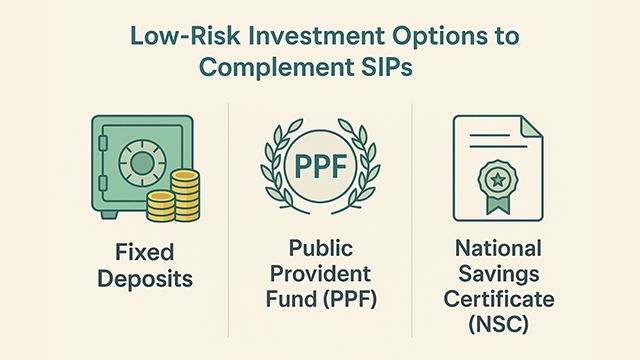
    Low-Risk Investment Options to Complement SIPs

    Low Risk

    SIPs offer growth potential, but you need to balance your portfolio with stable, low-risk options. This creates a safety net when markets fluctuate. Your capital stays protected while you build long-term wealth through diversification. Let’s take a closer look at three low-risk investment vehicles that work well with your SIP investments.

    Fixed Deposits

    Fixed Deposits (FDs) are one of India’s most trusted investment options. They give you guaranteed returns at a fixed rate throughout the deposit period. Regular citizens earn interest rates between 5-7%, while senior citizens get an extra 0.5%. FDs are predictable – you’ll know your exact earnings when your deposit matures.

    FDs stay unaffected by market volatility, which makes them great for balancing SIPs. The structure is simple: you put in a lump sum for a set period, and the bank guarantees your principal plus interest.

    You can choose FD terms from 7 days to 10 years. These deposits also let you earn regular income through periodic interest payments – a feature that works well for retirees. Tax-saving FDs with 5-year terms offer deductions up to ₹1.5 lakh under Section 80C.

    Public Provident Fund (PPF)

    The Public Provident Fund shines as a government-backed savings scheme that combines safety with returns effectively. It currently gives a 7.1% annual interest rate. Your returns usually beat inflation with almost no risk.

    PPF’s 15-year lock-in period makes it perfect for long-term goals like retirement or children’s education. You can make partial withdrawals after seven years, which adds some flexibility.

    Your PPF account needs a minimum yearly deposit of ₹500, with an upper limit of ₹1.5 lakh per financial year. This lets you adjust your contributions based on your finances. The entire investment qualifies for tax deduction under Section 80C, and you pay no tax on interest or maturity amounts.

    National Savings Certificate (NSC)

    National Savings Certificates give you another government-backed option with fixed returns and minimal risk. These certificates currently offer 7.7% interest per year, compounded annually. They give you both decent returns and complete safety.

    NSCs mature in five years, which is shorter than PPF. You still get tax benefits under Section 80C for investments up to ₹1.5 lakh. This timeframe works well for goals between your short-term needs and long-term plans.

    You can buy NSCs at any post office starting at ₹1,000, with no upper limit. Interest earned in the first four years gets reinvested and qualifies for more tax benefits. This means you can claim tax deductions on both your main investment and accumulated interest.

    These low-risk options combine with your SIP investments to create a balanced portfolio that handles market volatility while growing steadily. Each tool serves its purpose – FDs give stability and liquidity, PPF offers long-term tax-free growth, and NSCs help with medium-term goals and tax advantages. Together, they are the foundations for your wealth creation experience.

    Medium-Risk Investments for Balanced Growth

    Medium-risk investments strike an ideal balance between growth and stability as you move up the risk ladder from conservative options. These investments can give you higher returns than fixed deposits while keeping moderate volatility, which makes them great companions to your SIP strategy.

    Balanced mutual funds

    Balanced or hybrid mutual funds are the perfect example of a medium-risk investment approach that combines equities and debt instruments in a single portfolio. This combination creates the best risk-reward ratio – equities drive growth and debt provides stability.

    These balanced funds stick to a preset ratio of stocks and bonds, usually around 60% equity and 40% fixed income. The structure automatically rebalances as market conditions shift. The fund sells overperforming assets and buys underperforming ones to maintain target allocation.

    Balanced funds are a great way to get regular income while growing your capital. You get better protection from inflation than pure debt instruments and need less hands-on management. These funds work especially well if you have moderate risk tolerance and want both income and reasonable capital growth – making them perfect for retirees.

    Debt funds

    Debt mutual funds put most money into fixed-income securities like government bonds, treasury bills, and corporate debt instruments. These funds make money through interest payments and capital appreciation when interest rates go down.

    You’ll find several types of debt funds with unique features:

    • Short-duration funds: Invest in securities with 1-3 year maturities, ideal for medium-term goals
    • Corporate bond funds: Focus on high-rated corporate bonds to get better yields than government securities
    • Dynamic bond funds: Adjust portfolio duration based on interest rate trends

    Debt funds attract investors with their stable returns compared to equity investments. They beat fixed deposits in post-tax returns when held for at least three years, thanks to indexation benefits. So they work great for goals that are 3-5 years away.

    Corporate bonds

    Corporate bonds let you loan money directly to companies that pay regular interest in return. These bonds usually yield 8-10% annually, which is almost double what government bonds offer.

    The issuer’s creditworthiness largely determines a corporate bond’s risk-reward profile. Investment-grade bonds from financially stable companies carry moderate risk. Higher-yielding “junk bonds” come with greater default risk.

    Corporate bonds bring several unique advantages to a balanced portfolio. They create steady income streams through regular interest payments. You also get priority claims on company assets during financial troubles, which makes them safer than stocks. Corporate bonds show lower price swings than equities, which helps stabilize your portfolio during market downturns.

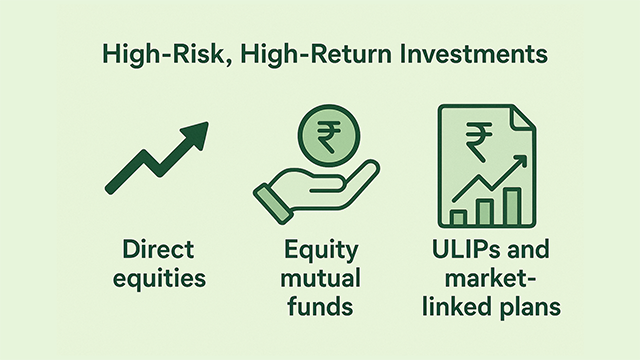
    High-Risk, High-Return Investments

    sip blog 3

    High-risk investments can bring great returns if you’re ready to handle uncertainty. Financial experts say you need to take calculated risks to build wealth over time. Higher risks often lead to higher potential returns.

    Direct equities

    Buying shares of specific companies makes you a partial owner with voting rights. Unlike SIPs that build positions gradually, direct equity needs deep research and a solid grasp of company basics.

    Smart investors look at several key factors to evaluate direct equity investments:

    • Business models and brand value
    • Management quality and corporate governance
    • Sector outlook and competitive position
    • Financial metrics including P/E ratio, ROE, and ROCE

    Direct equities shine because they can appreciate your capital. Yes, it is true that equity investments beat traditional savings options over long periods. All the same, timing plays a crucial role. Staggered investments work better than lump-sum approaches when markets seem overvalued.

    Equity mutual funds

    Equity mutual funds are perfect if you want high returns without managing stock portfolios yourself. These funds give you professional management and target aggressive growth. The investment focus stays on equity-related assets in companies of all sizes.

    These high-risk funds target specific areas:

    • Small and mid-cap funds for companies with higher growth potential
    • Sector-specific funds in high-growth industries
    • Funds with aggressive investment strategies

    These funds work best if you can invest for 5-7 years or more and help you stay ahead of inflation. Some funds have shown amazing results—reaching 31.62% annual returns over three years. Market movements can make fund values go up and down quite a bit.

    ULIPs and market-linked plans

    Unit Linked Insurance Plans (ULIPs) give you a unique high-risk option that combines life insurance with market-linked investments. Your premium splits between insurance coverage and funds you choose—equity, debt, or hybrid options.

    ULIPs come with a five-year lock-in period that helps build disciplined investing habits. They offer several benefits:

    • Tax benefits under Section 80C for premium payments
    • Tax-free switches between fund types
    • Tax-free maturity benefits under Section 10(10D)

    Equity-focused ULIPs might be riskier but can grow your money better over time. Starting early gives your investments more time to grow. Regular investments help balance out market ups and downs.

    How to Choose the Best Investment Plan in India

    Building lasting wealth needs a step-by-step approach to picking investment options. Your best investment plans in India should match your personal needs instead of following general advice.

    Match investments to your goals

    Start by setting clear financial goals. Short-term goals (1 year or less) work well with liquid funds or ultra-short-term debt funds that give low risk with decent returns. Medium-term goals (3-5 years) work better with balanced hybrid funds or short-term debt funds. Long-term dreams like retirement need equity mutual funds or PPF to reach their full growth potential.

    Assess your risk appetite

    The way you handle risk shapes your investment choices. Here’s what affects your risk comfort level:

    • Age (young investors usually handle market ups and downs better)
    • Income stability (steady paychecks let you take more risks)
    • Your financial duties and emergency savings
    • Your market knowledge and experience
    • How you react to market changes

    Vary for better returns

    Smart variation cuts down portfolio swings without losing returns. Good variation means:

    • Spreading your money across different types of investments
    • Investing in different places to protect against local economic problems
    • Spreading across sectors to lower industry risks

    Use SIPs as part of a bigger plan

    SIPs work best as part of a complete strategy. Look at fund history, costs, and how well the manager has done before picking SIPs. Stay disciplined with your investments whatever the market does to get the best long-term results.

    Conclusion

    Monthly SIPs alone won’t help you build lasting wealth. SIPs provide a disciplined way to invest, but they’re just one tool in your detailed financial toolkit. Your portfolio becomes more resilient when you add different investment options that match your specific goals.

    Successful investors know the value of spreading their money across different investments. Market fluctuations become less worrying with stable options like fixed deposits, PPF, and NSCs. Balanced and debt funds can give you steady growth without too much risk. Direct equities and aggressive mutual funds might suit you if you don’t mind some market ups and downs – they often bring better returns over time.

    Clear financial goals should drive your investment choices. You might need quick access to money for short-term plans, while long-term goals work better with stock market investments. Your comfort with risk depends on your age, steady income, and market understanding.

    SIPs work best as part of a bigger investment plan. Real financial security comes from spreading your money across different types of investments and staying committed even when markets get shaky.

    Building wealth works like a concert where different instruments create beautiful music together. Each investment plays its part in securing your financial future. Your investment experience deserves this all-encompassing approach where SIPs work among other carefully picked options to help you achieve true financial freedom.

    FAQs

    While SIPs are a good starting point, they are not enough on their own for comprehensive wealth creation. A well-rounded investment strategy should include a mix of low-risk, medium-risk, and high-risk options to balance stability, growth, and returns.

    Fixed Deposits (FDs), Public Provident Fund (PPF), and National Savings Certificates (NSC) are excellent low-risk options to complement SIPs. These government-backed instruments offer stability and guaranteed returns, making them ideal for capital preservation and short-term goals.

    To choose the best investment plan, match your investments to your financial goals, assess your risk appetite, diversify your portfolio, and use SIPs as part of a larger strategy. Consider factors like your age, income stability, and comfort with market fluctuations when making investment decisions.

    Balanced mutual funds offer a combination of equity and fixed-income securities, providing both growth potential and stability. They help manage risk through diversification, offer potential returns that can outpace inflation, and are suitable for investors seeking moderate risk with reasonable returns.

    Diversification is crucial in an investment portfolio as it helps minimize volatility and optimize returns. By spreading investments across different asset classes and geographical regions, you can reduce the impact of market fluctuations on your overall portfolio and position yourself for long-term growth.

  • Canara IPO 2025: Grey Market Premium, Allotment Date & Investor Outlook

    Canara IPO 2025: Grey Market Premium, Allotment Date & Investor Outlook

    Canara IPO 2025: Grey Market Premium, Allotment Date & Investor Outlook

    The Canara Robeco AMC IPO allotment date is set for October 14, 2025, following its launch in the Indian primary market today. This ₹1,326.13 crore initial public offering marks a significant milestone as one of the first public offerings by a PSU-backed mutual fund in recent years.

    According to market observers, the IPO watch GMP today shows Canara Robeco trading at a premium of ₹35, suggesting a potential listing gain of approximately 13% over the upper price band. The Canara Bank IPO date schedule indicates the offering will remain open until October 13, with shares priced between ₹253 and ₹266. Additionally, early subscription data shows moderate investor interest, with the retail portion subscribed 0.13 times and the NII segment filled 0.07 times by the first morning of bidding. In this article, we’ll examine the upcoming IPOs GMP trends, analyze whether the IPO of Canara Bank’s asset management arm presents a worthwhile investment opportunity, and provide you with essential insights to make an informed decision.

    IPO Overview: What You Need to Know About Canara Robeco 2025

    Canara Robeco’s market debut represents a significant milestone in the asset management industry. This public offering has generated considerable buzz among investors keen on financial sector opportunities. Let’s examine the key aspects of this IPO.

    IPO size and structure

    The Canara Robeco AMC IPO comes with a substantial offer size of ₹1,326.13 crore, comprising 4.99 crore equity shares. The company has established a price band between ₹253 and ₹266 per share with each share having a face value of ₹10.

    For retail investors, the minimum application requires 56 shares per lot, translating to a minimum investment of ₹14,896 at the upper price band. The regulatory allocation follows a structured approach with up to 50% reserved for Qualified Institutional Buyers, at least 15% for Non-Institutional Investors, and a minimum of 35% earmarked for Retail Individual Investors.

    Canara Bank IPO date and timeline

    The subscription window for this IPO opens on October 9, 2025 and closes on October 13, 2025. Before the public bidding begins, Canara Robeco conducted its anchor investor round on October 8, 2025, successfully raising ₹397.84 crore from these marquee investors.

    The tentative Canara ipo allotment date is set for October 14, 2025, with share credits to successful applicants’ demat accounts expected by October 15. Subsequently, the company plans to list on both the BSE and NSE with a tentative listing date of October 16, 2025.

    Investors using UPI for payments should ensure mandate confirmation by 5 PM on the final subscription day (October 13) to avoid application issues.

    Offer for Sale: What it means for investors

    Notably, this IPO is structured entirely as an Offer for Sale (OFS) by the promoter shareholders. The selling shareholders include Canara Bank offering up to 25,924,266 equity shares and ORIX Corporation Europe N.V. offering 23,930,091 equity shares.

    Given that it’s a complete OFS, the company itself won’t receive any proceeds from this public issue. Instead, all funds raised (minus expenses) will directly benefit the selling shareholders. This structure implies that investors are buying existing shares rather than contributing to new capital for business expansion.

    Despite being an OFS, financial experts like Anuj Gupta suggest the IPO might still attract investors due to its potential to unlock value in the AMC business.

    Company Fundamentals and Financial Performance

    With the Canara ipo allotment date approaching, let’s examine what makes this asset management company financially attractive to potential investors.

    Business model and AMC market position

    As India’s second-oldest asset management company established in 1993, Canara Robeco operates as a joint venture between Canara Bank (51%) and ORIX Corporation Europe (49%). The company manages 26 mutual fund schemes across equity, debt, and hybrid categories, maintaining a stable 1.5% market share in the industry. Its distribution network spans over 52,000 partners, though its distributor base of 50,935 remains smaller compared to industry giants like HDFC AMC (95,000) and Nippon Life AMC (1.11 lakh).

    Revenue and profit growth trends

    The company’s financial trajectory shows remarkable growth preceding the ipo of canara bank’s asset management arm. Revenue surged from ₹205 crore in FY23 to ₹404 crore in FY25—a 40% CAGR. Correspondingly, profit after tax jumped from ₹79 crore to ₹191 crore during the same period—representing a 55.4% CAGR. The cost-to-income ratio improved significantly from 47.7% in FY23 to 36.2% in FY25, while employee costs decreased from 29.1% of revenue to 21.9%.

    Asset under management (AUM) breakdown

    Canara Robeco’s average AUM reached ₹1.11 lakh crore as of June 2025, growing at a 28.6% CAGR from FY23. The company maintains a strong equity focus with 91.7% of AUM in equity funds, significantly higher than competitors like HDFC AMC (61.9%) and Nippon Life (48.1%). Notably, SIP assets formed about 33% of total AUM, well above the industry average of 21%.

    Retail vs institutional investor base

    A distinctive feature affecting upcoming ipos gmp performance is the company’s retail dominance—87% of AUM comes from retail and HNI investors. The firm manages 50.5 lakh folios, with 99% belonging to individual investors. This retail focus provides a sticky, granular client base less prone to sudden withdrawals.

    Return on equity and margins

    For investors monitoring ipo watch gmp today, the company’s profitability metrics appear compelling. Canara Robeco maintains a robust ROE of 36.3%, outpacing HDFC AMC (32.4%) and Nippon Life (32%). EBITDA margins expanded from 55.18% in FY23 to 65.41% in FY25, while the PAT margin improved to 47.2%.

    Grey Market Premium and Subscription Insights

    Market response offers early signals about investor appetite for the ipo of canara bank’s asset management business. Let me break down the current indicators.

    ipo watch gmp today: latest figures

    As of October 9, 2025, the Canara Robeco IPO GMP stands at ₹35-₹38, indicating a potential listing gain of approximately 13-14% over the upper price band. Interestingly, this reflects an upward trend from the previous day’s GMP of ₹20. The estimated listing price based on current Grey market trends hovers around ₹301 per share.

    Subscription status by category

    On day 1 of bidding, the overall subscription reached a modest 0.06-0.08 times. The retail segment showed the strongest initial interest at 0.13 times, followed by small NIIs at 0.11 times. Meanwhile, QIBs had yet to place significant bids as of the first morning. This pattern aligns with typical IPO behavior, where institutional investors often wait until closer to the closing date.

    How GMP and subscription affect listing price

    Grey market premiums generally serve as unofficial predictors of listing performance. However, experts caution that GMP remains subject to market volatility and shouldn’t be the sole factor in investment decisions. Furthermore, subscription trends across investor categories—particularly QIB participation—typically influence final listing outcomes.

    Market sentiment and volatility impact

    The rising GMP amid broader market pressure demonstrates remarkable resilience. Nevertheless, recent IPO fatigue appears evident, with 10 out of 14 recent issues trading below their offer prices.

    Investor Outlook: Should You Apply or Wait?

    Examining investor sentiment ahead of the canara ipo allotment date reveals divided expert opinions on this asset management offering.

    Expert opinions on valuation

    At the upper price band of ₹266, Canara Robeco trades at a P/E of 27.8x based on FY25 earnings. This appears moderately priced compared to HDFC AMC (48.2x) and Nippon Life (43.3x), yet commands a premium over Aditya Birla Sun Life (24.6x) and UTI AMC (22.8x). BP Equities recommends a “SUBSCRIBE” rating for medium to long-term horizons, whereas Anand Rathi considers it “fully priced”.

    Short-term vs long-term potential

    The ipo watch gmp today suggests a listing gain of approximately 13%, indicating modest short-term returns. Conversely, long-term investors may benefit from India’s mutual fund industry growth, expected at 16-18% CAGR between FY25-FY30. As Gurmeet Chadha notes, “In terms of pure growth, my sense is the top ones are better”.

    Risks in mutual fund industry

    Primary concerns include market volatility affecting fund performance, regulatory changes impacting fees, and economic downturns reducing investor confidence. Furthermore, 91.17% concentration in equity schemes creates disproportionate exposure to market fluctuations.

    How this IPO compares to other PSU-backed IPOs

    Unlike many PSU offerings, Canara Robeco demonstrates superior profitability with a 47.2% PAT margin and impressive 36.2% ROE. The upcoming ipos gmp trends suggest stronger investor interest than some recent PSU listings.

    Ideal investor profile for this IPO

    This offering suits investors with high risk tolerance seeking long-term growth. As Reliance Securities notes, it represents “a compelling play on India’s ongoing financialisation”. Essentially, it fits portfolios focused on India’s retail investment momentum.

    Conclusion

    Canara Robeco Asset Management Co Ltd IPO certainly presents an intriguing opportunity for investors looking to capitalize on India’s growing mutual fund industry. Despite being structured as a complete Offer for Sale, the company’s impressive financial metrics stand out—particularly its 55.4% profit CAGR and robust 36.3% ROE, which surpasses several industry competitors.

    Nevertheless, potential investors should carefully weigh both the strengths and limitations before applying. On one hand, the company demonstrates solid fundamentals with expanding EBITDA margins and a sticky retail-dominated investor base. Additionally, the current Grey market premium suggests reasonable listing gains around 13-14%.

    Conversely, concentration risk exists due to the heavy equity focus, which accounts for over 91% of AUM. Furthermore, the moderate Day 1 subscription numbers indicate cautious initial investor sentiment, though this often changes as the bidding window progresses.

    Based on expert assessments, this IPO appears most suitable for investors with medium to long-term horizons rather than those seeking substantial listing pop. Equally important, the pricing at 27.8x P/E positions it between premium-valued leaders and more affordable smaller players in the AMC space.

    Overall, we believe Canara Robeco represents India’s ongoing financial services evolution, though investors must align their expectations accordingly. The October 14 allotment date approaches quickly, thus prudent investors should consider their risk appetite, investment timeline, and portfolio diversification needs before making their final decision.

    FAQs

    The Canara Robeco AMC IPO has set a price band of ₹253 to ₹266 per share, with a lot size of 56 shares.

    The tentative allotment date for the Canara Robeco IPO is set for October 14, 2025.

    The current Grey Market Premium of ₹35-₹38 suggests a potential listing gain of approximately 13-14% over the upper price band.

    Canara Robeco demonstrates strong financial metrics with a 55.4% profit CAGR and a 36.3% ROE, which surpasses several industry competitors.

    The Canara Robeco IPO appears more suitable for investors with medium to long-term horizons, rather than those seeking substantial short-term gains.

  • LG Electronics India IPO Analysis: Hidden Facts Behind the $8.7B Valuation

    LG Electronics India IPO Analysis: Hidden Facts Behind the $8.7B Valuation

    LG Electronics India IPO Analysis: Hidden Facts Behind the $8.7B Valuation

    LG Electronics has created a buzz with its much-awaited Indian unit IPO. The company aims for a massive valuation of $8.7 billion (over ₹77,000 crore). The electronics giant plans to raise up to ₹11,607.01 crores by selling 10.18 crore shares through an offer-for-sale structure.

    Our team has really looked into LG Electronics’ IPO details and found some key points you should know. The company’s share price band sits between ₹1,080 and ₹1,140 per share. Investors can subscribe to the IPO from October 7 to October 9, 2025. Retail investors need ₹14,820 minimum to buy 13 shares at the upper price. The company’s price-to-earnings ratio ranges from 33.27 to 35.12 times its diluted EPS for FY2025. Many analysts find these levels attractive.

    Let’s take a closer look at LG Electronics India’s IPO valuation. We’ll get into its business model and financial performance. Our complete analysis will compare the company with industry peers to help you make a smart investment choice.

    IPO Structure and Key Details

    LG Electronics India’s IPO stands as one of the biggest public offerings in India’s capital markets for 2025. Here’s a detailed breakdown of its structure and key dates.

    IPO size, price band, and offer type

    The IPO comprises 10,18,15,859 equity shares with a face value of ₹10 each. This pure Offer for Sale (OFS) structure means LG Electronics Inc. will receive the entire ₹11,607 crore raised, as no fresh capital will be issued. The Indian subsidiary won’t get any funds from this offering.

    The price band ranges between ₹1,080 and ₹1,140 per share. LG Electronics India’s post-IPO market capitalization will reach about ₹77,820 crore ($8.7 billion) at the upper end of this range.

    Lot size and minimum investment

    Retail investors need to buy a minimum lot of 13 shares, which means investing ₹14,820 at the upper price band. They can apply for up to 13 lots (169 shares), which comes to ₹1,92,660. The company will give eligible employees a discount of ₹108 per share.

    Retail, QIB, and NII reservation breakdown

    The IPO allocation follows this pattern:

    • Qualified Institutional Buyers (QIBs): Not more than 50% of the offer
    • Non-Institutional Investors (NIIs): Not less than 15% of the offer
    • Retail Investors: Not less than 35% of the offer

    The company has also set aside up to 2,10,728 shares for eligible employees.

    Anchor investor participation and timeline

    Anchor investor bidding starts on October 6, 2025, a day before public subscription begins. Here’s the complete schedule:

    • IPO Opening: October 7, 2025
    • IPO Closing: October 9, 2025 (5 PM cut-off time for UPI mandates)
    • Basis of Allotment: October 10, 2025
    • Refund Initiation: October 13, 2025
    • Credit of Shares to Demat Account: October 13, 2025
    • Listing Date: October 14, 2025 on both NSE and BSE

    The anchor investor lock-in period ends after 30 days for 50% of the shares (November 9, 2025) and after 90 days for the remaining portion (January 8, 2026).

    Business Overview of LG Electronics India

    LG Electronics India Ltd, a 26-year old wholly-owned subsidiary of South Korea’s LG Electronics Inc., started operations in January 1997. The brand has grown into one of India’s leading consumer electronics names over the last several years.

    Core product segments and services

    Two main business segments drive LG Electronics India’s operations. The Home Appliances & Air Solutions division brings in 73.4% of revenue, while Home Entertainment generates 26.6%. Their product lineup includes refrigerators, washing machines, air conditioners, televisions, microwave ovens, water purifiers, and audio-visual equipment. The company’s revenue streams stay steady through installation services, repairs, and yearly maintenance contracts.

    Manufacturing and distribution footprint

    Two advanced manufacturing facilities in Greater Noida and Ranjangaon (Pune) showcase LG’s production strength. These plants have a combined capacity of 14.51 million units and run at 77% utilization in FY2025. The facilities produce many crucial components like compressors and motors in-house. LG Electronics India plans to invest ₹5,001 crore in a third plant at Sri City, Andhra Pradesh. This facility should start production by November 2026.

    Market share and competitive positioning

    LG Electronics India leads India’s home appliances and consumer electronics market. The company has held the top spot for four straight years through H1 CY2025. Their market dominance shows in impressive numbers across products. They hold 33.5% in washing machines, 29.9% in refrigerators, 27.5% in panel televisions, and 51.4% in microwaves. These figures come from offline channels, which make up about 78% of India’s consumer electronics market.

    Financial Performance and Key Metrics

    LG Electronics India’s exceptional performance in key metrics makes this IPO an attractive opportunity for investors.

    Revenue and profit growth trends

    The company’s revenue showed consistent growth from ₹19,865 crore in FY23 to ₹21,352 crore in FY24, marking a healthy 7.5% year-on-year increase. Revenue reached ₹24,367 crore in FY25, which established a solid 10.8% CAGR during this period. The strong performance continues with Q1 FY26 revenue at ₹6,796 crore.

    EBITDA, PAT, and net worth analysis

    The company’s profitability metrics improved remarkably. EBITDA margins grew from 9.6% in FY23 to 10.4% in FY24, and reached 12.8% in FY25. Profit After Tax rose from ₹1,345 crore in FY23 to ₹1,511 crore in FY24, and jumped to ₹2,203 crore in FY25. This growth represents an impressive 27.8% CAGR.

    Return ratios: ROCE and RoNW

    LG Electronics leads the industry with outstanding return metrics:

    • ROCE grew from 37.43% in FY23 to 45.31% in FY24, reaching 42.91% in FY25
    • RoNW increased from 27.35% to 40.45%, settling at 37.13% in FY25

    This is a big deal as it means that these figures outperform competitors like Havells (17.7%), Voltas (12.9%), and Whirlpool (9.1%).

    Debt-free status and capital efficiency

    The company’s most impressive achievement is its zero-debt status, with cash reserves of ₹3,606 crore. LG Electronics’ short working capital cycle of 14.54 days enables excellent free cash flow conversion at 59.49%.

    Valuation Breakdown and Peer Comparison

    The LG Electronics India IPO’s valuation story makes for a fascinating case study that deserves a closer look.

    LG Electronics India IPO valuation vs parent

    The company’s market capitalization exceeds ₹77,000 crore (approximately INR 734.11 billion) at the upper price band. This value almost matches its South Korean parent’s INR 750.99 billion valuation. This similarity stands out because LG India’s revenue of INR 236.27 billion in FY25 remains substantially lower than LG Inc.’s INR 5428.19 billion.

    Price-to-earnings (P/E) ratio analysis

    The company’s P/E ratio reaches 35.12 times at the upper price band based on FY25 earnings. This calculation leads to a post-issue P/E multiple of 35.1x, derived from an EPS of ₹32.46. Industry observers believe this pricing strikes a balance between market sentiment and fundamentals.

    Comparison with Whirlpool, IFB, and Samsung

    LG’s valuation proves reasonable against domestic competitors. Whirlpool currently trades at 48x P/E, IFB at 59x P/E, and Orient Electric at 49x P/E. This competitive edge positions LG well in India’s consumer electronics market, where it already competes with Whirlpool and Samsung.

    Market capitalization and EPS effect

    The market capitalization should reach approximately ₹77,380 crore after the IPO. The company expects its post-IPO EPS to touch ₹30.25, a slight decrease from the current ₹32.46. New investors should see minimal dilution effects.

    Analyst views on pricing and growth potential

    SBI Securities backs the IPO with a ‘Subscribe’ rating. They note that “the company outshines them [peers] in most valuation parameters with superior return profile”. Samco Securities’ analysts also find the issue “attractively priced” and “compelling compared to listed peers”.

    Conclusion

    LG Electronics India’s IPO stands out as a promising investment backed by market dominance and financial strength. Our analysis shows several reasons why this offering outperforms its peers. The wholly-owned subsidiary of South Korea’s LG Electronics Inc. has managed to keep leadership positions in product categories of all types and delivered steady revenue growth at a 10.8% CAGR over the last two years.

    The company’s financial health shines with expanding EBITDA margins, zero debt, and cash reserves of ₹3,606 crore. The 27.8% profit growth CAGR shows LG’s expertise to turn market leadership into strong financial results. The company’s return metrics make an even stronger case – both ROCE and RoNW numbers are substantially higher than competitors like Havells, Voltas, and Whirlpool.

    The IPO’s valuation seems reasonable at 35.1x P/E ratio, especially compared to domestic peers that trade at much higher multiples. Notwithstanding that, investors should think over that this pure Offer for Sale structure means proceeds will go to the parent company instead of funding the Indian subsidiary’s growth.

    The company’s plans to expand capacity through a third manufacturing facility in Sri City shows management’s confidence in future market needs. This IPO is a chance to invest in a market leader with proven financial discipline, strong brand recognition, and 20-year old manufacturing capabilities. The consumer electronics sector remains competitive, but LG’s long-standing presence and premium positioning are the foundations of sustained performance beyond the IPO.

    Frequently Asked Questions

    The IPO is worth ₹11,607 crore, consisting entirely of an Offer for Sale (OFS) of 10.18 crore equity shares. No new shares will be issued, so the proceeds will go to the parent company, LG Electronics Inc.

    The IPO opens on October 7, 2025, and closes on October 9, 2025. The price band is ₹1,080–₹1,140 per share. Listing on NSE and BSE is scheduled for October 14, 2025.

    Retail investors can apply for a minimum of 13 shares (one lot), requiring ₹14,820 at the upper price band. They can apply for up to 13 lots, totaling 169 shares worth ₹1,92,660.

    Revenue increased from ₹19,865 crore in FY23 to ₹24,367 crore in FY25 (10.8% CAGR). Profit After Tax rose to ₹2,203 crore, and EBITDA margins expanded to 12.8%. The company is debt-free with ₹3,606 crore in cash reserves.

    At a P/E ratio of 35.1x FY25 earnings, LG is priced more reasonably than peers like Whirlpool (48x), IFB (59x), and Orient Electric (49x). Analysts consider the IPO attractively valued given its higher profitability and market dominance.

    Since the IPO is a pure OFS, no funds will go to LG Electronics India’s expansion directly. Investors should also consider the competitive nature of the consumer electronics sector and its reliance on consumer demand cycles.

  • Tata Capital IPO 2025: A Deep Dive into Pricing, GMP, and Market Sentiment

    Tata Capital IPO 2025: A Deep Dive into Pricing, GMP, and Market Sentiment

    Tata Capital IPO is set to become the largest public offering by a Tata Group company in over a decade. With an impressive issue size of approximately ₹15,512 crore, this highly anticipated offering has already generated significant buzz among investors and market watchers alike.

    The upcoming IPO has been priced in the range of ₹310 to ₹326 per share, notably at a 56% discount to its last traded unlisted market price of ₹735. Additionally, the offering consists of 47.58 crore shares, including a fresh issue of 21 crore equity shares and an offer for sale of 26.58 crore shares. Scheduled to open from October 6 to October 8, 2025, the Tata Capital IPO GMP (Gray Market Premium) has been fluctuating between ₹25-31 and ₹75-90 per share, indicating potential listing gains for investors.

    In this article, we’ll take a comprehensive look at everything you need to know about the Tata Capital IPO. Furthermore, we’ll examine how this offering isn’t just a capitalization event but also driven by regulatory needs, as the RBI has mandated larger NBFCs to list, ensuring more transparency and investor trust. Whether you’re considering investing or simply staying informed, our analysis will help you understand the pricing strategy, market sentiment, and growth prospects of this significant offering from the Tata Group.

    Tata Capital IPO 2025: Key Dates and Offer Structure

    The much-anticipated Tata Capital IPO has a structured timeline for investors looking to participate. Let me walk through all the essential details you need to know.

    IPO opening and closing dates

    The subscription window for Tata Capital IPO opens on October 6, 2025, and will remain open until October 8, 2025. This three-day window applies to retail investors, high-net-worth individuals (HNIs), and other eligible categories. Mark your calendars if you’re planning to apply, as this timeframe is fixed without extension possibilities.

    Anchor investor timeline

    Regarding anchor investors, Tata Capital Ltd has scheduled the bidding day for October 3, 2025. The company has already secured ₹4,641.83 crore from these institutional investors, demonstrating strong pre-listing confidence. For these participants, there’s a structured lock-in period—50% of shares have a 30-day lock-in while the remainder faces a 90-day restriction.

    Lot size and minimum investment

    For retail investors, the minimum application requires a lot size of 46 shares. Given the upper price band of ₹326, this translates to a minimum investment of ₹14,996 per lot. Small non-institutional investors must apply for at least 14 lots (644 shares), requiring ₹2,09,944, whereas big non-institutional investors need a minimum of 67 lots, amounting to ₹10,04,732.

    Breakdown of fresh issue vs OFS

    The IPO comprises two components: first, a fresh issue of 21 crore shares aggregating to ₹6,846 crore. Second, an offer for sale (OFS) of 26.58 crore shares worth ₹8,665.87 crore. Within the OFS, Tata Sons will sell 23 crore shares while International Finance Corporation will divest 3.58 crore shares[81]. Importantly, proceeds from the fresh issue will strengthen Tata Capital’s Tier-1 capital base, whereas OFS proceeds go directly to the selling shareholders.

    Listing date and exchanges

    Following the subscription period, the basis of allotment will be finalized on October 9, 2025[62]. Subsequently, refunds to unsuccessful bidders and crediting of shares to successful applicants’ demat accounts will occur on October 10, 2025. The company has scheduled the listing of shares on both the BSE and NSE for October 13, 2025[81], which is when trading will officially commence.

    Understanding Tata Capital IPO GMP

    Behind every IPO launch exists an unofficial market that often provides early signals about investor interest. Let’s explore what Tata Capital’s gray market activity reveals about its potential listing performance.

    What is Gray Market Premium (GMP)?

    Gray Market Premium represents the amount investors are willing to pay above an IPO’s issue price before official listing. Essentially, it’s an unofficial trading environment where IPO applications and shares change hands outside formal exchanges. For example, if Tata Capital’s IPO price is ₹326 and the GMP is ₹25, it suggests investors expect the shares to list around ₹351.

    Current GMP trends for Tata Capital

    As of September 30, 2025, Tata Capital’s GMP ranges between ₹25-₹31 per share above the upper price band. This indicates a potential listing price of approximately ₹353, suggesting an expected return of about 8.28%. Meanwhile, other tracking platforms report slightly different figures, with some showing a GMP of ₹21 or ₹24, highlighting the volatile nature of these unofficial markets.

    How GMP reflects investor sentiment

    The premium serves as a barometer of market excitement and demand before listing. A positive GMP, as seen with Tata Capital, generally signals strong investor interest. Nevertheless, this enthusiasm must be viewed in context – the IPO is priced at a steep 56% discount to its last traded unlisted price of ₹735, and 71% below its April 2025 peak of ₹1,125.

    Limitations of relying on GMP

    Despite its popularity as a predictive tool, GMP carries significant limitations. First, it operates in an unregulated environment with no official oversight. Moreover, historical patterns show that GMP predictions often fail to materialize – nearly 30% of Indian IPOs between 2023-2025 listed below their issue price. The National Securities Depository Ltd IPO presents a cautionary tale where the gray market premium evaporated completely, resulting in a 35% listing-day decline. Consequently, investment decisions based solely on GMP could lead to disappointing outcomes.

    Tata Capital’s Financials and Valuation Metrics

    Examining the financial health of any IPO prospect remains crucial for informed investment decisions. Let’s analyze what the numbers reveal about Tata Capital’s offering.

    Revenue and profit growth over 3 years

    Looking at the financial trajectory, Tata Capital has shown consistent growth in its balance sheet size and income generation capacity. The NBFC has focused on expanding its retail and SME lending portfolios, which has contributed to its revenue stability even during market fluctuations.

    Key financial ratios post-IPO

    After the public offering, Tata Capital’s capital adequacy ratio is expected to strengthen significantly. This improvement should provide additional cushion for business expansion while maintaining regulatory compliance. Similarly, the debt-to-equity ratio might see favorable adjustments once the fresh capital infusion takes place.

    Comparison with listed NBFC peers

    In comparison with established players like Bajaj Finance and HDFC, Tata Capital offers a unique value proposition through its diversified lending portfolio. Although newer to the public markets, the company’s brand association with the Tata Group gives it distinct advantages in terms of trust and customer acquisition costs.

    Valuation vs industry average

    The pricing band of ₹310-326 positions Tata Capital attractively compared to industry standards. In particular, when evaluating price-to-book ratios alongside earnings potential, the valuation appears reasonable for long-term investors seeking exposure to India’s growing financial services sector.

    Should You Invest in Tata Capital IPO?

    Making an investment decision about the Tata Capital IPO requires careful consideration of several factors. Let’s evaluate what makes this offering worthy of your attention—or not.

    Strengths: Brand, growth, and distribution

    The Tata brand legacy provides exceptional trust and credibility in the marketplace. Tata Capital has delivered impressive 25% annualized loan growth over the past three years. Its extensive distribution network includes 1,516 branches across 1,109 locations in 27 states. This reach, coupled with diversified revenue streams from wealth management and private equity, creates multiple growth engines.

    Risks: High debt and sector sensitivity

    On the flip side, Tata Capital’s debt-to-equity ratio stands at 6.6x, which is relatively high. The company’s unsecured loans comprise 21% of its total gross loans as of March 2025. Additionally, its average borrowing cost increased to 7.8% in FY25 from 6.6% in FY23, potentially squeezing margins if rates rise further.

    Shareholder quota benefits

    For retail investors, approximately 35% of the issue is reserved. This allocation strategy aims to balance retail participation while leveraging institutional interest. The employee reservation of 0.25% (12,00,000 shares) offers another targeted opportunity.

    Short-term vs long-term outlook

    According to market expert Avinash Gorakshankar, large IPOs often create hesitation among investors seeking quick listing gains. In reality, although the company may benefit from funds raised, it could take time before delivering strong numbers—making this more suitable for patient investors with long-term vision.

    Conclusion

    Tata Capital’s IPO represents a significant milestone for the Tata Group, marking its largest public offering in over a decade. The substantial discount of 56% compared to its unlisted market price certainly makes this offering worth considering for value-conscious investors. Additionally, the regulatory push from RBI for larger NBFCs to go public adds another layer of credibility to this listing.

    While the GMP indicates positive listing gains potential, we must remember these unofficial premiums can be volatile and unreliable indicators of actual performance. Therefore, investment decisions should primarily rest on the company’s fundamentals rather than gray market speculation.

    The company’s consistent growth trajectory and extensive distribution network provide strong foundations for future expansion. Nevertheless, high debt levels and sensitivity to interest rate fluctuations remain legitimate concerns that cannot be overlooked.

    For retail investors, this IPO offers a balanced opportunity with its designated quota allocation. However, as with most large offerings, patience might prove essential. Short-term listing gains, although possible, should not be the primary motivation. Instead, Tata Capital’s brand strength and diversified business model make it a potentially rewarding long-term investment.

    Ultimately, your decision to invest should align with your financial goals and risk tolerance. Considering all factors – from pricing strategy to market positioning – Tata Capital presents an intriguing opportunity within India’s growing financial services sector. Still, as with any investment, thorough research and possibly consulting with a financial advisor before committing your capital would be prudent.

    FAQ

    The Tata Capital IPO has an issue size of approximately ₹15,512 crore, making it the largest Tata Group IPO in more than a decade. It includes a fresh issue of ₹6,846 crore and an offer for sale (OFS) of ₹8,665.87 crore.

    The subscription window will be open from October 6 to October 8, 2025. Anchor investor bidding is scheduled for October 3, 2025, and the listing on NSE and BSE will take place on October 13, 2025.

    The IPO is priced between ₹310–₹326 per share. The minimum lot size is 46 shares, requiring an investment of about ₹14,996 at the upper price band. Higher categories like small and big non-institutional investors have larger lot requirements.

    The Gray Market Premium (GMP) for Tata Capital IPO has been fluctuating between ₹25–31 and ₹75–90 per share, indicating potential listing gains. However, GMP is unofficial, volatile, and not always a reliable indicator of performance.

    Proceeds from the fresh issue will be used to strengthen Tata Capital’s Tier-1 capital base, while OFS proceeds will go to selling shareholders including Tata Sons and International Finance Corporation.

    Tata Capital benefits from the trusted Tata brand, strong 25% annualized loan growth, a diversified business model, and a wide distribution network of 1,516 branches across India. These factors support long-term growth potential.

    Key risks include a high debt-to-equity ratio of 6.6x, exposure to unsecured loans, and rising borrowing costs (7.8% in FY25 vs 6.6% in FY23). Additionally, NBFCs are sensitive to interest rate movements.

    While GMP suggests potential short-term listing gains, experts caution that large IPOs may take time to deliver strong financial results. Tata Capital IPO appears more suitable for patient, long-term investors rather than purely short-term traders.

  • Gifts, Discounts, and 10-Minute Deliveries – India’s Dark Store Revolution

    Gifts, Discounts, and 10-Minute Deliveries – India’s Dark Store Revolution

    Dark stores are changing India’s retail world at an unprecedented pace. The quick commerce market will reach an estimated USD 5.3 billion by 2025. Projections show further growth to USD 12.59 billion by 2030—reflecting a CAGR of 18.9%. This remarkable growth stems from careful planning and execution.

    A massive infrastructure buildout powers this transformation of urban Indian shopping habits. Swiggy’s Instamart added 498 dark stores in FY25 alone, which almost equals its total openings over the previous four years. Zomato’s Blinkit grew its store count by 147% year-on-year to 1,301 locations. These specialized mini-warehouses serve one purpose: they deliver everything from daily essentials to festive gifts in minutes instead of days.

    Traditional retail has felt the profound effects of this shift. Quick commerce drives much of incremental sales in metros. Urban consumers now divert 25% of their grocery spending from neighborhood kiranas. This piece takes a closer look at how these dark store operations deliver on their 10-minute promises. We’ll explore their discount strategies and analyze how they alter both consumer expectations and India’s retail economy.

    What is a Dark Store and Why It Matters

    Dark stores serve only as fulfillment centers for online orders. These retail outlets stay closed to public foot traffic and work as mini distribution centers strategically placed throughout urban areas.

    How dark stores differ from traditional retail

    Dark stores and conventional retail spaces have stark differences. Traditional shops create attractive displays and checkout counters to enhance customer experience. Dark stores completely remove these elements. Their interior layout looks like regular supermarkets with aisles and shelves, but you won’t find any promotional signage. The focus stays on optimization – with staff members called “pickers” who work 24/7 to complete orders shown on tablet computers attached to shopping trolleys.

    Dark stores also cut costs significantly. They run at nearly £6 (approximately ₹630) less per grocery order compared to picking items at traditional stores. This comes from their optimized layouts and no need for customer service staff.

    The rise of dark stores in India’s quick commerce boom

    The rise of dark stores in India's quick commerce boom

    Quick commerce in India has seen dark stores expand rapidly. Swiggy’s Instamart added 498 dark stores in FY25 alone—a number almost equal to its total openings in the previous four years. The company’s network now covers 1,021 stores across four million square feet.

    Zomato’s Blinkit grew even faster, with its store count jumping 147% year-on-year to 1,301 locations. The company’s warehousing space expanded to 5.2 million square feet. Zepto, another key player, stopped expanding after reaching about 1,000 stores.

    Why urban areas are ideal for dark store setups

    Urban centers create the perfect environment for dark store operations. Large populations in these areas drive high order volumes that enable quick fulfillment. Cities like Mumbai, Delhi, and Bengaluru lead this change because of their dense populations and strong demand for convenient shopping.

    Multiple dark stores placed close to high-order-density areas create hyperlocal delivery networks. This strategy has reduced average metro trip lengths by 20-30% in the last year. The result is lower delivery costs and the ability to keep those 10-minute delivery promises that define quick commerce.

    How 10-Minute Deliveries Actually Work

    Quick commerce apps deliver orders in 10 minutes through a sophisticated blend of technology, people, and logistics. Your order triggers a chain of precisely coordinated operations the moment you tap that purchase button.

    Order routing and inventory mapping

    A centralized system automatically sends your order to the nearest dark store through specialized management software. The platforms check product availability and store locations before assigning orders to pickers. Dark stores track their inventory live to guarantee products shown are ready for delivery. These facilities stock just 2,000-2,500 popular items and focus on essentials rather than variety.

    Role of technology in fast fulfillment

    Advanced Warehouse Management Systems (WMS) serve as the foundation of quick commerce and provide live visibility into stock levels and processing. Smart algorithms analyze buying patterns, seasonal trends, and customer behavior to maintain optimal inventory. Dark stores arrange their stock strategically. High-demand products sit closest to packing areas, while items follow logical sections for quick picking. This smart layout helps staff collect orders in just 60 seconds.

    Staffing and picker efficiency

    The core team watches dashboards that display active orders inside each dark store. Handheld devices guide pickers through optimized routes once they receive an order. A typical order has six SKUs and takes just 90 seconds to pick, pack, and bill. Team members receive specialized training for each fulfillment step to boost accuracy and output. Advanced facilities use batch picking where staff handle multiple orders at once to streamline processes.

    Last-mile delivery optimization

    Orders move to dispatch where the system assigns the nearest available delivery partner. GPS systems find the best routes by factoring in traffic, weather, and delivery points. Dark stores cover a delivery radius of 2-3 kilometers. The average delivery distance stays around 1.8 km, which makes the 10-minute delivery target possible. Zepto mentions their riders maintain 15 kmph on average without facing penalties for late deliveries.

    Last-mile delivery optimization

    Gifts, Discounts, and the New Consumer Experience

    Dark store operations are changing festive season shopping habits faster across India. People now choose between rushing to physical markets and getting instant deliveries from specialized platforms.

    How festive gifts are driving seasonal demand

    Quick commerce platforms started their festive preparations months ago. They saw demand spikes during celebrations like Janmashtami. Instamart and others now sell more than just daily essentials. Their catalog includes eco-friendly Ganpati idols, modaks, pookalam flower selections for Onam, and premium brand gold and silver coins for Dhanteras shoppers. Chocolates, namkeens, and salty snacks sales are rising a lot during festive seasons.

    Discount strategies used by dark store platforms

    Dark stores keep customers coming back with aggressive discounts and loyalty programs. Customers get free products, no delivery charges, special discounts, and cashback rewards. Many platforms still give deep discounts that make small purchases cheaper than regular e-commerce. This approach has pulled low-value purchases away from regular online stores. The average quick commerce basket now costs around ₹600.

    The psychology of instant gratification

    Quick commerce thrives on people’s desire to get things right away. Today’s shoppers put convenience first. Studies show 88% of buyers will pay extra to get items the same day or faster. About 41% don’t mind paying more for same-day delivery. Another 24% will pay even more to get items within one or two hours. This mindset affects how people make impulse purchases. When products arrive in minutes, spontaneous buying goes up by a lot.

    How consumer loyalty is changing to quick commerce

    Speed now determines where people shop. Research shows 39% of shoppers will switch to different brands just to get faster delivery. People don’t stock up at supermarkets like before. They buy less but more often through quick commerce. These platforms’ success has raised customer expectations everywhere. They now just need similar speed from pharmacies, electronics stores, and beauty shops.

    The Bigger Picture: Impact on Retail and Local Economy

    Quick commerce platforms are expanding rapidly and causing major disruption to India’s traditional retail landscape. Around 200,000 kiranas have shut down – 45% in metros, 30% in Tier-1 cities, and 25% in Tier-2/3 cities. Urban kiranas that remain open have seen their sales drop by 10-30%, and customer visits have reduced by half compared to previous years.

    How kiranas are adapting or losing ground

    Some kiranas are trying to survive by becoming dark stores for platforms like Zepto. Others have joined digital platforms such as PayNearby and KiranaPro to offer online ordering and delivery services. In spite of that, kiranas that rent shop space struggle to make enough profit after paying high rents.

    Real estate shifts driven by dark store demand

    Dark stores have altered the map of India’s real estate market. Dark store space demand reached 24 million square feet in 2023. Experts project this will grow at 12% CAGR to 37.6 million square feet by 2027. Property prices are “going through the roof” in both Tier-I and Tier-II cities. Monthly rental values range from ₹40 to ₹200 per square foot, with Delhi having the highest rates.

    Job creation vs. gig economy instability

    Quick commerce platforms will create over 4 lakh jobs by March 2025 – a 60% jump from current numbers. But this growth comes with serious drawbacks. The gig economy lacks job security and benefits because workers are labeled as “independent contractors” instead of employees. The sector will grow to INR 155,850.69 billion by 2032, yet gig workers face economic uncertainty and irregular work options.

    Regulatory and sustainability concerns

    Quick commerce’s disruption of traditional retail has caught regulators’ attention. These platforms work in regulatory gray areas and often present themselves as technology companies to avoid retail rules. States like Karnataka and Rajasthan have created laws to protect gig workers’ rights. Environmental issues have also surfaced as quick commerce operations create lots of single-use plastic waste. Food safety authorities now conduct more inspections after they found hygiene violations in many dark stores.

    Conclusion

    Dark stores have revolutionized India’s retail world. These specialized mini-warehouses make 10-minute delivery promises possible through advanced technology and hyperlocal logistics networks. Consumer behavior continues to change as people welcome the convenience of instant gratification.

    This retail revolution brings tremendous convenience at a heavy cost to traditional retail. Local kiranas struggle to survive, and thousands have closed their doors in cities of all sizes. Notwithstanding that, store owners can still adapt by switching to digital operations or joining forces with platforms that disrupt their business model.

    Dark stores alter urban economies by creating jobs, changing consumption patterns, and driving real estate prices. The sector’s rapid growth raises concerns about worker protections and environmental sustainability. Regulatory systems cannot keep pace with these changes, which creates uncertainty for everyone involved.

    Quick commerce means more than faster deliveries. This radical alteration changes how consumers, retailers, and urban spaces interact. Quick commerce platforms aggressively expand their reach, which raises questions about whether 10-minute deliveries justify such widespread economic and social changes.

    India’s dark store boom offers clear benefits through speed and accessibility. The effects on retail diversity, urban planning, and economic stability remain uncertain. Indian retail’s future depends on traditional businesses adapting to new realities while platforms balance their growth with sustainability and social responsibility.

    FAQs

    A dark store is a mini-warehouse that stays closed to shoppers and serves only as a fulfilment centre for online orders. Built for speed and efficiency, these stores make it possible for quick commerce platforms to deliver essentials and gifts within minutes.

    They combine live inventory mapping, optimised layouts, trained pickers, and hyperlocal placement within 2–3 km of customers. Orders are routed automatically, picked in 60–90 seconds, and dispatched to nearby riders with GPS-guided routes.

    Swiggy Instamart, Blinkit (Zomato), and Zepto are the main players. Together they have built thousands of dark stores across metros, scaling millions of square feet of warehousing to meet surging demand.

    High population density and concentrated demand allow platforms to process large volumes in small radii. This reduces delivery distances by up to 30% and makes 10-minute service economically viable in cities like Delhi, Mumbai, and Bengaluru.

    Speed has become a deciding factor in shopping. Consumers now make more frequent, smaller purchases and are willing to switch brands for faster delivery. Festive shopping has shifted online too, with instant access to gifts, food, and seasonal items.

    Quick commerce has diverted up to 25% of grocery spending in metros away from kiranas. Around 200,000 kiranas have shut down, while others adapt by partnering with delivery platforms or joining aggregator services.

    While dark stores create jobs and convenience, they also raise concerns about gig worker security, rising real estate costs, and sustainability issues like plastic waste. Regulators are only beginning to address these challenges.

  • Trading Account

    A Trading Account is an essential account that allows investors to buy and sell financial instruments such as stocks, bonds, derivatives, and mutual funds in the stock market. It acts as a bridge between your bank account and your Demat account, enabling seamless execution of trades on various stock exchanges. With a trading account, investors can access real-time market data, place orders, track investments, and implement strategies to maximize returns. Opening a trading account ensures a secure, efficient, and transparent trading experience while adhering to regulatory requirements.