findocblog

Blog

  • Shantai Industries Ltd Announces 1:5 Stock Split

    Shantai Industries Ltd Announces 1:5 Stock Split

    Shantai Industries Ltd, a long-standing player in India’s textile sector, has officially announced a 1:5 stock split, with the record date fixed for May 9, 2025. The move comes as part of the company’s efforts to enhance share affordability, broaden investor participation, and build long-term shareholder value.

    This marks the first major corporate action by the company since 2017, when it last issued a 2:1 bonus. With renewed momentum in its core business and a stock price nearing its historical highs, Shantai’s decision to split its shares reflects a confidence in its financial recovery and growth outlook.

    Stock Split Details

    • Split Ratio: 1 equity share split into 5
    • Old Face Value: ₹10 per share
    • New Face Value: ₹2 per share
    • Record Date: May 9, 2025

    All shares post-split will retain the same rights and obligations, and will be fully paid-up. The reduced face value is expected to make shares more accessible to retail investors, potentially increasing market liquidity and long-term ownership distribution.

    About Shantai Industries Ltd

    Founded in 1985, Shantai Industries Ltd is a textile and garment manufacturing company headquartered in Surat, Gujarat. It specializes in synthetic textile products and readymade garments, with a notable focus on exports. Over the decades, the company has positioned itself as a reliable supplier of fine-quality synthetic fabrics catering to both domestic and international markets.

    The company operates in a highly competitive yet resilient sector, with textiles being a cornerstone of India’s export economy. Shantai’s long-standing presence, sectoral experience, and niche product specialization offer it an advantage, especially during periods of recovery in global demand for affordable synthetic garments.

    Financial Performance

    Shantai Industries has recently shown signs of a financial turnaround, particularly evident in its Q3 FY24 (Dec 2024) earnings:

    • Revenue: ₹8.22 crore (compared to ₹0 in Q3 FY23)
    • Net Profit: ₹0.10 crore (vs. a net loss of ₹0.06 crore in Q3 FY23)

    The company recorded no revenue in the same quarter last year, highlighting the significance of this recovery. The shift from losses to profits, albeit modest, signals improving business conditions, possibly driven by higher order inflow, cost efficiency, or recovery in export demand.

    This return to profitability is notable for a company of its size—market capitalization of approximately ₹11.17 crore—and underlines the management’s effort to stabilize operations and regain growth footing after a subdued performance period.

    Corporate Strategy and Outlook

    The stock split appears aligned with Shantai Industries’ broader strategy to reposition itself among small-cap value opportunities. For a company with a relatively low market capitalization and limited public float, increasing accessibility through smaller denomination shares could generate more interest among retail investors and institutional small-cap funds.

    Moreover, with India’s textile exports expected to benefit from shifting global supply chains and favorable trade policies, companies like Shantai—with export readiness and manufacturing capacity—could be well-placed to benefit.

    The fact that this is Shantai’s first corporate action in over eight years adds weight to the significance of this decision. It may also signal management’s renewed focus on enhancing shareholder engagement and signaling confidence in long-term prospects.

    Conclusion

    Shantai Industries Ltd’s stock split is more than a cosmetic change—it reflects a company in transition. With revenues returning, a profitable quarter after losses, and a legacy of nearly four decades in textiles, the company appears to be entering a new phase. The May 9 record date could mark a turning point in how the market perceives this low-profile textile exporter.

    For investors seeking exposure to India’s textile sector through emerging players, Shantai may warrant a closer look—especially now that it is actively working to make its stock more accessible.

    Disclaimer: This article is for informational purposes only and should not be considered as investment advice.

  • The Great Rebound: What’s Fueling India’s $489 Billion Market Comeback?

    The Great Rebound: What’s Fueling India’s $489 Billion Market Comeback?

    After months of caution and capital flight, global investors are making a strong return to Indian equities. The Indian stock market has added nearly $489 billion in market capitalization in just over a month, rekindling foreign interest and pushing the Nifty 50 Index to outperform broader Asian benchmarks.

    So, what’s behind this massive rally? And is this the beginning of a sustained uptrend for Dalal Street? Let’s break it down.

    Global Funds Re-Enter the Fray

    Foreign Portfolio Investors (FPIs), who had been net sellers since September, have made a dramatic U-turn in April. In just the last nine trading sessions, FPIs have pumped over $4.1 billion into Indian equities—one of the strongest inflow streaks since July 2023. On April 24 alone, overseas investors added $345 million to their positions.

    This influx is reversing the trend that saw a $26 billion foreign exodus between September and February. Analysts attribute the renewed confidence to India’s domestic economic strength and resilience to global trade uncertainties.

    Tailwinds Supporting the Rally

    India’s $489 billion equity rally isn’t riding on foreign money alone. A mix of supportive domestic and international factors has buoyed market sentiment:

    • Monetary Easing: The Reserve Bank of India’s recent rate cut and liquidity infusion measures wiped out the long-standing cash deficit in the banking system.
    • Oil Prices and Inflation: Moderating crude prices and tame inflation have reinforced India’s appeal as a stable investment destination.
    • Trade Optimism: U.S. Treasury Secretary Scott Bessent’s comments hinting at an imminent trade deal with India have added a layer of optimism to the market.
    • Domestic Demand Story: Unlike many emerging markets, India is less dependent on exports. This internal demand strength has drawn funds to sectors like financials, consumer staples, defence, and healthcare.

    Market Macros

    • Nifty 50 has gained over 6.6% this April, far outpacing the MSCI Asia Pacific Index.
    • Broader indices like midcaps and smallcaps have risen 1.1% and 1.3%, respectively.
    • Currency Strength: The Indian rupee closed at 85.03 per USD—its best in two weeks—supported by equity inflows and easing geopolitical tensions.
    • Sectoral Leaders: Domestically oriented sectors—such as financials, consumer goods, and manufacturing—saw gains ranging from 2.5% to 11% since late March, reflecting renewed investor confidence in the country’s internal growth drivers.

    Investment Outlook

    India’s equity resurgence is undoubtedly attracting global capital. But smart investors know rallies bring both opportunities and risks. Expensive valuations and potential earnings downgrades could act as speed bumps. Yet, the broader narrative remains constructive:

    • Strong macro fundamentals
    • Domestic demand-led resilience
    • Regulatory and monetary support
    • Growing foreign confidence

    Going forward, investor focus should be on high-quality sectors with earnings visibility—financials, consumer staples, defence, and healthcare. Any short-term dips, particularly due to geopolitical developments, may offer compelling entry points for long-term investors.

    Conclusion

    Dalal Street’s $489 billion rebound marks more than just a rally—it signals a revival of global investor faith in India’s structural growth story. While vigilance is warranted amid valuations and regional risks, the tide appears to be turning decisively in India’s favour. For investors willing to ride short-term volatility, the road ahead could be rewarding.

    Disclaimer: This article is for informational purposes only and should not be considered as investment advice.
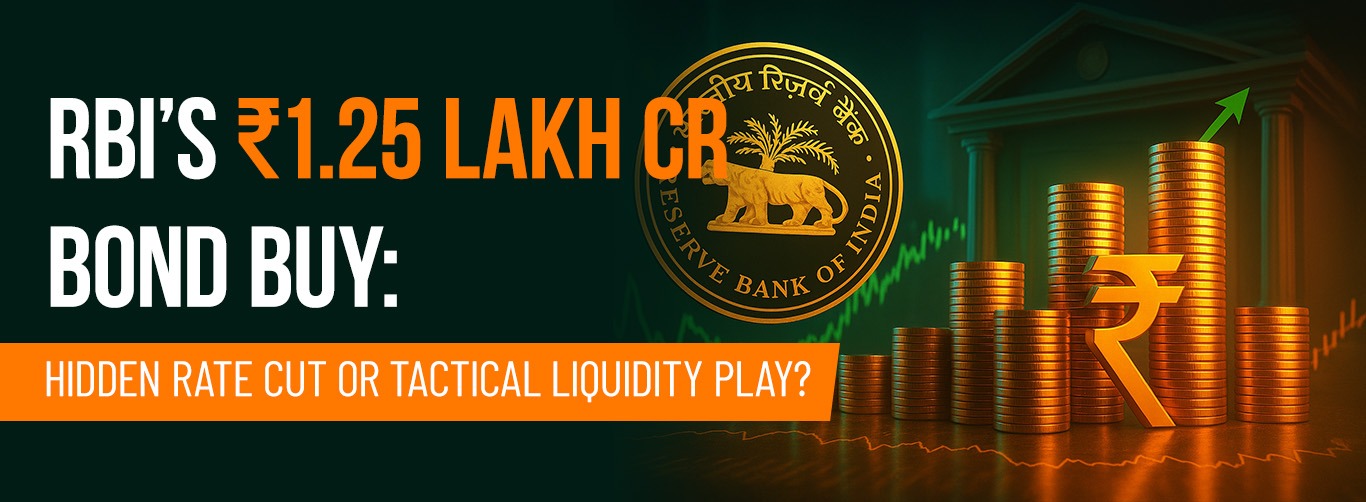
  • RBI’s ₹1.25 Lakh Cr Bond Buy: Hidden Rate Cut or Tactical Liquidity Play?

    RBI’s ₹1.25 Lakh Cr Bond Buy: Hidden Rate Cut or Tactical Liquidity Play?

    The Reserve Bank of India (RBI) has been making bold moves in 2025, but its recent decision to buy government bonds worth ₹1.25 lakh crore in May has sparked a bigger question in financial circles: Is the central bank engineering a stealth rate cut without actually changing the policy repo rate?

    Let’s break it down.

    Injecting Liquidity Without Cutting Rates

    When a central bank buys bonds in the secondary market, it pays cash to the sellers (usually banks), injecting liquidity into the banking system. With more liquidity in the system, the cost of overnight borrowing between banks comes down. That’s exactly what the RBI seems to be targeting.

    Currently, the RBI’s policy repo rate stands at 6.00%. But due to the ongoing bond buying program, the effective cost of overnight funds in the interbank market has dropped significantly. As of April 29, the weighted average call money rate was 5.93%, and analysts expect it to fall further to the Standing Deposit Facility (SDF) rate of 5.75%.

    In simpler terms, the RBI is keeping borrowing costs lower through liquidity, even though the headline policy rate remains unchanged. Many analysts call this a “de facto” rate cut.

    RBI Governor’s Liquidity Strategy

    Under Governor Sanjay Malhotra, who assumed office in December 2024, the RBI has aggressively pumped liquidity into the banking system. Here’s a snapshot of the liquidity infusion so far:

    • ₹2.83 lakh crore in January-March 2025
    • ₹1.20 lakh crore in April 2025
    • ₹1.25 lakh crore planned for May 2025

    This adds up to nearly ₹5.28 lakh crore in just five months. The Governor had previously stated that the RBI aims to maintain a liquidity surplus of around 1% of total bank deposits, translating to approximately ₹2.30-₹2.50 lakh crore in durable liquidity.

    Market Reaction

    The bond market reacted swiftly to the latest announcement. The yield on the 10-year benchmark government bond, which had touched 6.40% a day prior, fell to 6.32% after the May bond purchase plan was revealed. Lower yields reflect market expectations of softer borrowing costs in the near term.

    Why This Strategy Matters

    There have already been two policy rate cuts in 2025, but their transmission to the broader economy has been slower than expected. By increasing liquidity through bond purchases, the RBI is ensuring that these rate cuts reach the real economy faster. Cheaper interbank borrowing means lower lending rates for businesses and consumers, boosting credit and economic activity.

    This approach also provides the central bank flexibility. Instead of committing to more formal rate cuts (which could stoke inflation or spook foreign investors), the RBI can subtly influence short-term rates and maintain broader macroeconomic stability.

    Here’s a quick look at the liquidity tools deployed by the RBI since January 2025:

    Tool Month Amount (in billion ₹)
    Secondary Market Bond Buys Jan 388.25
    OMO (Open Market Operations) Jan 200.2
    6-month FX Swap Feb 445
    OMO Feb 800
    OMO Mar 1445.41
    3-year FX Swap Mar 1735 (870+865)
    OMO Apr 1200
    Planned OMO May 1250

    This shows a consistent and strategic effort to maintain surplus liquidity using a mix of bond purchases and forex swaps.

    Conclusion

    The RBI is clearly walking a fine line. On one hand, it is not overtly loosening policy through explicit repo rate cuts. On the other, it is delivering the same effect through targeted bond buying and liquidity infusions.

    This hybrid approach allows the RBI to stimulate credit growth and economic momentum without sending overtly dovish signals to global markets.

    Analysts believe that if inflation stays under control and external conditions remain stable, this strategy could work well in rebooting India’s economic engine.

    So yes, RBI’s big bond buy does look like a secret rate cut. And markets are already acting like it is one.

    Disclaimer: This article is for informational purposes only and should not be considered as investment advice.
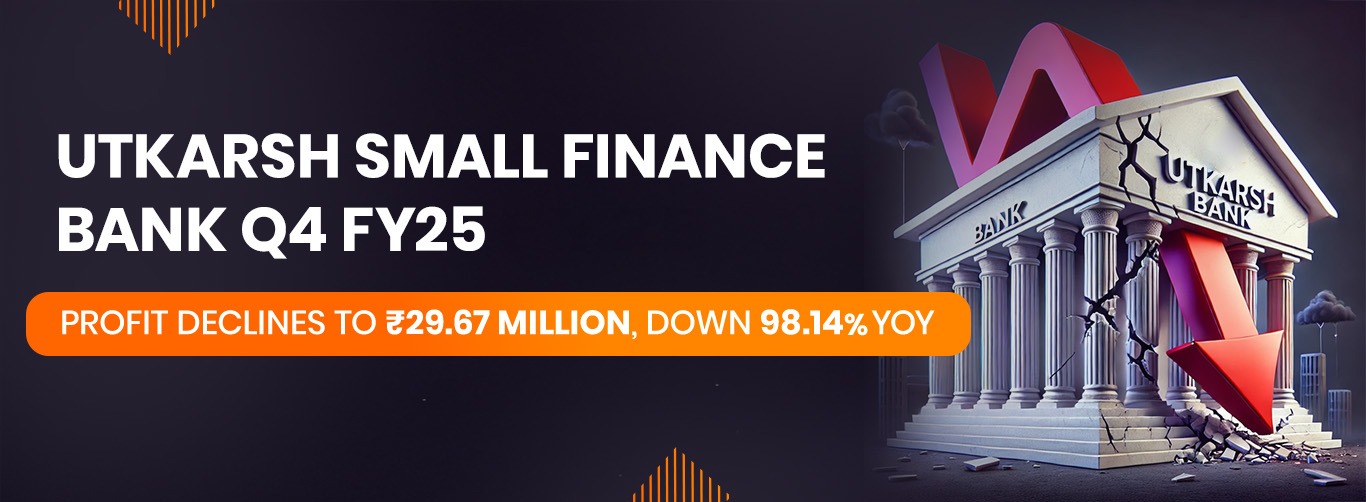
  • Utkarsh Small Finance Bank Q4 FY25: Profit Declines to ₹29.67 Million

    Utkarsh Small Finance Bank Q4 FY25: Profit Declines to ₹29.67 Million

    Utkarsh Small Finance Bank Ltd reported its Q4 FY25 results, showing a slight dip in revenue but a sharp decline in profitability. The bank’s interest earned for the quarter ended March 2025 stood at ₹8,796.23 million, down 1.79% from ₹8,956.20 million in the same quarter last year.

    However, the bank saw a significant jump in other income, which rose 137.90% to ₹2,871.10 million from ₹1,206.85 million year-on-year. Despite the increase in income from non-interest sources, the bank’s profit after tax (PAT) dropped massively by 98.14% to ₹29.67 million compared to ₹1,596.56 million in Q4 FY24.

    Utkarsh Small Finance Bank Financial Statement of Q4 Fy2025

    Parameter Q4 FY25 (202503) Q4 FY24 (202403) % Change
    Interest Earned 8796.23 8956.20 -1.79%
    Other Income 2871.10 1206.85 137.90%
    Interest Expended 4682.15 3556.73 31.64%
    Operating Expenses 4645.42 4645.42 22.76%
    Operating Profit 0.00 0.00 0.00%
    Provisions & Contingencies 2226.99 738.69 201.48%
    Tax 83.10 486.90 -82.93%
    PAT 29.67 1596.56 -98.14%
    OPM (%) 26.60 31.51 -15.59%

    Rising Expenses and Provisions Hurt Profitability

    Interest expenditure surged by 31.64% to ₹4,682.15 million from ₹3,556.73 million. Operating expenses remained flat quarter-on-quarter at ₹4,645.42 million, but provisioning and contingencies saw a massive jump of 201.48% to ₹2,226.99 million, up from ₹738.69 million.

    Tax expenses also dropped significantly by 82.93%, coming in at ₹83.10 million compared to ₹486.90 million in Q4 FY24.

    Operating Profit at Zero

    For Q4 FY25, the bank reported zero operating profit. Despite having increased income sources, higher interest costs, rising provisions, and flat operational costs left no room for operating margins. This reflects in the operating profit margin (OPM), which fell to 26.60% from 31.51% in Q4 FY24.

    Yearly Performance Also Affected

    For the full year ended March 2025, the bank’s PAT stood at ₹237.07 million, a drop of 95.24% compared to ₹4,976.28 million in FY24. On the other hand, interest earned grew by 18.45% to ₹37,649.26 million, and other income surged 49.83% to ₹5,998.34 million. However, these gains were offset by a 34.77% rise in interest expended and a 189.83% increase in provisions.

    Final Thoughts

    Utkarsh Small Finance Bank’s Q4 FY25 results reflect rising costs and provisioning pressures despite stable revenue. The steep fall in net profit indicates challenges in maintaining profitability in the face of increasing expenses and credit risk. Going forward, investors should watch the bank’s provisioning trends and asset quality closely.

    Disclaimer: This blog is for informational purposes only and should not be considered as financial advice or any buy/sell recommendations.

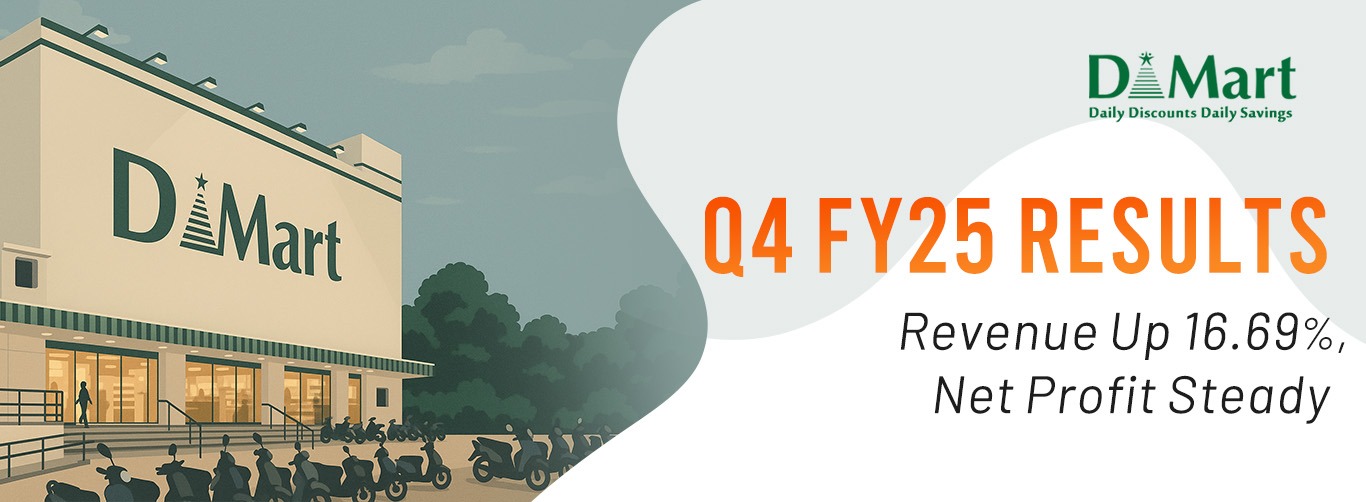
  • DMart Q4 Financial Results 2025: Revenue Up 16.69%, Net Profit Steady

    DMart Q4 Financial Results 2025: Revenue Up 16.69%, Net Profit Steady

    Avenue Supermarts Ltd, the parent company of DMart, posted its financial results for the fourth quarter ending March 2025 (Q4 FY25), showing moderate growth in revenue and profitability. The company registered a 16.69% rise in revenue, reaching ₹1,44,623.90 million compared to ₹1,23,934.60 million in Q4 FY24.

    Dmart Financial Statements Q4 2025

    Metric Q4 FY25 (202503) Q4 FY24 (202403) % Change YoY
    Sales 144623.90 123934.60 16.69%
    Other Income 391.30 522.00 -25.04%
    PBIDT 10205.30 9924.20 2.83%
    Interest 159.90 105.30 51.85%
    PBDT 10045.40 9818.90 2.31%
    Depreciation 2160.20 1780.80 21.31%
    PBT 7885.20 8038.10 -1.90%
    TAX 1688.10 1996.10 -15.43%
    Deferred Tax 66.50 16.50 303.03%
    PAT 6197.10 6042.00 2.57%
    Equity 6507.30 6507.30 0.00%
    PBIDTM(%) 7.06% 8.01% -11.88%

    Key Highlights

    • Sales Growth: The total sales rose to ₹1,44,623.90 million in Q4 FY25, reflecting a healthy year-on-year growth of 16.69%.

    • Operating Profit (PBIDT): Operating profit showed a modest increase of 2.83% to ₹10,205.30 million from ₹9,924.20 million in the same quarter last year.

    • Net Profit (PAT): The net profit grew by 2.57% to ₹6,197.10 million from ₹6,042.00 million in Q4 FY24.

    • Interest Costs: Interest expenses rose significantly by 51.85% to ₹159.90 million.

    • Depreciation Costs: Depreciation increased by 21.31%, reaching ₹2,160.20 million.

    • Profit Before Tax (PBT): The company reported a slight dip in PBT by 1.90%, ending at ₹7,885.20 million.

    • PBIDT Margin: The PBIDT margin dropped slightly to 7.06% in Q4 FY25 from 8.01% in Q4 FY24.

    Despite the growth in revenue, bottom-line expansion remained subdued due to higher depreciation, increased interest costs, and lower other income (down by 25.04%).

    Year-to-Date and Annual Performance

    For the full year FY25, Avenue Supermarts posted annual revenue of ₹5,77,898.10 million, reflecting a 16.67% growth compared to the previous year. Net profit for the full year stood at ₹29,271.80 million, showing a 8.62% growth over FY24.

    The company’s operating efficiencies remain robust, and it has maintained steady equity of ₹6,507.30 million. However, the drop in margins suggests rising costs are impacting profitability.

    Disclaimer: This blog is for informational purposes only and should not be considered as financial advice or any buy/sell recommendations.

  • Manorama Industries Q4 FY25 Results: Net Profit Surges 238% YoY to ₹422.67 Million

    Manorama Industries Q4 FY25 Results: Net Profit Surges 238% YoY to ₹422.67 Million

    Manorama Industries Ltd has posted impressive results for the quarter ending March 2025, showcasing substantial growth in both revenue and profit. The company’s remarkable performance reflects its operational efficiency, strong market demand, and strategic management decisions.

    Key Highlights

    Manorama Industries delivered a strong financial performance in Q4 FY25, with remarkable growth in both topline and bottom-line numbers. Here’s a breakdown of the key financial metrics:

    Financial Performance Breakdown:

    • Sales: Increased by 80% year-on-year, reaching ₹2,328.06 million, compared to ₹1,293.35 million in Q4 FY24. The strong revenue growth signals robust demand and the company’s growing market presence.

    • Other Income: Saw a significant surge of 139.97%, growing to ₹90.59 million from ₹37.75 million in the same quarter last year. This increase provided a solid boost to the company’s operating income.

    • PBIDT (Profit Before Interest, Depreciation, and Taxes): Soared by an impressive 197.21%, reaching ₹729.61 million compared to ₹245.49 million in Q4 FY24, demonstrating enhanced operating efficiency.

    • Interest Costs: Rose by 73.58% to ₹119.46 million, reflecting higher borrowing costs.

    • PBDT (Profit Before Depreciation and Tax): Increased by 245.36%, reaching ₹610.15 million from ₹176.67 million, reflecting improved operational performance.

    • Depreciation: Increased by 69.84%, reaching ₹63.98 million, slightly impacting overall profitability.

    • PBT (Profit Before Tax): Increased by a remarkable 292.93%, reaching ₹546.17 million from ₹139.00 million in Q4 FY24.

    • Tax Expense: Rose sharply by 785.30% to ₹123.50 million, reflecting the surge in profitability.

    • Net Profit (PAT): More than tripled, growing by 238.00% to ₹422.67 million from ₹125.05 million, driven by improved operating efficiency and strong revenue growth.

    Manorama Industries Q4 FY25 Financial Statement (₹ in Million)

    Parameter Q4 FY25 (₹ Million) Q4 FY24 (₹ Million) % Change YoY
    Sales 2328.06 1293.35 80.00%
    Other Income 90.59 37.75 139.97%
    PBIDT 729.61 245.49 197.21%
    PBDT 610.15 176.67 245.36%
    PBT 546.17 139.00 292.93%
    PAT 422.67 125.05 238.00%
    PBIDTM (%) 31.34% 18.98% 65.11%

    Year-to-Date (YTD) Performance: FY25 Overview

    Manorama Industries’ strong Q4 performance was mirrored throughout FY25, with steady growth across key financial metrics. The company’s full-year results reflect its operational efficiency and market leadership.

    Full-Year Financial Highlights:

    • Sales Growth (FY25): The company’s full-year sales were buoyed by Q4’s strong performance, driving the business forward in a competitive market environment.

    • Profit Growth: Despite rising interest and depreciation costs, Manorama Industries managed to increase profitability across the board, positioning itself for continued growth in the coming quarters.

    Profitability and Operational Efficiency

    Manorama Industries demonstrated significant improvements in its profitability metrics, thanks to better operating efficiency and strong revenue realization. The company’s profitability margins saw substantial growth, further highlighting the strength of its business operations.

    Key Profitability Metrics:

    • PBIDT Margin (PBIDTM%): Expanded to 31.34% in Q4 FY25, up from 18.98% in Q4 FY24, showing operational leverage and efficient cost management.

    • Net Profit Margin: The significant increase in net profit, coupled with the surge in other income and efficient cost control, led to a healthy improvement in overall margins.

    Analyst’s View: Impressive Growth and Strong Outlook

    Manorama Industries has demonstrated stellar growth in Q4 FY25, with key financial metrics reflecting exceptional operational efficiency and solid demand for its products. Key takeaways from the quarter include:

    Strengths:

    • Sales grew by a robust 80% year-on-year.
    • A significant surge in other income, boosting operating performance.
    • Exceptional growth in PBT and PAT, supported by improved margins.

    Challenges:

    • Rising interest and depreciation expenses slightly impacted profit margins, though overall profitability remained strong.

    Investor Insight:

    Manorama Industries continues to showcase impressive growth across revenue and profitability metrics. The company’s ability to control costs, expand margins, and improve operating efficiency has put it in a strong position for sustained growth moving forward.

    The Bottom Line

    Manorama Industries has delivered outstanding results for Q4 FY25, with strong revenue and profitability growth. The company’s impressive 238% increase in net profit underscores its operational efficiency and strategic focus. With a solid financial performance and a positive outlook, Manorama Industries is well-positioned for continued success.

    Disclaimer: This blog is for informational purposes only and should not be considered as financial advice or any buy/sell recommendations.

  • Ugro Capital Q4 FY25 Results: Net Profit Rises 24.04%, Sales Grow 25.05% YoY

    Ugro Capital Q4 FY25 Results: Net Profit Rises 24.04%, Sales Grow 25.05% YoY

    Ugro Capital Ltd announced its Q4 FY25 results, revealing strong growth across key financial metrics. The company has posted impressive figures, particularly in sales and net profit, indicating solid operational performance despite the challenging financial landscape.

    Key Highlights

    Ugro Capital demonstrated consistent growth in Q4 FY25, with a notable rise in both top-line and bottom-line performance. Below is the detailed breakdown of the company’s financial results:

    Financial Performance Breakdown:

    • Sales: Increased by 25.05% year-on-year to ₹4,031.76 million, compared to ₹3,224.08 million in Q4 FY24. This growth reflects the company’s expanding customer base and an increase in lending activities.

    • Net Profit (PAT): Rose by 24.04%, reaching ₹405.47 million from ₹326.88 million in the same quarter last year. The growth in profitability highlights Ugro Capital’s efficient cost management and its ability to perform well in a competitive market.

    • Operating Profit (PBIDT): Marginally improved by 29.73% to ₹2,516.58 million, compared to ₹1,939.87 million in Q4 FY24, showcasing strong operational efficiency.

    • Interest Expense: Increased by 41.41% to ₹1,812.13 million, up from ₹1,281.44 million last year, reflecting higher finance costs and their pressure on margins.

    • Depreciation Expense: Rose by 33.72% to ₹132.36 million from ₹98.98 million in Q4 FY24, impacting the overall profitability to some extent.

    • Profit Before Tax (PBT): Saw a modest increase of 2.26% to ₹572.09 million, up from ₹559.14 million in the previous year, despite the pressure from rising interest and depreciation costs.

    Ugro Capital Ltd Q4 FY25 Financial Statement (₹ in Million)

    Particulars Q4 FY25 (₹ Million) Q4 FY24 (₹ Million) % Change
    Sales 4031.76 3224.08 25.05%
    Other Income 92.62 79.84 16.01%
    PBIDT 2516.58 1939.87 29.73%
    Interest 1812.13 1281.44 41.41%
    PBDT 704.45 658.43 6.99%
    Depreciation 132.36 98.98 33.72%
    PBT 572.09 559.45 2.26%
    TAX 166.62 232.57 -28.36%
    PAT 405.47 326.88 24.04%

    Year-to-Date (YTD) Performance: FY25 Overview

    For the full fiscal year (FY25), Ugro Capital continued to demonstrate consistent growth, with a 33.20% increase in sales year-on-year, signaling strong business momentum.

    Full-Year Financial Highlights:

    • Sales Growth (FY25): Ugro Capital posted a 33.20% increase in sales for the full fiscal year, continuing its positive growth trajectory.

    • Profit Growth: The company managed to balance growth and efficiency, delivering stable returns despite the cost pressures seen in Q4.

    Profitability and Operational Efficiency

    Ugro Capital’s ability to maintain strong operational performance and profitability despite rising costs is a key highlight of its Q4 results. Here’s a detailed look at the company’s efficiency:

    Profitability Metrics:

    • PBIDTM (Profit Before Interest, Depreciation, and Tax Margin): Held steady at 62.42% in Q4 FY25, up slightly from 60.17% in the same period last year, indicating consistent operational efficiency and strong margin management.

    • Tax Expense: Declined by 28.36%, offering relief to the company’s bottom line and aiding the growth in net profit.

    • Deferred Tax: Dropped sharply by 71.13%, further contributing to the positive results for the quarter.

    Analyst’s View: Consistent Growth Amid Financial Pressures

    Ugro Capital’s Q4 FY25 results are a testament to the company’s robust growth strategy, even in a competitive market environment. Key insights from the quarter include:

    Strengths:

    • Strong sales growth of 25.05% year-on-year.
    • A healthy increase in operating profit and net profit.
    • Efficient cost control leading to stable margins.

    Challenges:

    • Rising interest and depreciation expenses putting pressure on profitability.
    • Modest increase in PBT, reflecting the impact of higher finance costs.

    Investor Insight:

    Ugro Capital has shown resilience in a challenging financial environment. The company’s ability to maintain stable margins and improve profitability despite rising costs suggests solid management and a promising outlook, provided it continues to optimize its operational expenses.

    The Bottom Line

    Ugro Capital’s Q4 FY25 results reflect consistent growth and strong operational performance, despite rising interest expenses and depreciation costs. The company has successfully balanced top-line growth with cost management, and its stable profit margins are a positive sign for the future. Going forward, Ugro Capital’s ability to control rising costs and maintain strong operational efficiency will be key to sustaining its growth momentum.

    Disclaimer: This blog is for informational purposes only and should not be considered as financial advice or any buy/sell recommendations.

  • Avantel Ltd Q4 FY25 Results: Net Profit Falls 43.77%, Revenue Up 17.81%

    Avantel Ltd Q4 FY25 Results: Net Profit Falls 43.77%, Revenue Up 17.81%

    Avantel Ltd announced its financial results for Q4 FY25, presenting a mixed performance across key financial metrics. While the company saw strong revenue growth, it struggled with declining profitability due to increased costs and higher interest expenses.

    Key Highlights

    The March 2025 quarter saw significant revenue growth, yet escalating costs affected the company’s bottom line, resulting in a sharp decline in net profit.

    Financial Performance Breakdown:

    • Revenue: Increased by 17.81% to ₹491.42 million, compared to ₹417.12 million in Q4 FY24, reflecting strong market demand and operational progress.

    • Net Profit (PAT): Declined by 43.77% to ₹73.57 million, down from ₹130.83 million in Q4 FY24. The drop in profitability was primarily driven by higher costs and interest expenses.

    • Operating Profit (PBIDT): Fell by 33.16% year-on-year to ₹130.27 million, indicating pressure on margins despite revenue growth.

    • Profit Before Depreciation and Tax (PBDT): Dropped by 35.52% to ₹123.72 million, down from ₹191.87 million in the previous year.

    • Interest Expenses: Increased significantly by 115.46% to ₹6.55 million, putting further strain on profitability.

    • Depreciation Charges: Rose by 18.31% to ₹28.04 million, contributing to the decline in operating profit.

    Avantel Ltd Q4 FY25 Financial Statement (₹ in Million)

    Particulars Q4 FY25 (₹ Million) Q4 FY24 (₹ Million) % Change
    Sales 491.42 417.12 +17.81%
    Other Income 4.76 4.60 +3.48%
    PBIDT 130.27 194.91 -33.16%
    Interest 6.55 3.04 +115.46%
    PBDT 123.72 191.87 -35.52%
    Depreciation 28.04 23.70 +18.31%
    PBT 95.68 168.17 -43.11%
    PAT 73.57 130.83 -43.77%

    Year-to-Date (YTD) Performance: FY25 Overview

    Looking at the full year (FY25), Avantel Ltd showed moderate improvement in overall sales, but net profit remained relatively flat, reflecting ongoing cost pressures.

    Full Year Financial Highlights:

    • Revenue: Increased by 10.97% year-on-year to ₹2,484.84 million.

    • Net Profit: Grew by 8.05% to ₹599.16 million, compared to ₹554.51 million in FY24, marking a slight improvement in profitability despite quarterly challenges.

    Profitability Under Pressure

    Despite solid revenue growth, Avantel Ltd’s profitability faced notable headwinds in Q4 FY25 due to rising expenses. Here’s a closer look:

    Profitability Metrics:

    • Profit Before Tax (PBT): Decreased by 43.11% to ₹95.68 million from ₹168.17 million in Q4 FY24.

    • Tax Expenses: Provided partial relief as tax provision dropped by 40.79% to ₹22.11 million, helping to cushion the impact on the bottom line.

    Analyst’s View: A Mixed Quarter with Challenges Ahead

    Avantel Ltd experienced solid revenue growth in Q4 FY25, but the rise in costs and interest expenses significantly hampered profitability. Key insights from the quarter include:

    Strengths:

    • Strong revenue growth driven by operational progress.
    • Modest increase in full-year net profit.

    Challenges:

    • Increased interest expenses and depreciation charges.
    • Substantial decline in operating profit and PBT, highlighting margin pressures.

    Investor Insight:

    Avantel Ltd’s ability to manage rising costs and interest expenses will be crucial for its future profitability. The company will need to focus on maintaining its revenue growth while optimizing costs and controlling interest expenses to improve profitability in the coming quarters.

    The Bottom Line

    Avantel Ltd’s Q4 FY25 results showcase strong revenue growth but highlight significant profitability challenges, primarily driven by increased operating costs and higher interest expenses. As the company navigates these headwinds, it will need to address cost pressures effectively to sustain its revenue momentum and improve profitability moving forward.

    Disclaimer: This blog is for informational purposes only and should not be considered as financial advice or any buy/sell recommendations.

  • IDFC First Bank Q4 FY25 Results: Revenue Up 14.52%, Net Profit Falls 58.02%

    IDFC First Bank Q4 FY25 Results: Revenue Up 14.52%, Net Profit Falls 58.02%

    IDFC First Bank Ltd has announced its financial results for Q4 FY25, delivering a mixed set of numbers. While the revenue saw healthy growth, the bottom line faced significant pressure due to increased provisions and expenses. Here’s a detailed breakdown of the bank’s quarterly and full-year performance.

    Key Highlights of IDFC First Bank Q4 FY25 Financial Results

    The bank witnessed strong revenue growth in the March 2025 quarter, primarily driven by robust interest earnings and other income. However, profitability took a sharp hit due to rising expenses and provisions.

    Performance Summary:

    • Interest Earned: Rose 14.52% year-on-year to ₹94,129.40 million, compared to ₹82,192.10 million in Q4 FY24.

    • Other Income: Increased by 15.43% to ₹18,954.10 million, reflecting diversification beyond traditional banking income.

    • Interest Expended: Jumped 20.14% to ₹45,057.80 million, indicating higher borrowing and funding costs.

    • Operating Expenses: Increased by 12.23% to ₹49,909.60 million, hinting at expansion activities or administrative cost escalations.

    • Operating Profit: Remained at zero, similar to the previous year’s performance.

    IDFC First Bank Q4 FY25 Financial Statement (₹ in Million)

    Particulars Q4 FY25 (₹ Million) Q4 FY24 (₹ Million) % Change
    Interest Earned 94,129.40 82,192.10 14.52%
    Other Income 18,954.10 16,420.00 15.43%
    Interest Expended 45,057.80 37,503.40 20.14%
    Operating Expenses 49,909.60 49,909.60 12.23%
    Provision & Contingencies 14,504.70 7,223.10 100.81%
    Tax 570.60 2,172.50 -73.74%
    Profit After Tax (PAT) 3,040.80 7,243.50 -58.02%
    Equity 73,221.10 70,699.90 3.57%
    Operating Profit Margin (OPM) 19.25% 20.24% -4.93%

    Profitability Under Pressure

    Despite higher revenues, profitability took a hit due to a surge in provisions:

    • Provisions and Contingencies: Shot up by 100.81% to ₹14,504.70 million.

    • Profit After Tax (PAT): Fell sharply by 58.02% to ₹3,040.80 million, compared to ₹7,243.50 million in Q4 FY24.

    • Operating Profit Margin (OPM): Slightly decreased to 19.25%, down from 20.24% year-on-year.

    Full Year FY25 Financial Overview

    Over the full financial year, the bank continued to show top-line growth but struggled on the profitability front.

    Annual Performance Metrics

    • Total Interest Earned: ₹365,014.90 million, up 20.38% year-on-year.

    • Other Income: ₹70,217.10 million, showing a 16.99% increase.

    • Interest Expended: Rose by 24.06%, outpacing interest earned.

    • Provisions and Contingencies: Soared by 131.55%, indicating a more conservative approach to risk management.

    • Profit After Tax (PAT): Dropped 48.42% to ₹15,248.50 million, compared to ₹29,565.10 million in FY24.

    • Equity Base: Grew marginally by 3.57% to ₹73,221.10 million.

    Analyst’s View: Cautious Optimism Amid Challenges

    IDFC First Bank’s Q4 FY25 results reflect a story of strong top-line momentum clouded by rising costs and cautious provisioning. Here’s a closer analysis:

    Strengths:

    • Solid growth in interest and non-interest income.
    • Stable equity base.

    Challenges:

    • Escalating interest expenses.
    • Higher provisions denting profitability.
    • Drop in operating margins.

    The bank’s proactive provisioning signals a cautious stance in the face of macroeconomic uncertainties, which could bode well for long-term stability.

    Investor Insight:

    Going forward, investors should closely track:

    • Asset quality indicators.
    • Provisioning trends.
    • Efforts to manage rising costs and improve profitability.

    A recovery in profitability will largely depend on the bank’s ability to manage asset quality without letting expenses spiral further.

    Final Thoughts

    IDFC First Bank’s Q4 FY25 results highlight the bank’s revenue strength but also underscore the growing pressure on its profitability. With a conservative approach towards risk management and a stable equity base, the bank appears to be preparing itself for future uncertainties. Investors would do well to stay vigilant on key metrics like provisioning, interest expenses, and asset quality trends in the coming quarters.

    Disclaimer: This blog is for informational purposes only and should not be considered as financial advice or any buy/sell recommendations.

  • The India Cements Q4 FY25 Result: Net Loss Widens by 157.96% | Revenue Falls 3.87%

    The India Cements Q4 FY25 Result: Net Loss Widens by 157.96% | Revenue Falls 3.87%

    The India Cements Ltd announced its financial results for the fourth quarter ended March 2025, reflecting a challenging operational performance. The company continued to face headwinds from declining sales and margin pressures, resulting in a significantly wider net loss.

    Key Highlights

    The fourth quarter results showcased a mix of operational challenges and cost-saving efforts. Despite lower finance costs, persistent sales and margin pressures weighed heavily on the overall performance.

    Performance Summary:

    • Revenue: Declined by 3.87% to ₹11,971.30 million, compared to ₹12,453.80 million in Q4 FY24.

    • Operating Profit (PBIDT): Fell sharply by 66.41% year-on-year to ₹240.30 million from ₹715.30 million, mainly due to lower sales volume and margin compression.

    • Interest Costs: Reduced by 25.31% to ₹476 million, indicating cost optimization efforts.

    • Other Income: Slightly fell by 4.58% to ₹235.40 million from ₹246.70 million in the same quarter last year.

    The India Cements Q4 FY25 Financial Statement (₹ in Million)

    Particulars Q4 FY25 (₹ Million) Q4 FY24 (₹ Million) % Change
    Sales 11,971.30 12,453.80 -3.87%
    Other Income 235.40 246.70 -4.58%
    PBIDT 240.30 715.30 -66.41%
    Interest 476.00 637.30 -25.31%
    PBT -1,011.30 -329.10 -207.29%
    PAT -756.60 -293.30 -157.96%
    PBIDT Margin (%) 2.01% 5.74% -65.05%

    Losses Deepen Despite Cost Controls

    While India Cements managed to reduce its finance costs, weak operational performance dragged its profitability further down:

    • Pre-Tax Loss (PBT): Expanded sharply to ₹1,011.30 million, a 207.29% rise compared to a loss of ₹329.10 million in Q4 FY24.

    • Net Loss (PAT): Widened significantly to ₹756.60 million from ₹293.30 million in the previous year’s quarter, marking a 157.96% increase.

    • PBIDT Margin: Weakened to 2.01% in Q4 FY25, down from 5.74% in Q4 FY24, reflecting a steep 65.05% decline.

    Full Year FY25 Financial Overview

    The full-year numbers paint a similar picture of declining revenues and escalating losses.

    Annual Performance Metrics:

    • Total Revenue: Dropped by 17.28% year-on-year to ₹40,884.70 million.

    • Annual Net Loss: Increased sharply to ₹6,675.60 million, compared to a loss of ₹2,025.20 million in FY24.

    The company’s operational margin deterioration and higher depreciation expenses contributed significantly to the worsening bottom line.

    Analyst’s View: Tough Road Ahead

    The India Cements Ltd faces substantial operational challenges that will require urgent strategic responses. Here’s a closer analysis:

    Strengths:

    • Lower finance costs signal active efforts towards cost rationalization.

    Challenges:

    • Persistent revenue decline.
    • Margin pressure leading to operating profit shrinkage.
    • Widening losses despite some cost-saving measures.

    Investor Insight:

    Recovery will likely depend on:

    • Revival in cement demand.

    • Aggressive cost control initiatives.

    • Strategic moves to improve sales volumes and operational efficiency.

    Management’s ability to stabilize margins and boost demand recovery will be critical for the company’s financial turnaround in the coming quarters.

    The Bottom Line

    The India Cements Ltd’s Q4 FY25 results underline the tough operating environment it continues to face. With lower sales, shrinking margins, and escalating losses, the road to recovery appears steep. Sustained demand improvement and stronger operational strategies will be key drivers if the company aims for a financial rebound.

    Disclaimer: This blog is for informational purposes only and should not be considered as financial advice or any buy/sell recommendations.