
findocblog

Category: Mutual Fund

  • How Much Loan Can You Get Against Your Mutual Funds?

    How Much Loan Can You Get Against Your Mutual Funds?

    Mutual fund investments can help you build wealth and serve as collateral for quick funds. Taking loans against mutual funds gives investors a practical way to get cash without selling their portfolio during market ups and downs.

    A loan against mutual funds lets you use your fund units as collateral for secured borrowing. This setup helps you access money quickly while your investments continue to grow. The interest rates are substantially lower than other options – between 8% and 12% per year, compared to unsecured loans that charge 9% to 14%. Your fund type determines how much you can borrow – equity mutual funds typically qualify for 50-70% of their value, and debt mutual funds can get you up to 80-90%.

    Quick processing stands out as a key benefit of these loans. Lenders usually release the money within one to two days. This speed makes them perfect for handling urgent money needs without disrupting your investment plans.

    Why consider a loan against mutual funds?

    Need to tap into your mutual fund portfolio’s value without selling your investments? A loan against mutual funds gives investors several advantages when they need quick cash.

    Quick liquidity without selling investments

    You can get immediate cash by taking a loan against mutual funds without disrupting your investment plans. The funds reach your account within 24 to 48 hours after approval. This makes it a great choice when you need urgent money. You can pledge your mutual fund units as collateral and get quick funds instead of selling investments during market downturns.

    Your investments keep growing because you own the mutual fund units throughout the loan period. You’ll benefit from potential capital appreciation and dividend distributions even after borrowing against them. Your portfolio continues to work for you while you use its value.

    Lower interest rates than unsecured loans
    Mutual Fund

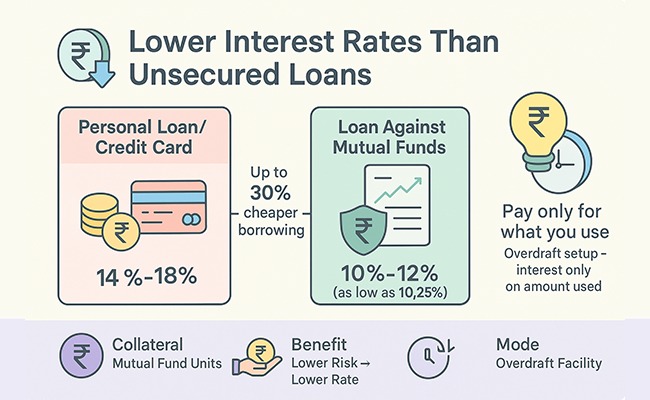
    The most important financial benefit is how budget-friendly these loans are. Lenders see these loans as less risky than unsecured borrowing options because your mutual fund units act as collateral. The interest rates on loans against mutual funds are much lower than personal loans or credit cards.

    These rates usually range between 10% and 12% per year, and some lenders offer rates as low as 10.25%. Many institutions also set up these loans as overdraft facilities. This means you pay interest only on the amount you use and for the time you use it.

    Ideal for short-term financial needs

    These loans work great for temporary financial needs without affecting your long-term investment goals. Here are some situations where this option makes sense:

    Handling unexpected medical emergencies or family needs
    Making down payments for major purchases like real estate or vehicles
    Supporting business growth or working capital needs
    Combining higher-interest debts into a lower-cost loan
    Paying for educational expenses or planned vacations

    The repayment options are flexible too. Many lenders don’t require fixed EMIs like traditional term loans. You can repay the principal amount anytime during the loan period as per your convenience. This gives you better control over your finances.

    How lenders decide your loan amount

    Lenders look at specific criteria to decide your borrowing limit against mutual funds. You should know these factors to get a good idea of your loan amount before you apply.

    Understanding loan-to-value (LTV) ratios

    LTV ratio is the life-blood of calculating loan amounts. This ratio shows what percentage of your fund’s value you can get as a loan. To name just one example, see a mutual fund portfolio worth ₹10 lakh – with a 50% LTV, you could borrow ₹5 lakh. Different financial institutions offer ratios between 50% and 90%.

    Your borrowing experience depends on LTV ratios in several ways:

    • They set your maximum eligible loan amount
    • Better interest rates usually come with lower LTVs
    • You must maintain this ratio while your loan runs

    Impact of fund type: equity vs debt

    Your choice of mutual fund type plays a big role in your borrowing limit. Market volatility makes equity-based funds riskier, so they come with lower LTV ratios than debt funds:

    • Equity/Hybrid/ETF mutual funds: LTV ratios go up to 50%
    • Debt/FMP mutual funds: You can get higher LTV ratios of 75% to 80%

    Debt funds get better terms because they’re more stable with fewer price swings. SBI lets you borrow up to ₹10 lakh against equity funds and up to ₹5 crores against debt funds. HDFC caps loans at ₹20 lakh for equity funds and ₹1 crore for debt funds.

    Role of credit score and borrower profile

    Mutual Fund

    Notwithstanding that mutual funds serve as collateral, lenders review your creditworthiness:

    Your credit score shapes approval speed, interest rates, and possible loan limits
    Better scores lead to more attractive terms
    Steady income shows you can handle repayments
    Your complete financial picture, including what you own and owe, determines your final approved amount

    Lenders check your credit history mainly to see how well you’ve paid back loans before, not to decide how much to lend.

    Steps to apply and get the loan

    The digital age has made it easier to get loans against mutual funds. Here’s what you need to do after deciding this is the right choice for you.

    Choosing the right lender

    You should start by looking at what different financial institutions have to offer. The loan’s interest rates, loan-to-value ratios, and processing fees need careful attention. Banks now give you flexible ways to repay with minimal penalties. Make sure the lender works with both SOA-based and demat-based mutual funds, since some only deal with specific formats. The lender’s customer service reputation matters too – you’ll want reliable support throughout your loan journey.

    Submitting folio and scheme details

    Most applications now happen digitally without any paperwork. The process starts when you download the lender’s app or visit their website. You’ll submit your PAN and Aadhaar for KYC checks, along with your mutual fund’s registered phone number and email. The next step lets you pick which mutual fund units to use as collateral – both equity and debt funds work fine. SBI and other lenders can wrap this up quickly, often in less than 10 minutes.

    Signing the lien agreement

    A lien lets lenders hold or sell your mutual fund units as security against the loan. Once you’ve picked your funds, you’ll approve the lien marking through OTP verification on RTA portals like CAMS or KFintech. The next steps involve confirming your bank details for loan payments and signing the digital loan agreement.

    Loan disbursement timeline

    Lenders move fast to check your details after you apply. Your money should hit your bank account within hours if everything checks out – some lenders promise to send it in 2-4 hours. SBI takes this a step further by creating an overdraft account right after marking the lien.

    Smart borrowing tips for investors

    Smart decisions about loans against mutual funds need careful planning. Here’s a guide to borrow wisely and protect your investments.

    Compare interest rates and terms

    The smart approach is to shop around instead of accepting the first offer. Interest rates typically range from 10% to 16%, and lenders offer significantly different terms. Processing fees vary between 0.35%-5% of loan amount, and annual maintenance charges can reach 5%. Early repayment policies deserve special attention since some lenders allow penalty-free prepayment. This flexibility can be valuable later.

    Avoid over-leveraging your portfolio

    Smart investors keep loan amounts to 60-70% of their portfolio value, regardless of higher limits offered by lenders. This buffer helps protect against market volatility that might trigger margin calls. A sudden drop in your fund’s value could force you to provide additional collateral or make unexpected payments.

    Plan repayment to avoid forced liquidation

    Your repayment schedule should align with reliable income streams. Defaulting carries serious consequences – lenders can liquidate your pledged units and disrupt your long-term financial goals. Your credit score will suffer, and you’ll face substantial penalties.

    Use loans only for productive purposes

    These loans work best for value-generating activities like business growth or debt consolidation. Taking loans for unnecessary expenses creates financial pressure without any real benefits. The decision to leverage your investment portfolio needs careful consideration of the true value it brings.

    Conclusion

    Loans against mutual funds definitely provide a practical solution when investors need quick liquidity without disrupting their investment goals. This piece shows how these loans offer many advantages that traditional borrowing options cannot match. Investors can access funds faster while their investments continue to grow and potentially generate returns.

    These loans become more attractive because of their lower interest rates. Pledging mutual fund units can save you substantial money during the loan period instead of using high-interest personal loans or credit cards. The flexible repayment options also give borrowers better control over their financial commitments.

    Your fund type is a vital factor in determining loan amounts. Debt mutual funds typically fetch higher loan-to-value ratios due to their stability. Equity funds offer lower LTVs because of market volatility. This difference shows why portfolio diversification matters for maximizing borrowing potential.

    Smart investors should approach these loans strategically. A careful comparison of lenders shows substantial variations in interest rates, processing fees, and terms. Borrowing less than the maximum allowed amount helps maintain a safety margin and protects against market fluctuations that might trigger margin calls.

    The application process runs efficiently now, with many lenders offering digital, paperless experiences. Most steps from selecting funds to signing lien agreements happen quickly, leading to fast loan disbursement.

    Loans against mutual funds serve as a valuable financial tool when used wisely. They help bridge temporary cash gaps without forcing premature exits from investment positions. All the same, borrowers must plan their repayment carefully and use funds productively to avoid forced liquidation. These loans can enhance your broader financial strategy while preserving long-term investment goals if you understand and use them responsibly.

    FAQ

    The LTV ratio typically ranges from 50% to 90%, depending on the type of mutual fund. Equity funds generally qualify for 50-70% of their value, while debt funds can fetch up to 80-90% of their value as a loan.

    Most lenders process and disburse loans against mutual funds within 1-2 days. Some institutions even offer disbursement within 2-4 hours after application completion and verification.

    Yes, interest rates for loans against mutual funds are generally lower than unsecured loans. They typically range between 10% and 12% per annum, which is significantly less than personal loans or credit card rates.

    Absolutely. When you take a loan against your mutual funds, you retain ownership of the units. This means you can still benefit from potential capital appreciation and dividend distributions throughout the loan period.

    If you default on the loan, the lender has the right to liquidate your pledged mutual fund units to recover the outstanding amount. This could disrupt your long-term financial goals and potentially damage your credit score. It’s crucial to plan your repayments carefully to avoid such situations.

  • What is a Registrar and Transfer Agent (RTA)? Roles & Services

    What is a Registrar and Transfer Agent (RTA)? Roles & Services

    A Registrar and Transfer Agent (RTA) is a specialised organisation that helps companies and mutual fund houses manage their investor data. RTAs issue and transfer securities, like shares or mutual fund units, and maintain up-to-date records of investors. They also handle customer service and process corporate actions. RTAs act as a link between the investors and the company.

    Why RTAs Are Essential in Financial Markets

    Registrar and Transfer Agents (RTAs) are essential for ensuring smooth operations in financial markets. They act as a link between investors, companies, and mutual funds, simplifying many processes.

    • They reduce the workload on companies and mutual funds.
    • They keep investor records safe and updated.
    • They make investing and withdrawing easier for investors.
    • They ensure timely payments like dividends.

    Roles & Responsibilities of a Registrar and Transfer Agent

    Registrar and Transfer Agents (RTAs) handle multiple tasks that keep financial markets running efficiently. Their roles go beyond just record-keeping, covering everything from security issuance to investor support.

    Role Description
    Issuance & Transfer Help companies issue new securities and manage the buying/selling of stocks or mutual funds
    Maintain Investor Records Store investor names, contact info, and investment details
    Corporate Actions Ensure timely dividend payouts, bonuses, splits, and other actions
    Investor Support Handle queries, complaints, and service requests from investors

    1. Issuance & Transfer of Securities

    RTAs help process IPOs and mutual fund investments. They check if investors are eligible and update records when shares are bought or sold.

    2. Maintenance of Investor Records

    RTAs keep a record of who owns how many shares or mutual fund units, along with names, addresses, and contact details.

    3. Dividend, Corporate Actions & Claim Processing

    They help with timely dividend distribution, manage share buybacks, and update investor details during events such as mergers or splits.

    Services Provided by RTAs to AMCs

    RTAs also support Asset Management Companies (AMCs) by handling critical back-office and investor-related tasks that ensure smooth mutual fund operations.

    Service Explanation
    SIP/SWP Processing Manage regular investment and withdrawal plans
    NAV Calculation Help mutual funds calculate the daily unit value
    Sales & Marketing Support distributors and campaigns for fund promotion
    Accounting Keep transaction and expense records
    KYC Verify investor identity

    Services Provided by RTAs to Investors

    For investors, RTAs act as a single point of contact, offering various services that make investing and account management easier.

    Service Explanation
    Buy/Sell Requests Help investors invest in or withdraw from mutual funds
    Statements Provide CAS, capital gain, and transaction summaries
    Account Updates Support changes in nominee, bank, or contact details
    Demat/Remat Convert mutual fund units to and from demat form

    Best Registrar and Transfer Agents in India

    India has several well-known Registrar and Transfer Agents (RTAs) that provide reliable services to both companies and investors. Here are some of the best RTAs in the country:

    RTA Known For
    CAMS Servicing leading mutual funds with advanced digital services
    KFin Technologies Offers RTA services to mutual funds and listed companies
    Link Intime Handles IPO services and investor data
    Bigshare Services Focuses on investor services for smaller companies

    Findoc also offers seamless Demat account opening and investor support solutions. This makes it easier for clients to access capital markets and manage investments efficiently.

    Regulatory & SEBI Compliance Norms for RTAs

    Registrar and Transfer Agents (RTAs) operate under strict regulatory guidelines to ensure transparency and investor protection. Securities and Exchange Board of India (SEBI) has laid down specific compliance norms that RTAs must follow:

    • Mandatory Registration: RTAs must be registered with SEBI before offering their services.
    • Investor Protection Rules: They must comply with SEBI’s investor-centric regulations.
    • Data Confidentiality: Investor information must be kept secure and confidential.
    • Grievance Redressal: Investor complaints must be addressed quickly and effectively.

    SEBI Investor Charter and Timelines

    • Complaints must be resolved within 30 days
    • Dividends must be credited within 30 days of declaration
    • Demat transactions must be updated in 2 days

    MITRA: Tracking Inactive or Unclaimed Folios

    MITRA is a tool that helps investors find old or forgotten mutual fund investments using details like PAN or email ID. It is helpful when investors lose track of where they invested.

    Technology Trends: Digital Portals & Certification in RTA Functions

    RTAs now offer online services where investors can update information, download statements, or file complaints easily. These digital tools make investing more convenient.

    NISM Certification for RTA Professionals

    • NISM offers certification exams for RTA staff
    • Certified staff are trained in compliance, transactions, and grievance handling
    • Helps maintain industry quality and service standards

    Findoc’s digital platform further enhances investor convenience by enabling easy portfolio tracking and faster service requests. This ensures an efficient and hassle-free investment experience.

    RTAs vs In-House Registrars: A Comparison

    Companies can either outsource their record-keeping to Registrar and Transfer Agents (RTAs) or manage it internally through an in-house registrar. Here’s how the two approaches compare:

    Feature RTA In-House Registrar
    Cost More cost-effective Higher maintenance cost
    Expertise Trained professionals Limited internal know-how
    SEBI Compliance Strictly followed Needs ongoing updates
    Scalability Handles large volumes Challenging for large data

    Mutual Fund Calculator

    SIP Calculator
    Lumpsum Calculator
    Mutual Fund Return Calculator

    Frequently Asked Questions (FAQs)

    Registrar agents primarily maintain investor records and process corporate actions, while transfer agents handle the actual transfer of securities. In India, both functions are often combined and managed by RTAs.

    RTAs help investors with buy/sell requests, statements, account updates, and demat services. For AMCs, they manage SIP/SWP processing, NAV calculation, marketing support, accounting, and investor KYC verification.

    You can update your bank or contact details with your RTA by submitting a written request or online form, along with valid ID and supporting documents for verification..

    The mutual fund house or company appoints the RTA to manage investor services. The fund house or company pays the fees, not the investors. For you, as an investor, most services are free.

    Issues such as incorrect details, delayed updates, or missing statements can happen. To fix them, contact the RTA directly via phone, email, or their website. If not resolved, you can file a complaint with SEBI through the SCORES portal.

  • XIRR in Mutual Funds: Meaning, Uses, Calculation & Benefits

    XIRR in Mutual Funds: Meaning, Uses, Calculation & Benefits

    XIRR tells you the growth of your mutual fund investments and takes into account all the irregular inflows and outflows

    XIRR is a more realistic and accurate measure than absolute returns

    Let’s say you have started investing in mutual funds and want to compare the returns between two funds. If you only see the absolute returns, you might not get the real picture. This is one scenario in which XIRR, which stands for Extended Internal Rate of Return, comes to the rescue.

    XIRR in Mutual Funds

    In mutual funds, when one choses the SIP (Systematic Investment Plan) option, the investments made are spread over different time periods. Also, many investors choose to withdraw some amount which is known as partial withdrawal. Even when it comes to lumpsum investments, the inflows and outflows can be spread across different dates. To measure the returns, XIRR is used.

    What is XIRR?

    XIRR tells you the growth of your mutual fund investments and takes into account all the irregular inflows and outflows. Let’s understand this with the help of a following example:

    January 1, 2024: Shilpa starts investing in ABC mutual fund with an initial investment of Rs 10,000.

    June 1, 2024: She has some extra funds and invests Rs 10,000 more.

    January 1, 2025: The total amount invested is Rs 20,000 (10,000 + 10,000). The value of her portfolio is now Rs 25,000. She decides to check her returns.

    Now, her absolute returns are Rs 5,000 (Portfolio value 25,000 minus Investment value 20,000). In percentage terms, her absolute returns are 25%. But since she spread her investments, it’s not really accurate. Using the XIRR tool in Excel, XIRR comes out to be 32.15%.

    Why Does it Make Sense for Mutual Fund Investments?

    XIRR is a very useful tool when it comes to mutual funds. Here are some reasons:

    1) It accounts for irregular cash flows and outflows.
    2) Helps you evaluate and compare your mutual fund schemes.
    3) It’s a more realistic and accurate measure than absolute returns.
    4) It’s useful even when you redeem units from any mutual fund scheme.

    Calculation

    XIRR can be calculated using Microsoft Excel which has an inbuilt XIRR calculation function.

    XIRR formula in excel is: = XIRR (value, dates, guess)

    Step by Step Process to Calculate in Excel

    1. Create a spreadsheet with two columns — dates and corresponding cash flows.
    2. The amount you have invested should be in negative as cash is going out. Similarly, the amount you gave redeemed should be in positive. The current value of your portfolio should also be in positive.
    3. Use the XIRR function in Excel by selecting your cash flow range and date range.
    4. The resulting percentage is your XIRR.

    Example of How to Use the Function in Excel

    Let’s take an example of Kabir making an SIP of Rs 10,000 every quarter in the year of 2024.

    His transaction dates are:

    • January 1, 2024
    • April 1, 2024
    • July 1, 2024
    • October 1, 2024
    • December 1, 2024

    His total amount invested is Rs 50,000 and let’s assume the value of his investment to be Rs 60,000 on January 1, 2025. To calculate the XIRR in excel, follow these:

    1. In column A enter the dates and in column B, enter the SIP amounts. The SIP amounts should start with minus sign.
    2. Enter the date of January 1, 2025 in column A and the amount of Rs 60,000 in column B as that is the value of the portfolio.
    3. In the box below 60,000, type in =XIRR(select the amounts in column B, then select the date in in column A,).
    4. It will look like =XIRR(B2:B7,A2:A7,)
    5. The XIRR will be displayed in point terms. You can covert it in percentage terms. It comes out to 40%.

    Can We Use CAGR Instead for Calculating Returns?

    CAGR (Compound Annual Growth Rate) is commonly used when evaluating mutual funds with regular cash flows. It is best suited when the investment pattern is constant like in lumpsum. On the other hand, XIRR is used when the inflows are irregular. It’s ideal for SIP investments and also accounts for irregular withdrawals. It is a more accurate measure of returns and is also used to compare two or more mutual fund schemes.

    Final Thoughts

    XIRR is a great tool for evaluating mutual fund returns. The biggest advantage of XIRR is that it accounts for the timing and amount of each investment and also each withdrawal to give the real picture. Investors can also compare two or more mutual fund schemes they are invested in and take corrective measures if necessary.

    FAQs

    In Excel, use =XIRR(values, dates) where values include all cash flows (investments as negatives, redemptions as positives) and dates are corresponding transaction dates.

    Yes, XIRR considers all cash flows, including partial withdrawals or redemptions.

    No. Since mutual funds are long-term investments, monitoring XIRR quarterly or bi-annually is sufficient.

    Yes. A negative XIRR means the current value of your investment is less than your total investment, indicating a loss.

    Yes. XIRR reflects portfolio value changes and thus fluctuates with market movements.

  • What is SIP – Systematic Investment Plan?

    What is SIP – Systematic Investment Plan?

    A Systematic Investment Plan (SIP) is a disciplined and convenient investment method offered by mutual funds, allowing individuals to invest a fixed sum of money at regular intervals—monthly or quarterly—instead of making a lump sum investment. It provides a structured way of investing, ensuring financial discipline while reducing the impact of market volatility.

    Understanding the Fundamentals of SIP

    A Systematic Investment Plan (SIP) is an easy method to invest either in mutual funds or the stock market. You invest a fixed amount regularly, such as monthly, which purchases funds or stock units. SIP in the share market and SIP in the stock market help manage market volatility through rupee cost averaging and grow wealth over time via compounding. Regular, disciplined investing allows small contributions to accumulate into a significant corpus, making long-term financial goals more achievable.

    Key Features of a SIP Investment Plan

    A SIP provides a straightforward method to invest regularly. It helps manage risk and build wealth over time.

    • Regular Investment: Invest a set amount every week, month, or quarter in mutual funds or the stock market.
    • Low Starting Amount: SIPs can begin with just ₹500, making them accessible for all investors.
    • Flexibility: You can alter, reduce, or stop your SIP based on shifting financial objectives.
    • Risk Reduction: Regular investments buy more units when markets are low and fewer when high, reducing the average cost per unit.
    • Compounding Benefits: Returns earn further returns over time, helping your corpus grow significantly.
    • Convenience: Automated investments via your bank account make SIPs simple, disciplined, and stress-free.

    How Does SIP Work?

    A SIP is a convenient and disciplined approach to investing money in mutual funds or shares at periodic intervals, thus helping to create wealth over the long term.

    • Regular Investment: Invest a fixed amount at set intervals in mutual funds or stocks.
    • Decide Parameters: Choose the investment amount, frequency (daily, weekly, monthly, quarterly), and investment option.
    • Auto-Debit: The amount selected is auto-debited and invested on the pre-decided date.
    • Unit Allocation: Units are distributed according to the prevailing Net Asset Value (NAV), which fluctuates with market performance.
    • Compounding: Periodic investments increase with time as returns give rise to additional returns, building wealth while controlling risk.

    If you’re planning to start a SIP online, make sure you open a free demat account to seamlessly link your SIP investments and track their growth.

    How to Start a SIP?

    1. Select a mutual fund scheme based on financial goals and risk appetite.
    2. Complete the KYC verification and submit required documents.
    3. Set up the SIP amount, frequency (monthly/quarterly), and tenure.
    4. Provide bank standing instructions for auto-debit.
    5. Regularly monitor and review SIP performance.

    SIP investments can be modified or paused anytime without penalties. Investors can use SIP calculators to estimate future returns and make informed decisions.

    Let’s understand SIP with an example:

    Month Investment (₹) Price Per Unit (₹) Units Purchased
    Month 1 1,000 50 20
    Month 2 1,000 40 25
    Month 3 1,000 20 50
    Month 4 1,000 25 40
    Month 5 1,000 50 20
    Total ₹5,000 155 units

    Thus, the average cost per unit is ₹5,000 / 155 = ₹32.26 per unit, ensuring a cost-effective investment strategy.

    Benefits of SIP Investing

    1. Disciplined Investment Approach – Encourages consistent investing habits.
    2. Power of Compounding – The reinvestment of earnings leads to wealth accumulation over time.
    3. Rupee Cost Averaging – Reduces the impact of market fluctuations.
    4. Convenience – Automated deductions ensure hassle-free investing.
    5. Low Investment Requirement – Start with as little as ₹500 per month.
    6. Flexibility – Adjust the SIP amount or pause it when required.
    7. Diversification – Spread investments across multiple asset classes.
    8. Professional Fund Management – Managed by experienced fund managers.
    9. Passive Investing Option – Invest in passively managed index funds via SIP.

    Types of Mutual Fund SIPs

    1. Regular SIP – Fixed investment at regular intervals.
    2. Flexible SIP – Allows changes in investment amounts.
    3. Perpetual SIP – Continues indefinitely until manually stopped.
    4. Trigger SIP – Investments based on market conditions or set triggers.
    5. Multi SIP – Invest in multiple mutual fund schemes via a single SIP.
    6. Step-up SIP – Allows predefined periodic increases in investment amount.

    Things You Should Know Before Starting a SIP

    Before starting a Systematic Investment Plan (SIP), keep the following points in mind:

    • Set Financial Targets Clearly: Determine if the SIP is for retirement, house purchase, or child education. Specific goals enable you to select the proper funds and investment size.
    • Associate with Bank Account: Link your SIP with a bank account having an adequate balance to prevent payment defaults and ensure regular investing.
    • Investment Frequency: Opt for a frequency that works with your budget, e.g., quarterly or monthly, to stay disciplined and control liquidity.
    • Long-Term Horizon: SIPs are planned for slow but sure wealth accumulation. Bumps in the market are inevitable, so be patient.
    • Compare Funds: Review previous track record, scheme type, and risk level to choose a scheme that meets your needs.

    Tips to Select the Right Mutual Fund Scheme for SIP Investment

    Selecting the right mutual fund for your SIP is essential to achieving your financial goals and building long-term wealth. Consider the following points:

    • Define Your Goals: Make a decision about whether you want to invest for long-term goals like retirement, or short-term purposes like purchasing a bike or going on a holiday.
    • Check Past Performance: Examine how past performance has been, but remember that past returns cannot guarantee future outcomes.
    • Compare Expense Ratios: The expense ratio is the fee charged by the fund house. Lower costs can improve your net returns over time.
    • Review Consistency of Returns: Analyse fund performance over 3, 5, or 10 years to understand its stability and reliability.
    • Read Risk Labels Carefully: Check whether the fund is labelled “Low,” “Moderate,” or “High” risk before investing.
    • Check the Fund Manager and Fund House: Choose funds managed by reputable companies with a proven track record.
    • Use Reliable Platforms: Findoc makes it easier to compare funds and select the right option for your needs.

    Who Can Benefit from Investing in SIPs in the Stock Market?

    Stock market Systematic Investment Plans (SIPs) are appropriate for most investors seeking disciplined, long-term wealth generation.

    • Salaried Individuals: Ideal for setting aside a fixed portion of income each month to achieve goals such as buying a house or planning for retirement.
    • Beginners: A simple, low-risk way to start investing while gradually building confidence and discipline.
    • Self-Employed Professionals: Flexible for irregular income, allowing small contributions that can grow as earnings increase.
    • Homemakers and Students: Start with just ₹500 per month, making investing accessible and easy.
    • Experienced Investors: Helps maintain consistency and steadily grow wealth over the long term.
    • Anyone with Long-Term Goals: Supports step-by-step achievement of objectives like education, property purchase, or retirement planning.

    The Power of Compounding & Early Investments

    Starting early can significantly impact wealth accumulation due to compounding. For example, investing ₹2,000 per month for 5 years at an 8% annual return can grow substantially if left invested for the long term.

    Consider this: Person A and Person B both invest ₹2,000 per month at an 8% annual return till they turn 60. However, Person A starts at the age of 25 and Person B starts at the age of 35: 

    • Person A starts investing at 25 years and holds till 60 years – final corpus grows to ₹14 lakh.
    • Person B starts at 35 years and holds till 60 years – final corpus is only ₹6 lakh.

    This demonstrates why starting early leads to greater financial growth.

    Difference Between SIP (Systematic Investment Plan) and Mutual Funds (Lump Sum Investment)

    Investors can invest in mutual funds either via a Systematic Investment Plan (SIP) or by lump-sum investment. Both methods target market appreciation but vary with regard to timing, risk, and appropriateness.

    Feature SIP (Systematic Investment Plan) Lump Sum Investment
    Investment Mode Fixed amount at regular intervals One-time large investment
    Market Timing No need to time the market Risk of wrong timing
    Risk Reduces risk through cost averaging Higher risk if market falls
    Suitability Ideal for small, steady investors Suitable for large funds at once

    Common Myths About SIP

    There is a lot of confusion regarding SIP, what SIP is, and how SIP works, among investors when they initiate a SIP in the share market or a SIP in the stock market. The major myths are:

    • Stop SIPs When Returns Fall: Natural fluctuations in the short term; SIP is optimum over 10–12 years.
    • Too Risky: Rupee cost averaging lessens the effect of market fluctuation.
    • Low NAV Implies more Returns: NAV is merely the unit price, not a performance measure.
    • Only Small Investors can Have It: A stock SIP has no limit to maximum investment.
    • Amount cannot be Altered: Contributions can be increased or reduced at any time for flexibility.

    Conclusion

    SIPs provide a structured, affordable, and flexible investment route, making them ideal for long-term wealth creation. They help investors avoid emotional investing, benefit from rupee cost averaging, and leverage compounding power. Selecting the right SIP depends on individual financial goals, investment horizon, and risk tolerance. Start your SIP today for a secure financial future!

    Disclaimer: This article is for informational purposes only and should not be considered as investment advice.


    Frequently Asked Questions

    No, investments made through SIPs are subject to market risks. However, if you invest with a long-term horizon, you are more likely to earn good returns over time.

    It can be discouraging to see your investment value drop in a falling market. However, you should not stop your SIP. Continuing your SIP during market downturns allows you to buy more units at lower prices, which can benefit you in the long run.

    There’s no one-size-fits-all answer. It depends on your investment style. SIP helps build discipline and is ideal for beginners or those with a steady income. If you’re an experienced investor who closely tracks the market, a lump sum investment may work better for you.

    Yes, you can stop your SIP at any time. After doing so, you can either withdraw your invested amount or let it remain invested in the fund.

    Yes, if you invest in a tax-saving mutual fund such as an ELSS (Equity Linked Savings Scheme), you can claim deductions of up to ₹1.5 lakh under Section 80C of the Income Tax Act.

    Yes, returns from SIPs are taxable. The tax treatment depends on the type of mutual fund and the holding period of your investment.

  • Understanding the Role of Mutual Funds in Retirement Planning

    Understanding the Role of Mutual Funds in Retirement Planning

    A mutual fund pools money from various investors and invests it in a diverse range of assets, including stocks, bonds, money market funds, and government securities. Mutual funds are regulated by SEBI in India to ensure transparency and protect investor interests. When these investments generate income, the earnings are distributed proportionately among the investors. The overall collection of these investments is known as a portfolio.

    In recent years, investment funds like mutual funds have become increasingly popular, particularly for retirement planning. According to global statistics from 2023, 60% of individuals have increased their mutual fund investments, with 79% citing retirement as their primary goal. In India, individual investors made up about 96.9% of listed mutual funds investments in 2021, highlighting the growing use of mutual funds to supplement retirement income.

    This article explores how mutual funds with dividends can play a critical role in securing your retirement. Keep reading to learn how you can mitigate retirement risks by investing in mutual funds.

    The Role of Mutual Funds in Retirement Planning

    1. Diversification

    You’ve probably heard the phrase, “Don’t put all your eggs in one basket.” Mutual funds embody this principle by spreading investments across various asset classes or industries, reducing exposure to the risk of any single market or asset.

    For instance, if one stock in your mutual fund portfolio declines, its impact can be cushioned by gains from other stocks. This diversification allows investors to match their risk tolerance to their retirement goals. Younger investors, for example, may opt for higher-risk equity funds targeting growth, while those nearing retirement might prefer balanced or bond funds with more stable returns.

    2. Compounded Growth

    Mutual funds also allow for the compounding of returns. This means the earnings generated by your investment are reinvested back into the fund, helping your money grow at an accelerated rate over time.

    For example, if you invest ₹20,000 in a mutual fund that offers an annual return of 9%, your returns will be reinvested each year, allowing your initial investment to grow significantly over a longer period, such as 10 or 20 years, without any additional input from you.

    3. Professional Management

    Mutual funds are managed by professional fund managers who have extensive knowledge of the markets and a deep understanding of different asset classes. They make informed decisions based on market research and trends, ensuring that your money is allocated efficiently across multiple investments.

    These experts help reduce the burden of constantly monitoring the market, ensuring that your portfolio is optimized and aligned with your long-term goals, including minimizing potential losses due to market fluctuations.

    4. Tax Benefits

    Certain mutual funds offer tax-saving benefits, which can be especially useful in retirement planning. For example, Equity Linked Savings Schemes (ELSS) allow you to lock your investment for three years and qualify for a tax deduction of up to ₹1,50,000 under Section 80C of the Income Tax Act. Additionally, the gains from ELSS after the three-year period are treated as long-term capital gains and are taxed at 10% if they exceed ₹1 lakh in a financial year.

    Debt funds also offer tax-efficient benefits through indexation, which helps lower the tax burden on long-term capital gains. Additionally, if you invest in mutual funds via the National Pension Scheme (NPS), you can defer taxes until withdrawal, and in some cases, you may even qualify for full tax exemption under certain conditions.

    5. Steady Retirement Income

    As you approach retirement, a steady income stream becomes essential, and mutual funds can help provide this. Many mutual funds invest in a combination of equity and debt, offering periodic payouts through dividends or interest, which can supplement your income during retirement.

    Some mutual funds also offer plans that allow for systematic withdrawals, ensuring a consistent cash flow in your post-retirement years. Your fund manager can also customize a systematic withdrawal plan (SWP) that aligns with your specific needs, ensuring your investment lasts throughout your retirement.

    6. Flexibility

    One of the key advantages of mutual funds is their flexibility. You can adjust your portfolio as your financial needs or risk tolerance change over time. For example, as you near retirement and become more risk-averse, you can shift from equity to debt investments. Mutual funds are also highly liquid, meaning you can access your funds in case of an emergency without much hassle.

    Drawbacks of Mutual Funds

    While mutual funds offer many benefits, there are drawbacks of mutual funds to consider. One such drawback is the potential for high mutual funds fees, which can eat into your returns over time. When you compare mutual funds, it’s important to evaluate these fees, such as expense ratios, to ensure they align with your investment goals. Additionally, mutual funds can be subject to market volatility, which means your returns are not guaranteed, especially in the short term.

    Key Takeaways for Retirement Planning

    A diversified portfolio is crucial for managing risk, and mutual funds provide an excellent platform to diversify across various asset classes. By investing in mutual funds, you can align your portfolio with your risk tolerance and retirement timeline, ensuring financial security in your later years.

    Start building your retirement corpus today with the Findoc by investing in a range of large-cap, mid-cap, and small-cap mutual funds. We’ll help you create a robust plan for your post-retirement life.

  • What is a SIP? How to Invest in Mutual Funds via SIP?

    What is a SIP? How to Invest in Mutual Funds via SIP?

    A Systematic Investment Plan (SIP) is a method of investing a fixed sum of money every month in a mutual fund scheme. You can choose between different equity and debt funds. A SIP allows you to buy units regularly on a fixed date.

    This long-term systematic investment plan can provide higher returns and minimize risk. Investing in a mutual fund SIP is a smart way to channel your savings to create long-term wealth. With SIPs, you can invest your hard-earned money in a planned and systematic manner.

    What Makes SIP the Best Way to Invest in Mutual Funds?

    Investing through a SIP comes with several benefits:

    • Power of Compounding: With a SIP, you invest a small amount regularly for the long term, starting at an early age. This gives you the benefit of compounding and creates wealth over time.
    • Rupee Cost Averaging: By investing a fixed amount of money consistently for a long time, you achieve a lower average cost, reducing the impact of market volatility.
    • Easy to Invest: Investing in a SIP is straightforward and can be done easily with a few mouse clicks. It doesn’t involve a complicated process.
    • Small Capital Requirement: You don’t need a large sum of money to start investing in a SIP. You can begin with as little as INR 500 per month.

    How to Invest in Mutual Funds via SIP?

    Before starting any investment, you should list your dreams and set realistic financial goals, then work out a plan to achieve them.

    Once you’ve figured out your SIP goals, it becomes easier to choose the right funds. Using a systematic investment plan calculator can help you plan your investments more effectively by estimating potential returns based on your inputs.

    However, investing in a SIP requires completing your KYC (Know Your Customer). For this, you need to submit your identity proof and address proof and complete your IPV (In-Person Verification).

    Identify the schemes in which you would like to invest. These might include equity funds, debt funds, and tax-saving funds. Diversifying your investments through multiple SIPs in different schemes can optimize returns and minimize risks.

    Experts recommend investing for the long term to enjoy the twin benefits of the power of compounding and rupee cost averaging by navigating different market cycles.

    Complete the formalities for SIP investment, including forms and cheques. Then invest in mutual funds via SIP of your choice.

    Final Thoughts

    Investing in SIPs is like planting seeds for your future financial growth. It’s an easy, disciplined, and affordable way to build wealth over time. By staying updated with the latest mutual fund news and using a SIP Calculator plan, you can visualize how your small monthly contributions can grow into a substantial corpus, helping you achieve your financial goals. So, start small, stay committed, and let your money work for you.

  • What are Flexi-Cap Funds? How is it different from Multi-Cap Funds?

    What are Flexi-Cap Funds? How is it different from Multi-Cap Funds?

    The Asset Under Management (AUM) of the Indian MF Industry has grown from ? 6.80 trillion as on April 30, 2012, to ?38.04 trillion as on April 30, 2022, more than 5.5-fold increase in a span of 10 years. Along with this, the mutual fund industry has crossed a milestone of 10 crore folios during the month of May 2021. The industry comprises various Asset Management Companies (AMCs) that offer a variety of schemes to the investors like equity-oriented, debt-oriented, hybrid, gilt, money market, etc. One such type of scheme that has been recently introduced in India is called flexi-cap funds. In this article, we will try to understand such schemes and how they are beneficial for investment.

    What Is Flexi-Cap Fund?

    Flexi-Cap Fund is an open-ended, dynamic equity scheme. It invests across companies of any market capitalizations i.e., large-caps, mid-caps, and small-caps companies. Such type of funds allows the investors to diversify their portfolio and alongside mitigate risk, reduce volatility and generate good returns. Unlike other funds like large-cap, mid-cap or small-cap funds which need to invest in companies restricted to their specific market capitalization size, flexi-cap funds offer the fund manager to be flexible and pick any stock from the benchmark to be included in the portfolio.

    Flexi-Cap Funds vs Multi-Cap Funds

    • As per regulation, a Multi-cap Fund has to invest at least 75% of its total assets in equities and in case of a Flexi-cap Fund, it has to invest a minimum of 65% of its assets in equity and equity-related instruments.
    • For a Multi-cap fund, the investment has to be minimum 25% in large-cap, minimum 25% in mid-cap and minimum 25% in small-cap companies. But in case of a Flexi-cap Fund, there are no minimum threshold for investments in large, mid and small cap.
    • A Multi-cap Fund is required to maintain the equity allocation regardless of the market conditions whereas a Flexi-cap Fund provides its fund manager better flexibility to explore investment opportunities and churn the portfolio whenever they want.

    Advantages of Flexi-Cap Funds

    • It can grab opportunities across the entire market spectrum like market capitalization, sector, style of investing, etc.
    • There is always a battle between risk and returns in the markets. Flexi-cap funds have a unique approach to balance the risk and returns in the market to ensure that the invested capital stays safe and fetches good growth.
    • Flexi-cap funds can be referred to as ‘all weather investing’ because there is complete freedom given the fund manager and based on the market cycles and swings, the AUM can be allocated accordingly to avoid any downsides and volatility.
    • It is one of the best equity investment avenues for investors who have a moderate to high risk profile with a long-term approach for investing.
    • Another big advantage is that they are dynamic in nature. If a particular theme or style of investing seems no longer profitable, the fund manager can modify or change the style that seems to fit in the current market environment.

    Top 3 best Flexi cap Funds based on the past Returns:

    flexi-cap-fund
  • How Large Cap Equity Funds can be your master stroke in Investment

    We all have dreams that we aspire to achieve in our lives. Rano’s story is similar to many of us. She wanted to pursue higher studies in management, but her family couldn’t afford the hefty fees. This is a common challenge; like Rano, many children are unable to continue their education due to financial constraints.

    However, Rano’s story takes a different turn. One day, during her first year of college, she came across a newspaper advertisement that said, “Equity Funds are subject to market risk.” Curious, she began searching for more information about this phrase. While browsing the internet, she eventually found a comprehensive article on Equity Mutual Funds, specifically focusing on large-cap equity funds.

    The article explained: Large-cap Equity Mutual Funds invest the pooled corpus of money into shares of well-established, financially stable companies with a large market capitalization. These funds are known for their relative stability and are considered less risky compared to mid-cap and small-cap funds. In simple terms, large-cap equity funds invest in shares of large companies on your behalf. Although she found it difficult to understand at first, she continued reading.

    The article further explained that at least 65% of the portfolio must comprise investments in equity and equity-related instruments, with a significant portion typically allocated to large-cap stocks. The remainder can be invested in money market instruments or debt securities, depending on the investment objective of the scheme. Compared to other types of mutual funds, equity fund investments, especially large-cap funds, are associated with a moderate level of risk but are also expected to generate stable returns over the long term.

    top-8-large-cap-funds

    The mention of stable returns caught her attention, and she eagerly read the next line, which stated, “Furthermore, there is no such thing as a ‘one-size-fits-all’ equity fund. There are many different types of equity funds based on investment strategy, market capitalization, and taxation benefits, each with its own investment objective that must be matched to your risk profile. However, large-cap equity funds are often recommended for investors seeking steady growth with lower risk.”

    After giving some thought to what she had read, Rano began to wonder if she could ask her father to invest in a large-cap equity mutual fund.

    She approached her dad and explained everything. She also mentioned that a key advantage of investing in large-cap equity mutual funds is their ability to provide inflation-beating returns while offering relative stability. This means that, despite rising inflation and market fluctuations, the returns should be sufficient to offset these effects. Investing in large-cap equity mutual funds also enables the investor to have a diversified portfolio, as the money is spread across several large, established companies.

    Moreover, losses in one large-cap stock can be offset by gains in others, minimizing overall risk. Additionally, these mutual funds are managed by professionals, making it easier to invest. Rano suggested, “Dad, why don’t we start investing in large-cap mutual funds together? My internship earnings and your savings could help cover the fees for my MBA program. Maybe we could also consult with professional analysts to understand large-cap equity mutual funds in-depth?”

    Her dad agreed to consult a professional, and they dialed a number with the tagline, “We can help you invest with ease.” The analyst answered the call, and Rano’s dad began by saying, “My daughter wants to study for an MBA, but we might not be able to save enough for her education. Can you help us understand how mutual funds, particularly large-cap funds, could help us save this amount over the next 3-4 years?” The analyst listened to their concerns and began explaining the different types of investment caps.

    He explained, “There are three types of caps: Large, Mid, and Small. However, it’s important to consider the factors that affect equity mutual funds before investing. When it comes to risk, large-cap equity mutual funds are comparatively less risky than mid-cap and small-cap funds because large companies tend to be more stable and less affected by market fluctuations. Small-cap and Mid-cap funds have a higher risk profile but also offer significantly higher growth potential.

    “On the other hand, large-cap funds, which I think would be perfect for your daughter’s education fund, provide good returns while significantly reducing investment risks. This will help you save enough money for her education. Therefore, depending on your risk appetite, you can choose the type of equity fund that suits you best.

    Frequently Asked Questions

    1. What are Large Cap funds?

    Large-cap funds are those funds that invest a big or larger proportion of their corpus in the top 100 companies by market capitalization, as defined by SEBI.

    2. Are they risky?

    Market risk exists but is comparatively lower from small cap and mid cap funds due to the financial health of the companies. Investors should be prepared for possible moderate losses.

    3. What are the usual returns?

    Usually provide stable and more predictable returns, but lesser growth potential due to the size of the companies.

    4. What about the time horizon?

    Generally, have a time horizon of 3-5 years because the companies are mature and can provide capital appreciation over this period.

    5. Are they safe investments?

    The funds are known as safer form. They can easily withstand the bear market. Also, they can deliver stable returns when compared to the middle and the small cap funds.

    6. Why should I invest in large cap funds?

    Well, those companies which have a market capitalization of more than Rs. 20,000 crore come under large cap funds. These companies have a good track record which is also backed by good governance practices. So, you can develop your trust since they abide by the healthy corporate ethics.

    7. Who should invest in large cap funds?

    Since these funds are less volatile in nature relative to other funds and their performance is generally stable, it makes investors less vulnerable to the equity market. If someone is looking to diversify their portfolio, large cap funds are more suitable. If you don’t want to take high risks and want to stick with pretty returns, then you must think of investing in it.

    8. Are there any factors that an investor should consider here?

    Yes, you can look for: What is investment purpose or objective?, What has been the past performance of large cap funds, How much experience does the fund manager have?, What is the expense or cost ratio and how will it impact? This will help you understand if large-caps funds are your preference? I believe, if you have 3-4 years and you want to get a stable yet good return that is not volatile as well, then large-cap funds are the most suitable ones for your daughter’s education. The analyst said. He also added that the fundamental goal of investing in equities mutual funds is to increase your wealth at a faster rate than inflation. Equity fund returns are significantly higher than those of other mutual fund types. Also, for people searching for a short-term investment, equities investments are not the best option, so at least 3-4 years investment is the best. After listening to the analysts, Rano and her dad agreed to invest in Equity Mutual Funds with a large-cap.

    They couldn’t believe that the analyst was right. They had a genuine amount of deposit in their bank account after 4 years of investment with a large cap. And they now had enough money to pay for Rano’s MBA program fee. Now, this was an emotional moment for both Rano and her dad. Afterall why not? All thanks to Rano’s curiosity to know and courage to take the risk.

    One more important lesson to learn here. Most of us give up on our dreams due to lack of money, but money is not an intrinsic value; it can be generated through timely investment. And Rano proved it through Equity Mutual Funds.

  • All about Mutual Funds; explore insights

    All about Mutual Funds; explore insights

    We all know the feeling of watching your savings grow as you invest in something sure to be a hit. What if we told you there are other ways for people like yourself, who don’t have much money but want access to financial markets? Mutual funds can provide this opportunity through investing pools made up by many investors – or even just one!

    A mutual fund doesn’t rely on any specific person’s expertise; instead, it draws upon various viewpoints, making them more resilient against negative influences than an individual could ever hope to become alone. So, if curiosity got sparked after reading about how these things work (which, let’s face it, was probably inevitable), then we’re here to give you a whole tour on mutual funds.

    A recent report by NS Venkatesh, chief executive officer of Amfi and India’s Mutual Fund Association, reveals that as many as 2.39 crores mutual fund investors have doubled to 1.19 crore at the end of March 2017, which is an impressive growth rate over two years.

    Here are the top 4 reasons people buy Mutual Funds!

    It’s no surprise that mutual funds are among the most popular financial investments. The funds offer many features to please an assortment of appetites, with affordability as its main selling point for many!

    Professional Management

    The fund managers are responsible for doing all the research, and they guide you to select which stocks to buy or sell. In addition, their knowledge of market trends helps lower your risk if one company fails because it diversifies investments among many companies in different industries that could be affected by such an event.

    Affordability

    Most new investors start small, so they can learn about investing before committing lots upon joining up with retirement plans like pensions etc. Still, over time most funds allow adjustments upwards when someone has gained enough experience & confidence.

    Diversification

    “Keep your financial bowl healthy.” A mutual fund typically invests in various companies and industries to help lower risk and manage your portfolio accordingly. Diversification is a saviour that enables you to balance your highs and lows in mutual funds.

    Liquidity

    As shared, mutual funds also typically offer affordable pricing with low initial minimums followed by regular purchases at fair market value as NAV goes up over time – often just 1% per year! In addition, you can quickly redeem shares when needed without paying any hefty fees associated.

    What are the risks associated with Mutual Funds?

    Mutual funds are a great way to invest in the market, but they come with risks. For example, mutual fund managers can force you out if an investment doesn’t go according to plan. And there’s no guarantee that your money will be safe even after retirement since this investing requires constant reinvestment rather than just keeping what earned interest has accumulated over time like saving accounts do.

    There are also several advantages; some people feel more comfortable putting their assets into something where someone else knows how it should grow, which might lead them to choose investments. Such as mutual funds because then all risk is offloaded onto others who know what needs doing so long as those managing affairs have to access enough capital from elsewhere (earned through fees).

    Your portfolio is worth more today than it was yesterday. But how do you know if the price of your investments has gone up or down? You can check with a financial advisor for answers, but before doing so, be aware that several different types and sources of dividends are available! (And hey, do you know we can help you out too and you don’t have to worry about the losses, we are on it too!)

    Dividends may come from stock in companies that pay out profits every quarter; bonds might provide interest income monthly – even daily sometimes-and investor funds invest portfolios based upon specific strategies like growth investing for long term success where small increases could lead to significant returns over time while slowing down economic volatility.

    Yes, almost all funds indeed carry some level of risk. And with mutual funds, you may lose money because the securities held by a fund can go down in value, or dividends could change as market conditions do so. But past performance is not an indicator for future returns; it is necessary to diversify your investments and avoid placing all eggs into one basket! And an expert can guide you better at this.

    Here is a quick guide to understanding different types of Mutual Funds.

    There are so many funds out there; it’s hard to keep up! There is a mutual fund for every type and style of investor.

    Common ones include money market or liquid assets management; sector-, country-, region-specific equity investments; alternative strategies that seek high returns by investing in companies that aren’t doing well but may eventually turn around. These can be riskier bets than traditional markets because they’re betting on an unknown future event happening sooner rather than later.

    Let’s know about the various Mutual Funds and their unique traits.

    Equity Funds

    The category of “Equity” funds is the largest in this list. There are many different types, such as small-Cap, Mid-cap and large-cap stocks for investments based on size or approach towards growth strategies. These strategies are aggressive investing versus income-producing values that do not have high expectations about future returns but rather strict guidelines to earn profits from dividends paid out by companies’ earnings instead. Additionally equity can be categorized according to Reflecting Domestic (U S) Stocks vs Foreign Equities which will boost one’s investment options depending upon where you want your money to go generate greater rates than those offered through other countries’ economies.

    Fixed-income

    Fixed-income funds are a great way to invest if you’re looking for stability. These mutual funds have set rates, such as government bonds or corporate debt instruments. They pay interest on what the company has saved in their pocket, which is then passed down through shares with dividends at regular intervals (usually annually).

    It could be argued that these investments offer more security than alternatives like stocks, where one can lose 50% overnight. However, there still needs careful consideration before making any decisions because while fixed income provides peace of mind when things go smoothly – nobody wants an emergency fund complete!

    Index funds

    Index funds are another popular investment strategy that has become increasingly popular in recent years. Index fund managers base their decisions on the belief it’s tough and often expensive to try to beat market averages consistently over time; this way, you can spend less money with your advisor or research team, who will pass along any excess returns back into shareholder pockets instead of spending them all away trying harder than before when nothing was really gained from those efforts anyway!

    Balanced fund

    A balanced fund is an investment that attempts to reduce the risk associated with various asset classes. There are two variations- one designed for those who want more stability and another which considers volatility to make it easier on investors’ appetites.

    The aim behind this kind of strategy can be summarized as follows: if you’re scared about stocks going down, then put your money into bonds; however, if things don’t look so bad after all but what happened last year seems too far off due historical trends continuing at their current pace – why not try investing some cash alongside its equivalent amount worth gold or silver coins?

    Income funds

    Income funds are named for their purpose, to provide steady cash flow. These investments consist primarily in high-quality corporate bonds and government debt which holds them until maturity so that they can generate interest rates from it as well as produce income on an ongoing basis? For investors who want this type of security but may also have cautioned about the various financial that makes situation more complicated and make sense because if something goes wrong, it’s not like anyone will come out ahead significantly since most people had invested money into things knowing full well how risky stocks could potentially get once everyone starts panicking again.

    How to buy or sell Mutual Funds?

    You can buy and sell mutual funds through an online brokerage account, or you may have the option to do so at a local bank branch. Findoc also helps in buying and selling mutual funds. We have an expert team and dedicated fund investors to guide you throughout your mutual funds’ investment journey.

    Fund investors buy mutual fund shares from the fund itself or through a broker for an agreed-upon price, including any sales loads. The net asset value at the time of purchase is only included in this calculation and does not reflect changes to NAV after that (this would be considered misleading). Fund managers can redeem their shareholdings with prompt payment within seven days if they choose to–a good reason why those who invest should consider doing so before maturity!

    Wondering how to get started?

    The best way to invest in a mutual fund is through findoc.com and complete your KYC formalities before you can proceed with the process, but it’s not complicated!

    Here’s how:

    1. Signing up for an account on Findoc requires just some basic information like name or email address that will be used as identification once we have taken care of everything else (i.e., full coordination between customer-facing systems).
    2. You can identify the funds you are interested in investing in or take help from our fund investors.
    3. Investing your money is an important decision that you should not take lightly. And investing in Mutual Funds through a reliable source is much more important than anything else.

    So, if you are young or even in your late 50s, you must consider this. Also, don’t forget that Mutual Funds can expand your multiple income streams too!

  • Best Large Cap Mutual Funds 2021

    Best Large Cap Mutual Funds 2021

    Large Cap Mutual Funds, is a type of mutual fund which according to SEBI, invests in the top 100 companies.

    Things to Consider as An Investor

    RISK: Market risk exists in large-cap equity funds, but it is moderate. They are known for generating consistent dividends and wealth accumulation. The money is invested in financially strong businesses, the underperformance is averaged out over time which provides stability.

    RETURN: Large Cap Funds do not perform erratically as they have a history of strong performance during both market lows and highs. The risk exposure is comparatively less for these funds, therefore the returns on them are less volatile.

    INVESTMENT HORIZON: These funds are suitable for investors with a long- term horizon. Typically, the fund underperforms during market downturns, but returns in the 10% to 12% range over the long term of more than seven years.

    FINANCIAL GOAL: They are perfect for an investor who wants to take on a moderate amount of risk. These funds can be used to build wealth for retirement planning, or to fulfill your house loans, to plan for children’s weddings etc. These funds can also be used to establish a portfolio for new investors who want to get into the stock market but are concerned about risk.

    CAPITAL GAIN TAX: One of the other advantages of investing in Large Cap Funds is that investor is subject to capital gains. Capital gains on such investments are tax-free as long as they don’t exceed Rs. 1 lakh. Long-term capital gains that surpass Rs. 1 lakh are subject to a 10% tax. Short term capital gains (when money is withdrawn in less than 1 year), are subject to 15% tax.

    Now let us take a look at the top 8 Large Cap Funds

    top-eight-large-cap-funds

    These funds invest in companies that have market Cap of more than 20000 crore. It also shows us the returns generated by these funds across 1,2 and 3 years. Let’s take the example of Mirae Asset Large Cap Fund to show the returns we can expect based on historical data.

    MIRAE ASSET LARGE CAP FUND

    mirae-asset-large-cap-fund

    The above table shows us the value of a Rs 1000 SIP started on 1 April 2018. Suppose we invest 1000 every month for 1 year up till 1/3/19. This SIP gives 49.19% absolute returns and an annualized return of 14.27% in 3 years up till 1/4/21. The SIP reaches a value of 17903.17 with just 12000 invested!

    mutual-fund

    Now suppose we instead choose to invest via lumpsum. The value of lumpsum investment of 10000 after 3 years is 16016.13. Thus, the lumpsum gives us a 60.16% absolute return and a 17% annualised return in just 3 years!

    It also shows us the risk ratios associated with these funds. For example, Mirae Asset fund has an alpha of 18%. This indicates that it outperforms its expected returns (based on its portfolio) by 18%. The Sharpe Ratio of 0.56 indicates a 56% risk adjusted return for the fund. Its beta of 0.97 means that for every 1 point of deviation in its benchmark index (usually Nifty 50), we can expect the portfolio to move by 0.97 points. The standard deviation of 20.98 indicates the volatility of the returns around its average 17% return. Thus, these ratios must be studied over time and across funds to choose the correct fund for your own risk profile and financial goals.

    Another example of Large Cap Mutual Fund with a horizon of 5 years, we have taken ICICI Prudential Blue Chip Fund.

    large-cap-mutual-fund

    This example shows us an important aspect while investing in mutual funds. Notice how the 2 year value of our SIP is less than the 1 year value. It shows us that there are risks associated with investing in mutual funds. However, over the long run these tend to average out, and in 5 years we can see again that our investment is generating healthy returns. This is the advantage of long-term investing! The investment almost doubles in value to 22504.86 after 5 years, generating absolute returns of 87.54%. The annualised returns rises to 13.4%.

    lumpsum-amount

    Again, the lumpsum amount follows the same pattern as the SIP, dipping initially before recovering over the 3 and 5 year periods. The lumpsum reaches a value of 19965.35 after 5 years, generating absolute return of 99.65% and an annualised return of 15%.

    ratio

    The ratios for this fund are shown above. As we can see, the fund has a slightly lower beta and standard deviation than Mirae, which indicates slightly less risk in this fund. However, the alpha of this fund is negative, which tells us that the fund is underperforming its expected returns. Thus it is important to consider your own risk profile and goals while investing in the correct mutual fund. Finally, we’ll look at Axis Bluechip Fund to see the effect of investing for 10 years.

    mutual-fund-invested

    Over 10 years, we can start seeing the effects of compounding. Our investment corpus of 12000 has more than tripled in value during this period to 39328.53, with an annualised return of 12.6%. Thus you can reap these benefits by staying invested for longer periods of time.

    lumpsum-value

    The lumpsum value more than triples in 10 years as well, reaching an amount of 34673.57 by the end of 10 years. This shows us the power of compounding.

    L10

    Again, we can see from the ratios that Axis Blue chip has a lower beta and standard deviation as compared to the previous 2 funds, indicating the presence of slightly lower risk in the fund. It thus has better risk adjusted returns than the other 2 funds, despite slightly lower absolute returns. The alpha of the fund indicates that it is beating its benchmark.

    This article showed us various time horizons that an investor can consider while investing in large cap Mutual Funds with two different methods of investing, lumpsum and SIP. We saw how different funds have different risk and return profiles using ratios and investors must consider this carefully before investing.