findocblog

Author: findocc

  • Avantel Ltd Q4 FY25 Results: Net Profit Falls 43.77%, Revenue Up 17.81%

    Avantel Ltd Q4 FY25 Results: Net Profit Falls 43.77%, Revenue Up 17.81%

    Avantel Ltd announced its financial results for Q4 FY25, presenting a mixed performance across key financial metrics. While the company saw strong revenue growth, it struggled with declining profitability due to increased costs and higher interest expenses.

    Key Highlights

    The March 2025 quarter saw significant revenue growth, yet escalating costs affected the company’s bottom line, resulting in a sharp decline in net profit.

    Financial Performance Breakdown:

    • Revenue: Increased by 17.81% to ₹491.42 million, compared to ₹417.12 million in Q4 FY24, reflecting strong market demand and operational progress.

    • Net Profit (PAT): Declined by 43.77% to ₹73.57 million, down from ₹130.83 million in Q4 FY24. The drop in profitability was primarily driven by higher costs and interest expenses.

    • Operating Profit (PBIDT): Fell by 33.16% year-on-year to ₹130.27 million, indicating pressure on margins despite revenue growth.

    • Profit Before Depreciation and Tax (PBDT): Dropped by 35.52% to ₹123.72 million, down from ₹191.87 million in the previous year.

    • Interest Expenses: Increased significantly by 115.46% to ₹6.55 million, putting further strain on profitability.

    • Depreciation Charges: Rose by 18.31% to ₹28.04 million, contributing to the decline in operating profit.

    Avantel Ltd Q4 FY25 Financial Statement (₹ in Million)

    Particulars Q4 FY25 (₹ Million) Q4 FY24 (₹ Million) % Change
    Sales 491.42 417.12 +17.81%
    Other Income 4.76 4.60 +3.48%
    PBIDT 130.27 194.91 -33.16%
    Interest 6.55 3.04 +115.46%
    PBDT 123.72 191.87 -35.52%
    Depreciation 28.04 23.70 +18.31%
    PBT 95.68 168.17 -43.11%
    PAT 73.57 130.83 -43.77%

    Year-to-Date (YTD) Performance: FY25 Overview

    Looking at the full year (FY25), Avantel Ltd showed moderate improvement in overall sales, but net profit remained relatively flat, reflecting ongoing cost pressures.

    Full Year Financial Highlights:

    • Revenue: Increased by 10.97% year-on-year to ₹2,484.84 million.

    • Net Profit: Grew by 8.05% to ₹599.16 million, compared to ₹554.51 million in FY24, marking a slight improvement in profitability despite quarterly challenges.

    Profitability Under Pressure

    Despite solid revenue growth, Avantel Ltd’s profitability faced notable headwinds in Q4 FY25 due to rising expenses. Here’s a closer look:

    Profitability Metrics:

    • Profit Before Tax (PBT): Decreased by 43.11% to ₹95.68 million from ₹168.17 million in Q4 FY24.

    • Tax Expenses: Provided partial relief as tax provision dropped by 40.79% to ₹22.11 million, helping to cushion the impact on the bottom line.

    Analyst’s View: A Mixed Quarter with Challenges Ahead

    Avantel Ltd experienced solid revenue growth in Q4 FY25, but the rise in costs and interest expenses significantly hampered profitability. Key insights from the quarter include:

    Strengths:

    • Strong revenue growth driven by operational progress.
    • Modest increase in full-year net profit.

    Challenges:

    • Increased interest expenses and depreciation charges.
    • Substantial decline in operating profit and PBT, highlighting margin pressures.

    Investor Insight:

    Avantel Ltd’s ability to manage rising costs and interest expenses will be crucial for its future profitability. The company will need to focus on maintaining its revenue growth while optimizing costs and controlling interest expenses to improve profitability in the coming quarters.

    The Bottom Line

    Avantel Ltd’s Q4 FY25 results showcase strong revenue growth but highlight significant profitability challenges, primarily driven by increased operating costs and higher interest expenses. As the company navigates these headwinds, it will need to address cost pressures effectively to sustain its revenue momentum and improve profitability moving forward.

    Disclaimer: This blog is for informational purposes only and should not be considered as financial advice or any buy/sell recommendations.
  • IDFC First Bank Q4 FY25 Results: Revenue Up 14.52%, Net Profit Falls 58.02%

    IDFC First Bank Q4 FY25 Results: Revenue Up 14.52%, Net Profit Falls 58.02%

    IDFC First Bank Ltd has announced its financial results for Q4 FY25, delivering a mixed set of numbers. While the revenue saw healthy growth, the bottom line faced significant pressure due to increased provisions and expenses. Here’s a detailed breakdown of the bank’s quarterly and full-year performance.

    Key Highlights of IDFC First Bank Q4 FY25 Financial Results

    The bank witnessed strong revenue growth in the March 2025 quarter, primarily driven by robust interest earnings and other income. However, profitability took a sharp hit due to rising expenses and provisions.

    Performance Summary:

    • Interest Earned: Rose 14.52% year-on-year to ₹94,129.40 million, compared to ₹82,192.10 million in Q4 FY24.

    • Other Income: Increased by 15.43% to ₹18,954.10 million, reflecting diversification beyond traditional banking income.

    • Interest Expended: Jumped 20.14% to ₹45,057.80 million, indicating higher borrowing and funding costs.

    • Operating Expenses: Increased by 12.23% to ₹49,909.60 million, hinting at expansion activities or administrative cost escalations.

    • Operating Profit: Remained at zero, similar to the previous year’s performance.

    IDFC First Bank Q4 FY25 Financial Statement (₹ in Million)

    Particulars Q4 FY25 (₹ Million) Q4 FY24 (₹ Million) % Change
    Interest Earned 94,129.40 82,192.10 14.52%
    Other Income 18,954.10 16,420.00 15.43%
    Interest Expended 45,057.80 37,503.40 20.14%
    Operating Expenses 49,909.60 49,909.60 12.23%
    Provision & Contingencies 14,504.70 7,223.10 100.81%
    Tax 570.60 2,172.50 -73.74%
    Profit After Tax (PAT) 3,040.80 7,243.50 -58.02%
    Equity 73,221.10 70,699.90 3.57%
    Operating Profit Margin (OPM) 19.25% 20.24% -4.93%

    Profitability Under Pressure

    Despite higher revenues, profitability took a hit due to a surge in provisions:

    • Provisions and Contingencies: Shot up by 100.81% to ₹14,504.70 million.

    • Profit After Tax (PAT): Fell sharply by 58.02% to ₹3,040.80 million, compared to ₹7,243.50 million in Q4 FY24.

    • Operating Profit Margin (OPM): Slightly decreased to 19.25%, down from 20.24% year-on-year.

    Full Year FY25 Financial Overview

    Over the full financial year, the bank continued to show top-line growth but struggled on the profitability front.

    Annual Performance Metrics

    • Total Interest Earned: ₹365,014.90 million, up 20.38% year-on-year.

    • Other Income: ₹70,217.10 million, showing a 16.99% increase.

    • Interest Expended: Rose by 24.06%, outpacing interest earned.

    • Provisions and Contingencies: Soared by 131.55%, indicating a more conservative approach to risk management.

    • Profit After Tax (PAT): Dropped 48.42% to ₹15,248.50 million, compared to ₹29,565.10 million in FY24.

    • Equity Base: Grew marginally by 3.57% to ₹73,221.10 million.

    Analyst’s View: Cautious Optimism Amid Challenges

    IDFC First Bank’s Q4 FY25 results reflect a story of strong top-line momentum clouded by rising costs and cautious provisioning. Here’s a closer analysis:

    Strengths:

    • Solid growth in interest and non-interest income.
    • Stable equity base.

    Challenges:

    • Escalating interest expenses.
    • Higher provisions denting profitability.
    • Drop in operating margins.

    The bank’s proactive provisioning signals a cautious stance in the face of macroeconomic uncertainties, which could bode well for long-term stability.

    Investor Insight:

    Going forward, investors should closely track:

    • Asset quality indicators.
    • Provisioning trends.
    • Efforts to manage rising costs and improve profitability.

    A recovery in profitability will largely depend on the bank’s ability to manage asset quality without letting expenses spiral further.

    Final Thoughts

    IDFC First Bank’s Q4 FY25 results highlight the bank’s revenue strength but also underscore the growing pressure on its profitability. With a conservative approach towards risk management and a stable equity base, the bank appears to be preparing itself for future uncertainties. Investors would do well to stay vigilant on key metrics like provisioning, interest expenses, and asset quality trends in the coming quarters.

    Disclaimer: This blog is for informational purposes only and should not be considered as financial advice or any buy/sell recommendations.

  • The India Cements Q4 FY25 Result: Net Loss Widens by 157.96% | Revenue Falls 3.87%

    The India Cements Q4 FY25 Result: Net Loss Widens by 157.96% | Revenue Falls 3.87%

    The India Cements Ltd announced its financial results for the fourth quarter ended March 2025, reflecting a challenging operational performance. The company continued to face headwinds from declining sales and margin pressures, resulting in a significantly wider net loss.

    Key Highlights

    The fourth quarter results showcased a mix of operational challenges and cost-saving efforts. Despite lower finance costs, persistent sales and margin pressures weighed heavily on the overall performance.

    Performance Summary:

    • Revenue: Declined by 3.87% to ₹11,971.30 million, compared to ₹12,453.80 million in Q4 FY24.

    • Operating Profit (PBIDT): Fell sharply by 66.41% year-on-year to ₹240.30 million from ₹715.30 million, mainly due to lower sales volume and margin compression.

    • Interest Costs: Reduced by 25.31% to ₹476 million, indicating cost optimization efforts.

    • Other Income: Slightly fell by 4.58% to ₹235.40 million from ₹246.70 million in the same quarter last year.

    The India Cements Q4 FY25 Financial Statement (₹ in Million)

    Particulars Q4 FY25 (₹ Million) Q4 FY24 (₹ Million) % Change
    Sales 11,971.30 12,453.80 -3.87%
    Other Income 235.40 246.70 -4.58%
    PBIDT 240.30 715.30 -66.41%
    Interest 476.00 637.30 -25.31%
    PBT -1,011.30 -329.10 -207.29%
    PAT -756.60 -293.30 -157.96%
    PBIDT Margin (%) 2.01% 5.74% -65.05%

    Losses Deepen Despite Cost Controls

    While India Cements managed to reduce its finance costs, weak operational performance dragged its profitability further down:

    • Pre-Tax Loss (PBT): Expanded sharply to ₹1,011.30 million, a 207.29% rise compared to a loss of ₹329.10 million in Q4 FY24.

    • Net Loss (PAT): Widened significantly to ₹756.60 million from ₹293.30 million in the previous year’s quarter, marking a 157.96% increase.

    • PBIDT Margin: Weakened to 2.01% in Q4 FY25, down from 5.74% in Q4 FY24, reflecting a steep 65.05% decline.

    Full Year FY25 Financial Overview

    The full-year numbers paint a similar picture of declining revenues and escalating losses.

    Annual Performance Metrics:

    • Total Revenue: Dropped by 17.28% year-on-year to ₹40,884.70 million.

    • Annual Net Loss: Increased sharply to ₹6,675.60 million, compared to a loss of ₹2,025.20 million in FY24.

    The company’s operational margin deterioration and higher depreciation expenses contributed significantly to the worsening bottom line.

    Analyst’s View: Tough Road Ahead

    The India Cements Ltd faces substantial operational challenges that will require urgent strategic responses. Here’s a closer analysis:

    Strengths:

    • Lower finance costs signal active efforts towards cost rationalization.

    Challenges:

    • Persistent revenue decline.
    • Margin pressure leading to operating profit shrinkage.
    • Widening losses despite some cost-saving measures.

    Investor Insight:

    Recovery will likely depend on:

    • Revival in cement demand.

    • Aggressive cost control initiatives.

    • Strategic moves to improve sales volumes and operational efficiency.

    Management’s ability to stabilize margins and boost demand recovery will be critical for the company’s financial turnaround in the coming quarters.

    The Bottom Line

    The India Cements Ltd’s Q4 FY25 results underline the tough operating environment it continues to face. With lower sales, shrinking margins, and escalating losses, the road to recovery appears steep. Sustained demand improvement and stronger operational strategies will be key drivers if the company aims for a financial rebound.

    Disclaimer: This blog is for informational purposes only and should not be considered as financial advice or any buy/sell recommendations.
  • Unison Metals Launches ₹34.33 Cr Rights Issue – Expansion, Debt Reduction in Focus

    Unison Metals Launches ₹34.33 Cr Rights Issue – Expansion, Debt Reduction in Focus

    Unison Metals Limited, a leading stainless steel and industrial materials manufacturer based in Ahmedabad, has announced a Rights Issue aimed at raising ₹34.33 crore. This strategic move is part of the company’s ongoing efforts to strengthen its financial position, enhance operational capabilities, and support future growth initiatives.

    Rights Issue Highlights

    • Issue Size: ₹34.33 crore
    • Issue Price: ₹25 per share
    • Entitlement Ratio: 6 Rights Equity Shares for every 7 fully paid-up Equity Shares held
    • Record Date: May 16, 2025
    • Issue Open: June 5, 2025
    • Issue Close: June 16, 2025

    The full amount is payable on application, and the Rights Entitlements can be renounced up to June 10, 2025.

    About Unison Metals Ltd

    Established in 1990 and headquartered in Ahmedabad, Unison Metals Ltd is a prominent player in the manufacturing of hot and cold rolled stainless steel sheets, along with chemical compounds such as sodium silicate and frit engobe. The company’s products are widely used in industrial applications, including the production of soaps, detergents, glazes, and fireproofing materials.

    Unison operates two integrated manufacturing units located in Vatva, Gujarat, covering a total area of 8,645 square meters. These units are equipped to handle the company’s end-to-end manufacturing needs, enabling efficient and scalable production under one roof.

    Over the years, the company has also diversified its business into trading electronic appliances and electric kitchenware, and in 2018–19, it launched a Ceramic Frit Project to further expand its portfolio. Recognised by UNIDO for collaboration in stainless steel innovation, Unison Metals continues to evolve with a focus on quality, innovation, and operational excellence.

    Objectives of the Rights Issue

    The net proceeds from the Rights Issue are intended to support the following key areas:

    • Purchase of land for future expansion
    • Repayment of existing loans, helping reduce debt burden
    • Working capital augmentation to support day-to-day operations and upcoming projects
    • Acquisition of new plant and machinery to boost production capabilities
    • General corporate purposes aimed at strengthening the overall business framework

    These initiatives are aligned with Unison’s long-term vision of expanding its footprint in the stainless steel and industrial materials sector while maintaining sustainable growth.

    Financial Overview (Standalone, ₹ in Crores)

    Metric FY 2023–24 FY 2022–23
    Total Assets 100.83 96.76
    Revenue 150.05 111.25
    Profit After Tax 0.94 0.65

    The financial data indicates steady growth in revenue and profitability, underlining the company’s strong operational performance and financial discipline.

    Looking Ahead

    The Rights Issue offers an opportunity for existing shareholders to participate in Unison Metals’ growth journey. With the planned investments in infrastructure and capital, the company aims to increase its production efficiency, diversify its offerings, and solidify its position as a key player in the Indian industrial manufacturing landscape.

    Disclaimer: This article is for informational purposes only and should not be considered as investment advice.

  • Info Edge Approves 1:5 Stock Split – What It Means for Investors

    Info Edge Approves 1:5 Stock Split – What It Means for Investors

    Info Edge (India) Ltd, one of India’s leading internet-based companies, has announced a 1:5 stock split, aiming to improve liquidity and attract a broader investor base. This marks the first stock split in the company’s history since its listing.

    Following shareholder approval via postal ballot on April 11, 2025, the Board of Directors has set May 7, 2025, as the record date to determine the eligibility of shareholders for the stock split.

    Stock Split Details

    • Split Ratio: 1 equity share split into 5
    • Old Face Value: ₹10 per share
    • New Face Value: ₹2 per share
    • Record Date: May 7, 2025

    All shares post-split will carry the same rights as the existing shares and will be fully paid-up. The stock split is expected to make the company’s shares more affordable and accessible, especially for retail investors.

    About Info Edge (India) Ltd

    Founded in 1995 and headquartered in Noida, Info Edge (India) Ltd is among the pioneers of India’s internet ecosystem. The company owns and operates some of the most well-recognized online platforms in the country, spanning various high-impact domains:

    • Recruitment: Naukri.com, India’s largest online job portal, remains the company’s flagship brand and a market leader in the recruitment space.

    • Real Estate: 99acres.com is a dedicated property listing platform connecting buyers, sellers, and brokers across the country.

    • Matrimony: Jeevansathi.com caters to the growing online matrimonial market in India, offering matchmaking solutions across communities.

    • Education: Shiksha.com provides information and guidance to students about colleges, courses, and exams.

    Info Edge has played a pivotal role in India’s digital transformation, particularly in connecting professionals, students, and families to trusted online platforms. Over the years, the company has expanded its reach through organic growth and strategic investments in tech-enabled businesses.

    Financial Performance

    Q3 FY25 (Standalone)

    • Revenue: ₹671.5 crore, up 12.8% year-over-year
    • Operating Profit: ₹263.4 crore, up 20.4% YoY
    • Net Profit: ₹242.59 crore, an increase of 60.6% from the same quarter last year
    • Operating Margin: 39.2%

    The company also reported strong billing growth across all business segments:

    • Recruitment: +15.2% YoY
    • Real Estate (99acres): +16.0%
    • Matrimony (Jeevansathi): +36.0%
    • Education (Shiksha): +12.3%

    FY24 Summary

    • Revenue: ₹2,536.34 crore, up 8.13% from FY23
    • Net Profit: ₹575.21 crore, compared to a loss of ₹107.41 crore in FY23

    The company maintains a strong cash position and has continued to operate with minimal debt, showcasing prudent financial management and consistent performance across business cycles.

    Looking Ahead

    The stock split aligns with Info Edge’s long-term vision to promote greater market participation and shareholder value creation. With a portfolio of leading digital platforms and a robust financial foundation, the company is well-positioned to capitalize on growth opportunities in India’s expanding digital economy.

    Disclaimer: This article is for informational purposes only and should not be considered as investment advice.

  • Where 91% of FY25 Govt Spending Is Going – 5 Key Sectors to Watch in India’s Infrastructure Push

    Where 91% of FY25 Govt Spending Is Going – 5 Key Sectors to Watch in India’s Infrastructure Push

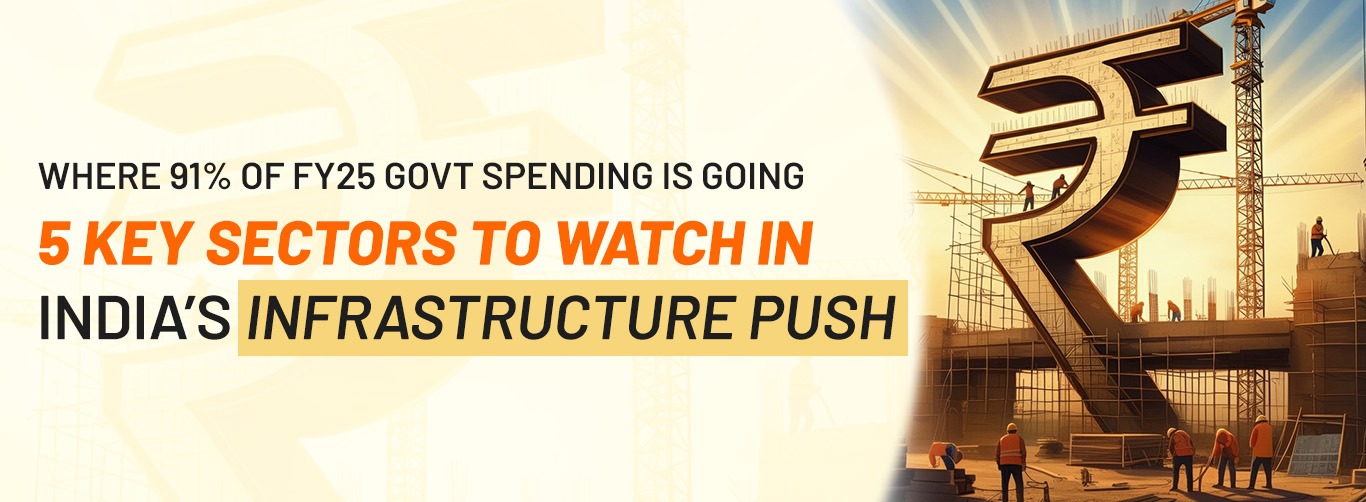
    As India gears up for a transformative infrastructure push, five core sectors are set to receive the lion’s share of central government investments in the financial year 2024–25. According to a recent research report by Bank of Baroda, a staggering ₹6.8 lakh crore, or nearly 91% of the total planned investment, is earmarked for just five strategic sectors: renewable electricity, road transport, refineries, conventional electricity, and shipping.

    This concentrated allocation reflects the government’s continued focus on driving long-term economic growth through sustainable energy, robust connectivity, and industrial development.

    1. Renewable Electricity: Powering the Green Shift

    Leading the pack, renewable electricity has claimed the largest share of the investment—₹2.7 lakh crore, or 37% of the total. These projects are projected to add 12,555 megawatts (MW) of new green energy capacity.

    This massive push underscores India’s commitment to accelerating its energy transition and reducing dependence on fossil fuels, in line with its climate goals. Solar and wind power are expected to dominate this segment, with several large-scale utility and hybrid projects already in the pipeline.

    2. Road Transport: Building the Nation’s Backbone

    The road transport sector continues to be a key pillar of India’s infrastructure agenda. With a significant portion of investment flowing into highway expansion and connectivity upgrades, the aim is to boost trade efficiency, ease logistics costs, and improve rural–urban mobility.

    Although the exact breakdown for this sector wasn’t disclosed in the report, it remains one of the top destinations for capital expenditure.

    3. Refineries: Fueling the Future

    The government also plans to invest ₹1 lakh crore in the refinery sector, primarily through state-run enterprises. These investments are geared toward boosting domestic refining capacity and are expected to generate 600 MW of power, making them a hybrid model of industrial and energy output.

    The move also supports India’s broader aim of becoming a self-reliant energy hub while meeting rising fuel demand.

    4. Conventional Electricity: Powering Progress

    Despite the strong tilt toward renewables, conventional electricity generation hasn’t been left behind. Around ₹99,376 crore will go toward traditional power projects. The bulk of this—₹80,000 crore—is concentrated in a single large-scale project in Bihar, with additional investments planned for Odisha and Chhattisgarh.

    This balanced approach is likely aimed at ensuring energy reliability and meeting immediate power needs, especially in under-electrified regions.

    5. Shipping: Coastal Infrastructure Gets a Lift

    The shipping sector rounds out the top five, with projects worth ₹62,120 crore. Notably, Gujarat is set to receive ₹58,750 crore, making it the largest beneficiary. The remaining investments will support coastal infrastructure development in Assam, Karnataka, Kerala, and Tamil Nadu.

    These investments aim to modernize ports, boost cargo handling, and enhance India’s global trade competitiveness.

    What About the Rest?

    The remaining 9% of the investment pie, still a significant amount, is distributed across other sectors such as:

    • Chemicals and Steel
    • Railways and Minerals
    • Housing and Health
    • Education and Fertilizers
    • Electricity transmission and storage

    While smaller in scale, these sectors remain essential to holistic development and social welfare.

    Focus on Eastern India

    The report also highlights a geographic shift in investment priorities, with Chhattisgarh set to receive the highest allocation at ₹1.4 lakh crore, followed by Odisha with ₹0.8 lakh crore. This signals a strategic intent to boost infrastructure and economic activity in eastern India, a region historically under-invested compared to its western and southern counterparts.

    Bottom Line: A Decisive Infrastructure Play

    The FY25 investment plan reflects the government’s focus on building long-term infrastructure that fuels growth, improves connectivity, and supports sustainability. With a clear tilt toward renewables and logistics, these five sectors are not only shaping India’s economic priorities but also laying the groundwork for its green and inclusive future.

    As these projects unfold, they are likely to have a multiplier effect across industries, generating jobs, encouraging private investments, and boosting regional development.

    Subscribe for more insights on India’s infrastructure and policy trends.

    Disclaimer: This article is for informational purposes only and should not be considered as investment advice.

  • Persistent Systems Q4 FY25 Results: Net Profit Jumps 56%, Revenue Soars 95%

    Persistent Systems Q4 FY25 Results: Net Profit Jumps 56%, Revenue Soars 95%

    Persistent Systems Ltd delivered an exceptional performance in Q4 FY25, reflecting strong operational momentum and a sharp rise in profitability. The company reported a significant revenue jump and robust improvement across most financial metrics, signaling solid business fundamentals and consistent demand.

    Result Summary:

    • Revenue up 95.45% YoY
    • Net Profit up 56.36% YoY
    • Operating Profit up 39.66% YoY
    • Other Income down 54.52% YoY
    • Margins slipped to 13.23% from 18.51%

    Persistent Systems Q4 FY25 Financial Highlights (₹ in Million)

    Metric Q4 FY25 (₹ Mn) Q4 FY24 (₹ Mn) % Change YoY
    Sales 31,875.51 16,309.02 95.45%
    Other Income 160.00 351.82 -54.52%
    Operating Profit (PBIDT) 4,215.78 3,018.69 39.66%
    Net Profit (PAT) 2,876.40 1,839.57 56.36%
    PBIDT Margin 13.23% 18.51% -28.55%

    Revenue Surges by 95.45%

    The topline for the quarter ended March 2025 stood at ₹31,875.51 million, marking a massive 95.45% YoY growth compared to ₹16,309.02 million in Q4 FY24. This growth highlights the company’s strong execution and expansion across service lines and geographies.

    Profitability Expands Across the Board

    • Operating Profit (PBIDT) rose by 39.66%, reaching ₹4,215.78 million, compared to ₹3,018.69 million in the same quarter last year. This reflects improved cost efficiency and better realization on projects.
    • Net Profit (PAT) jumped by an impressive 56.36% to ₹2,876.40 million, up from ₹1,839.57 million in Q4 FY24. This jump can be attributed to strong operating leverage and disciplined financial management.

    Interest and Depreciation

    Interest expenses increased sharply by 263.15% YoY to ₹147.33 million, likely due to borrowings or leasing obligations. Depreciation expenses also grew moderately by 13.73% YoY to ₹470.80 million.

    Taxation Trends

    Tax expenses remained stable at ₹721.25 million compared to ₹724.58 million last year, while deferred tax moved into a credit of ₹26.36 million against a debit of ₹34.37 million earlier.

    Margins Under Pressure

    Despite the strong growth, PBIDT margins for the quarter contracted to 13.23% from 18.51%, mainly due to rising costs and a drop in other income, which fell by 54.52%.

    Persistent Systems has demonstrated impressive growth in Q4 FY25. However, investors may want to keep an eye on the declining margins and rising finance costs, which may impact profitability if the trend continues.

    Disclaimer: This blog is for informational purposes only and should not be considered as financial advice or any buy/sell recommendations.
  • Hindustan Unilever Q4 FY25 Results: Net Profit Up 3.62%, Revenue Grows 2.4%

    Hindustan Unilever Q4 FY25 Results: Net Profit Up 3.62%, Revenue Grows 2.4%

    Hindustan Unilever Ltd (HUL), a household name in India’s FMCG space, posted its Q4 results for the financial year 2024-25, showing modest yet consistent growth across key financial parameters.

    Result Summary:

    • Revenue (Sales) rose by 2.4% YoY to ₹1,52,140 million from ₹1,48,570 million.

    • Other Income jumped by 35.91% YoY to ₹2,990 million.
    • Operating Profit (PBIDT) increased by 3.01% YoY to ₹37,650 million.

    • PBIDT Margin stood at 24.75%, marginally up from 24.60%.

    • Interest cost reduced by 26.47% to ₹750 million.

    • Profit Before Tax (PBT) improved by 3.30% to ₹33,540 million.

    • Net Profit (PAT) rose by 3.62% YoY to ₹24,930 million from ₹24,060 million.

    • Depreciation increased by 8.30% to ₹3,130 million.

    • Tax expense slightly increased by 2.38% to ₹8,610 million.

    • Deferred Tax showed a shift to ₹390 million from -₹130 million last year.

    • Equity capital remained unchanged at ₹2,350 million.

    HUL Q4 FY25 Financial Highlights (₹ in Million)

    Particulars Q4 FY25 Q4 FY24 YoY Change (%)
    Sales152140.00148570.002.40
    Other Income2990.002200.0035.91
    PBIDT37650.0036550.003.01
    Interest750.001020.00-26.47
    PBDT36670.0035360.003.70
    Depreciation3130.002890.008.30
    PBT33540.0032470.003.30
    Tax8610.008410.002.38
    Deferred Tax390.00-130.00-400.00
    PAT24930.0024060.003.62
    PBIDT Margin (%)24.7524.600.59

    Revenue Trends

    For Q4 FY25, the total revenue stood at ₹1,52,140 million, up by 2.4% compared to ₹1,48,570 million in the same quarter last year. This marginal rise suggests steady consumer demand in a challenging environment. Other income also rose sharply by 35.91% to ₹2,990 million from ₹2,200 million in Q4 FY24.

    Operating Performance

    The company reported an operating profit (PBIDT) of ₹37,650 million, registering a 3.01% increase from ₹36,550 million in the previous year’s same quarter. This reflects efficient cost control and a strong operating model. The PBIDT margin improved slightly to 24.75% from 24.60%.

    Profit Before Tax and Net Profit

    HUL recorded Profit Before Tax (PBT) of ₹33,540 million, up 3.28% from ₹32,470 million in Q4 FY24. Depreciation costs rose to ₹3,130 million, while interest costs declined by 26.47%, indicating better treasury management.

    Net Profit (PAT) for the quarter reached ₹24,930 million, growing by 3.62% year-on-year. This improvement signals strong bottom-line growth despite economic uncertainties and inflationary pressures.

    Year-to-Date Performance

    For the financial year FY25, HUL generated ₹6,14,690 million in revenue, with a 1.65% growth over FY24. The annual net profit reached ₹1,06,440 million, marking a 5.24% rise from the previous year’s ₹1,01,140 million. The company maintained a healthy operating margin throughout the year.

    The Bottom Line

    HUL has maintained stable growth in revenue while delivering consistent profitability. The improvement in operating margins, control over finance costs, and a rise in other income have all contributed to stronger earnings. With continued focus on innovation, cost optimization, and strong brand positioning, HUL is well-placed to navigate upcoming quarters.

    Disclaimer: This blog is for informational purposes only and should not be considered as financial advice or any buy/sell recommendations.

  • Will gold hit ₹1 lakh by Akshaya Tritiya? This is what experts say

    Will gold hit ₹1 lakh by Akshaya Tritiya? This is what experts say

    With Akshaya Tritiya just around the corner on April 30, the spotlight is on gold—and whether the yellow metal could scale the ₹1 lakh mark per 10 grams. Currently, 24 karat gold prices are already above ₹96,000 (inclusive of GST), with futures on MCX recently touching a record high of ₹93,940.

    A Stellar 2025 for Gold So Far

    Gold prices have jumped nearly 20% year-to-date, gaining approximately ₹16,000 per 10 grams since January. This sharp rise is being driven by geopolitical tensions, particularly between the US and China, expectations of interest rate cuts, increased central bank buying, and investor demand for safe-haven assets.

    Is ₹1 Lakh Achievable by Akshaya Tritiya?

    Experts believe the momentum remains positive, but they caution that breaching the ₹1 lakh level within April may be ambitious.

    According to market analysts, gold is currently testing a resistance zone between ₹94,500 and ₹95,000, while ₹92,000 is seen as a critical support. Technical indicators, such as the Relative Strength Index (RSI), suggest the metal is in overbought territory, indicating potential for short-term consolidation or volatility.

    While the sentiment remains bullish, the consensus is that reaching ₹1 lakh in the next couple of weeks would require a strong new catalyst, such as fresh geopolitical escalations or a significant economic disruption.

    Investor Sentiment & Recent Trends

    Despite record-high prices, some profit booking has been observed. Data shows that gold ETFs saw net outflows in March, signaling cautious investor behavior. However, the overall appetite for gold as a hedge remains strong, particularly in an environment of rising uncertainty.

    Experts note that gold has always performed well in crisis-like situations, thanks to its ability to retain value when other asset classes falter. Ongoing trade tensions, market volatility, and inflation concerns are likely to keep demand elevated.

    Outlook for FY26

    Looking ahead, the outlook for gold remains optimistic. Analysts project that if current trends continue, with central banks continuing to accumulate gold, inflation concerns persisting, and the possibility of interest rate cuts, prices could move closer to ₹95,000–₹97,000 per 10 grams by the end of FY26.

    However, breaching the ₹1 lakh mark would likely require additional triggers—such as a sharper decline in global growth, renewed currency depreciation, or further escalation in geopolitical conflicts.

    Experts also caution that most of the bullish factors may already be priced in, and without new developments, prices could consolidate at higher levels or even face mild corrections due to profit booking or a recovery in risk assets like equities and the dollar.

    Bottom Line: Is ₹1 Lakh Within Reach?

    While gold continues to glitter, a ₹1 lakh price tag by Akshaya Tritiya seems unlikely under current conditions, though not entirely out of the question. The metal remains a reliable store of value and a hedge against uncertainty, making it a preferred asset for long-term investors, especially in volatile times.

    Even if the symbolic ₹1 lakh threshold isn’t crossed this month, gold’s long-term outlook remains robust heading into FY26.

    Disclaimer: This article is for informational purposes only and should not be considered as investment advice.

  • With Trump Tariffs on Hold, Which Indian Industries Could Shine?

    With Trump Tariffs on Hold, Which Indian Industries Could Shine?

    In a significant move with global implications, U.S. President Donald Trump announced a 90-day pause on reciprocal tariffs for all countries except China on April 9. The decision comes after a volatile week in the markets triggered by a surprise 26% tariff announcement on India just days earlier.

    With this temporary relief, Indian equities are poised to bounce back when markets reopen on April 11, after a holiday on Mahavir Jayanti. The pause is expected to lift sentiment across several sectors that were reeling from the tariff shock. Here’s a look at the Indian sectors and stocks that could benefit the most from this breather in trade tensions:

    1. Information Technology (IT) – Breathing Room After Brutal Selloff

    The IT sector has been among the hardest hit in the recent market downturn. Since April 2, the Nifty IT index has shed over 10%, reflecting investor concern over the sector’s deep reliance on U.S. revenues and fears of a potential recession.

    However, the tariff pause coupled with Goldman Sachs withdrawing its U.S. recession forecast has significantly improved the outlook for tech stocks. This reversal could drive a relief rally.

    2. Auto Component Makers – Possible Rebound After Slide

    Auto component manufacturers saw sharp declines last week amid fears of reduced exports and higher costs. The latest pause in tariffs is expected to ease concerns and spark investor interest in the segment again.

    3. Metals – Tariff Truce, China Stimulus Add Shine

    Metal stocks, among the worst hit from the tariff fallout, are now likely to benefit the most from the relief. The rebound in copper and other metal prices, driven both by the U.S. pause and China’s fresh stimulus measures, adds further tailwinds.

    4. Realty – Dual Boost from Tariff Pause and RBI Rate Cut

    The RBI’s recent 25 bps rate cut combined with the return of positive global sentiment is expected to lift realty stocks. Lower interest rates improve affordability, while reduced external uncertainties add to buyer and investor confidence.

    5. Fisheries – Relief for Shrimp Exporters

    The U.S. is a critical market for Indian seafood exporters, particularly shrimp feed companies. The earlier tariff announcement had sent stocks in this segment tumbling. The 90-day relief window is likely to revive hopes for stable demand from the U.S.

    6. Solar EPC Firms – Tailwinds for Clean Energy Exporters

    India’s solar engineering, procurement, and construction (EPC) firms with U.S. exposure are well positioned to benefit from the tariff pause. The uncertainty had threatened project timelines and profitability, but the latest decision provides much-needed breathing space.

    7. Electronics Manufacturing Services (EMS) – Apple Effect in Focus

    Indian EMS companies stand to gain from Apple’s shifting supply chain strategy. Reports of increased iPhone sourcing from India to avoid China tariffs had already boosted stock prices. The continuation of tariff pressure on China, with India spared for now, reinforces this trend.

    8. Textiles – Mixed Signals, but a Clear China Advantage

    Indian textile exporters could emerge as winners due to the 125% tariff on Chinese textiles. However, the decision to pause tariffs on Vietnam and Bangladesh—two other key suppliers to the U.S.—may cap some of the upside for Indian players.

    Expert View: A Tactical Pause, Not a Policy Shift

    Ashok Chandak, President of the India Electronics & Semiconductor Association (IESA), said the tariff pause reflects a “tactical recalibration” rather than a fundamental change in U.S. trade policy.

    “The temporary relief gives businesses and India vital space to stabilise supply chains and adapt operations,” Chandak noted, adding that underlying trade tensions remain due to a baseline 10% tariff still in effect.

    The next 90 days are likely to shape future trade engagements between the U.S. and India, but for now, the reprieve has thrown a lifeline to several sectors on Dalal Street.

    Disclaimer: This article is for informational purposes only and should not be considered as investment advice.